

 en
 English
 русский
 Español
 عربى

Most roller shutter problems on fire trucks and specialty vehicles are written into the specification, not worn into the slats. A manual shutter fitted to a compartment the crew opens fifty times a s...
READ MORE
Reinforced Manual Specialty Vehicle Roller Shutter: Durable Access, Secure Storage, and Flexible Customization
2026.10.21
Content
- 1 Why Specialty Vehicle Storage Doors Matter
- 2 Product Overview
- 3 High-Strength Aluminum Alloy Door Panels
- 4 Surface Treatment for Weather and Corrosion Resistance
- 5 Balancing System and Manual Operation
- 6 Precision Tracks and Flexible Rollers
- 7 Protection Against Impact, Scratching, and Water Penetration
- 8 Flexible Configuration for Different Vehicle Designs
- 9 Electrical Options for Light Strips and Sensors
- 10 Advantages Compared with Conventional Alternatives
- 11 Manufacturing Strengths and Production Approach
- 12 OEM and ODM Customization Capabilities
- 13 Quality Control Considerations
- 14 Installation and Integration Guidance
- 15 Maintenance and Service Recommendations
- 16 Applications Across Emergency and Specialty Vehicles
- 17 How to Specify the Correct Configuration
- 18 Recommended Project Workflow
- 19 Q&A
- 19.1 What is a specialty vehicle roller shutter?
- 19.2 Is this product manually operated?
- 19.3 What materials are used for the door panels?
- 19.4 What are the available opening dimensions?
- 19.5 What is the door panel width?
- 19.6 Can the roller shutter be used on fire trucks?
- 19.7 How does the product resist outdoor conditions?
- 19.8 Can the shutter be supplied in different colors?
- 19.9 Are light strips and sensors available?
- 19.10 What makes this product different from a standard commercial roller shutter?
- 19.11 Can the manufacturer support OEM and ODM projects?
- 19.12 How should the product be maintained?
- 19.13 What information should be provided when requesting a quotation?
- 20 Conclusion
- 21 References
- 22 Product: Reinforced Manual Specialty Vehicle Roller Shutter
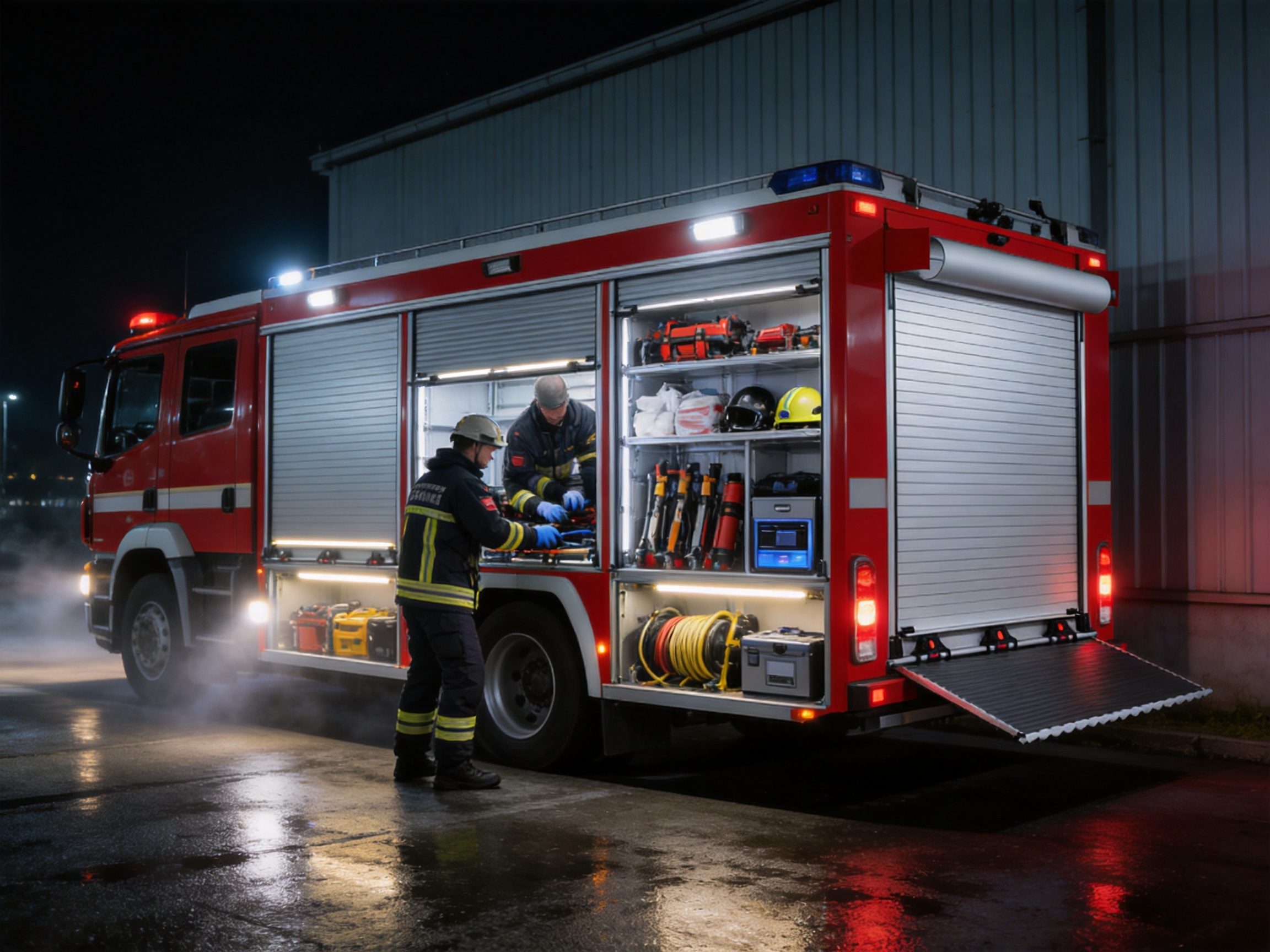
Specialty vehicles used for fire response, rescue, emergency engineering, and public safety operations require storage systems that are dependable under demanding conditions. Tools, hoses, breathing apparatus, nozzles, demolition equipment, ladders, and electronic accessories must remain protected during transport while also being available quickly when crews arrive at an incident. A roller shutter is therefore much more than a simple vehicle door. It is an important part of equipment organization, weather protection, operational efficiency, and vehicle service life.
The reinforced manual specialty vehicle roller shutter is designed for this demanding role. It combines high-strength aluminum alloy door panels, corrosion-resistant surface treatment, a carefully engineered balancing system, precision tracks, flexible rollers, and customizable structural components. The result is a practical access solution for fire trucks, rescue vehicles, utility vehicles, service bodies, and other specialty platforms where equipment storage must remain secure, compact, and easy to operate.
Unlike ordinary storage doors intended for light commercial applications, this roller shutter is developed around the requirements of emergency and specialty vehicles. It is designed to withstand frequent opening and closing, exposure to rain and road contamination, vibration during driving, contact with tools, and the demanding working environment surrounding emergency response. At the same time, its manual operating design provides a straightforward and dependable solution without requiring a complex powered system.
Why Specialty Vehicle Storage Doors Matter
Fire and rescue vehicles often carry a large amount of equipment in limited space. The available compartments may be narrow, tall, shallow, or positioned around wheel arches and other chassis components. Equipment must be stored in an organized way, but the vehicle must also retain a clean exterior profile and provide rapid access for operators wearing gloves or protective clothing.
A conventional hinged door can require additional clearance beside the vehicle. This can make it difficult to open in narrow streets, crowded industrial areas, or rescue scenes where other vehicles and obstacles are nearby. A roller shutter solves this problem by moving vertically and rolling into a compact upper compartment. The door does not swing outward into the working area, allowing personnel to stand close to the vehicle and access stored equipment efficiently.
For emergency vehicles, the door must also contribute to the protection of the stored contents. Fire hoses, breathing apparatus, hydraulic tools, nozzles, portable pumps, and electrical equipment may be exposed to rain, dust, spray, and temperature changes. A well-designed shutter helps create a barrier against water penetration and environmental contamination while reducing the risk of accidental contact with stored equipment.
Operational reliability is equally important. A door that binds, rattles, becomes difficult to lift, or produces excessive noise can slow down a response team and increase maintenance requirements. The reinforced manual specialty vehicle roller shutter uses a balancing system and a coordinated track-and-roller structure to support smooth movement. The manual operating method allows the user to open or close the door directly, while the mechanical components are engineered to reduce operating effort and improve consistency.
Product Overview
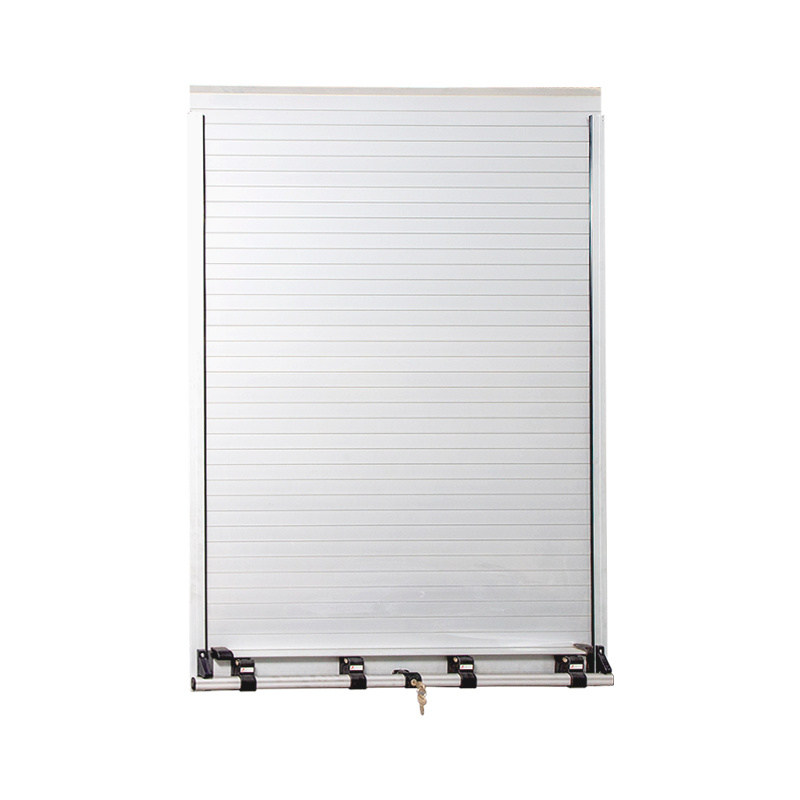
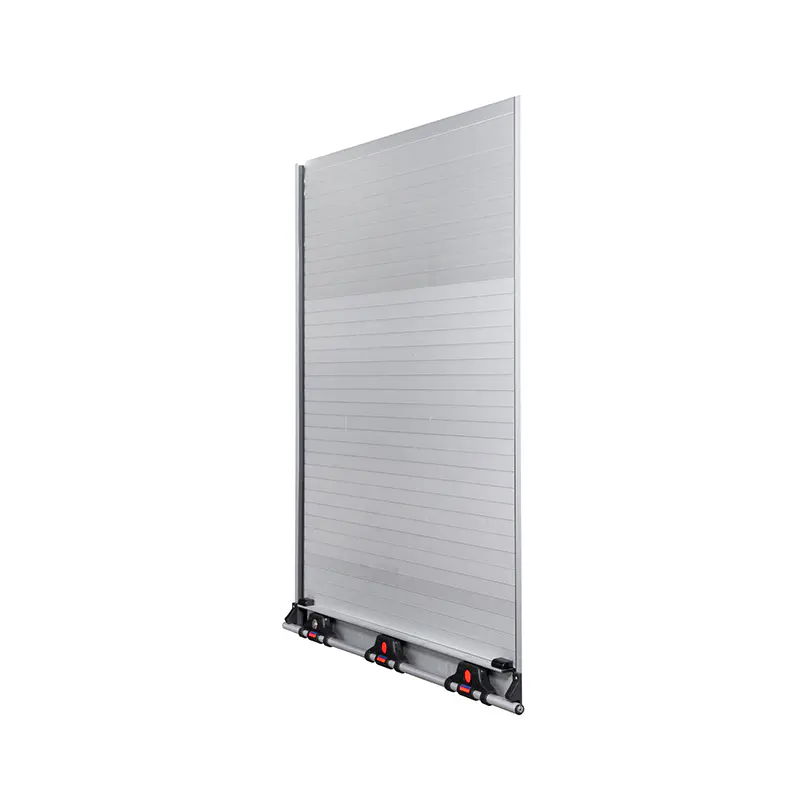
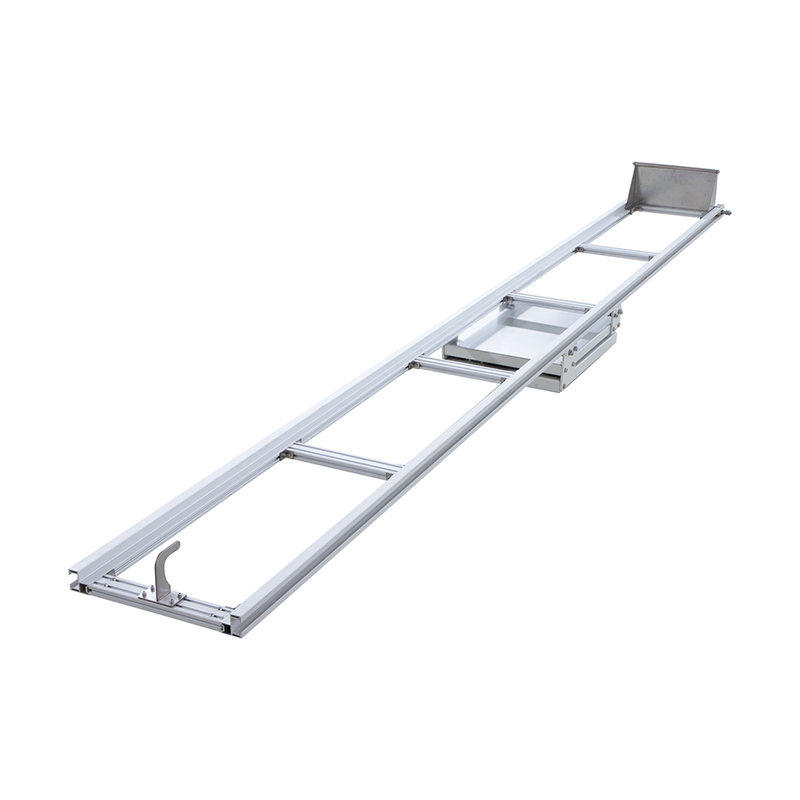
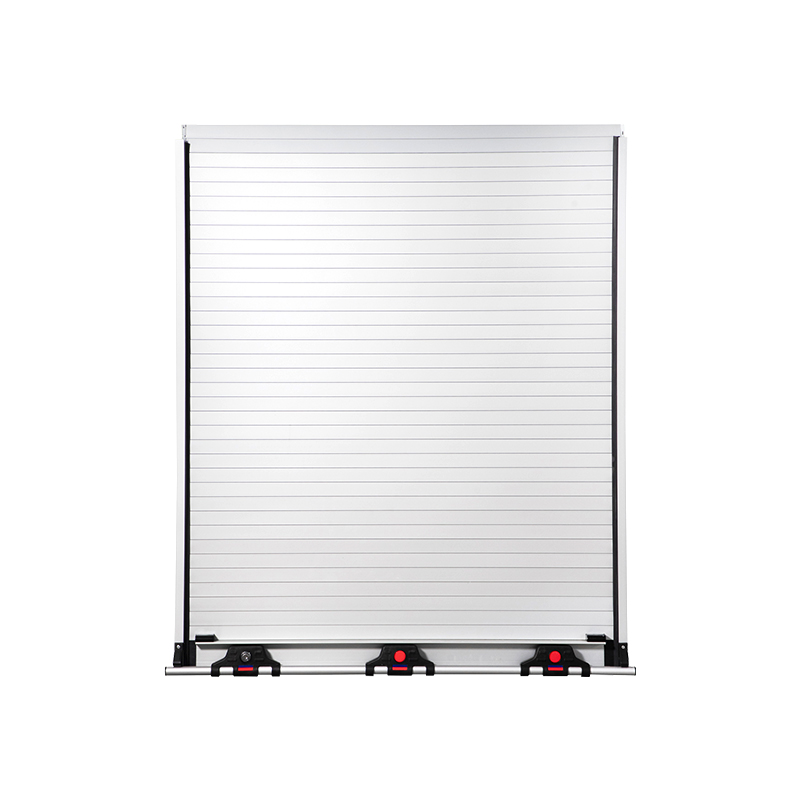
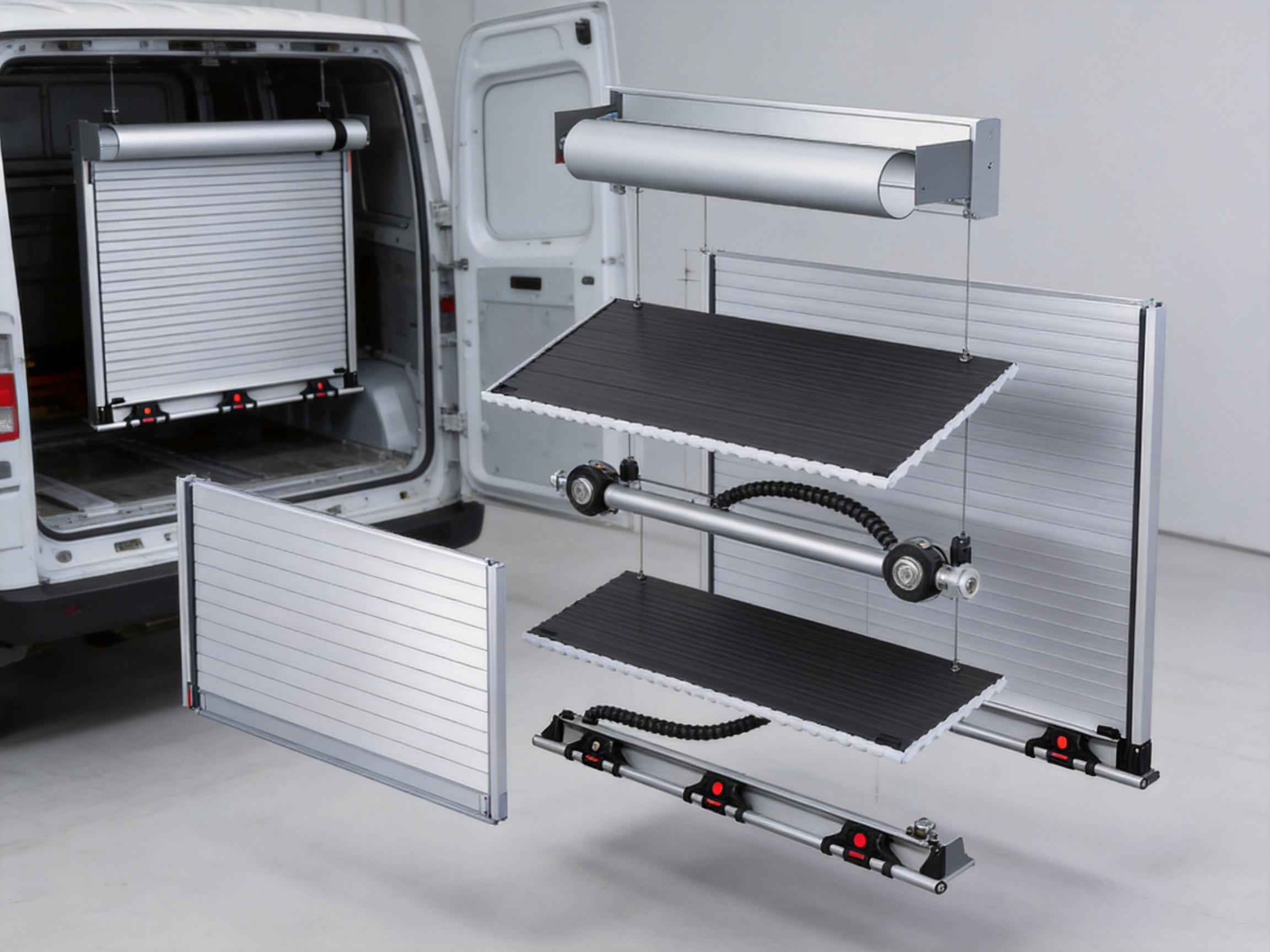
The product consists of interconnected aluminum alloy door panels, side tracks, rollers, a balancing mechanism, a door head or upper housing, optional rain gutters, sliders, and associated connection components. These parts can be combined according to the dimensions and application conditions supplied by the customer.
The door panels are available in a double-layer or single-layer configuration, depending on the required balance between strength, weight, appearance, and installation conditions. The panels are made from high-strength, high-toughness aluminum alloy. This material offers a useful combination of low weight, structural performance, corrosion resistance, and suitability for surface finishing.
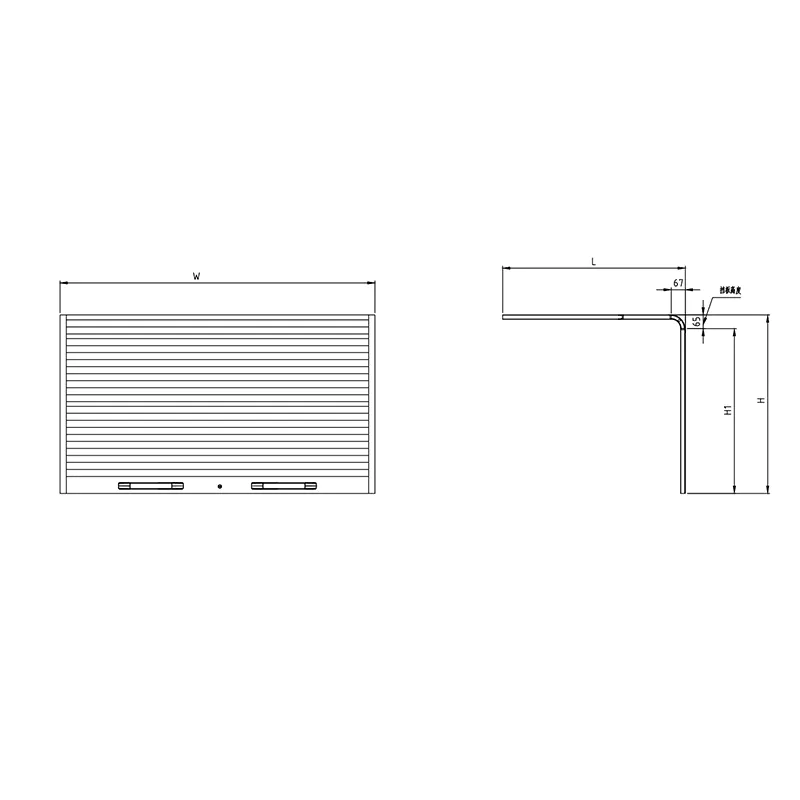
The stated door panel width is 35 mm. The overall opening width and height are customizable. This allows the roller shutter to be integrated into different vehicle bodies and storage compartments rather than limiting the customer to a small range of standardized openings.
Available appearance options include aluminum, red, and carbon gray. These choices allow the shutter to coordinate with fire apparatus paint schemes, rescue vehicle bodywork, fleet identification systems, and customer-specific design requirements.
Light strips and sensors can be configured for either 24 V or 12 V systems. These options can support compartment illumination, status indication, or related vehicle integration requirements, subject to the vehicle’s electrical architecture and the final configuration agreed during engineering review.
| Item | Available Information |
|---|---|
| Product type | Reinforced manual specialty vehicle roller shutter |
| Primary application | Fire trucks, rescue vehicles, emergency vehicles, utility vehicles, and specialty service bodies |
| Door panel construction | High-strength aluminum alloy, single-layer or double-layer blade options |
| Door panel width | 35 mm |
| Opening width W | Customizable according to customer requirements |
| Opening height H | Customizable according to customer requirements |
| Light strips and sensors | 12 V or 24 V options |
| Color options | Aluminum, red, or carbon gray |
| Operating method | Manual operation supported by a balancing system |
| Structural options | Multiple blades, door heads, tracks, rain gutters, sliders, and connection methods |
Reinforced Manual Specialty Vehicle Roller Shutter
High-Strength Aluminum Alloy Door Panels
The door panel is the most visible and most frequently handled part of a roller shutter. It must withstand repeated movement, contact with equipment, vibration, changing weather conditions, and the general wear associated with emergency vehicle service. The use of high-strength, high-toughness aluminum alloy provides a strong foundation for these requirements.
Aluminum alloy is particularly suitable for specialty vehicle body systems because it offers lower mass than many steel alternatives while retaining useful mechanical strength. Reducing unnecessary weight can help vehicle manufacturers manage payload, fuel consumption, axle loading, and overall vehicle balance. For fire and rescue vehicles that already carry pumps, tanks, ladders, hoses, breathing apparatus, and heavy tools, every component must be selected with weight efficiency in mind.
The product is designed to resist impact and scratching during normal service. This is important because equipment is not always handled gently during an emergency. Tools may be removed quickly, personnel may work in limited visibility, and the shutter may be exposed to accidental contact with hose couplings, ladders, handles, or other apparatus. A robust panel helps preserve both the protective function and the appearance of the storage compartment.
The single-layer and double-layer panel choices provide additional flexibility. A single-layer configuration may be appropriate where weight, simplicity, and available compartment space are priorities. A double-layer configuration may be selected where a more reinforced door construction is preferred. The correct selection depends on opening dimensions, vehicle structure, operating frequency, expected loading conditions, and customer requirements.
The interconnected blade design also allows the shutter to roll into a compact upper area. This creates a practical balance between a wide access opening and efficient storage of the door itself. When open, the shutter does not occupy the space directly in front of the compartment, which is valuable when crews need to work close to the vehicle.
Surface Treatment for Weather and Corrosion Resistance
Specialty vehicles are used outdoors and may operate in rain, snow, high humidity, dust, road salt, industrial environments, and areas exposed to firefighting water or foam residues. A roller shutter with insufficient surface protection may lose its appearance, develop corrosion, or experience premature wear at exposed points.
The product can undergo processes such as electrophoresis, oxidation, and spraying. These treatments are intended to improve surface protection and provide stronger resistance against weathering, aging, rain, and corrosion. The exact finishing process can be selected according to the material, color, application environment, and appearance requirements of the vehicle body.
Electrophoretic treatment can help create a consistent protective coating over suitable metal surfaces. Oxidation treatment can improve the surface characteristics of aluminum components, while spraying provides color flexibility and an additional protective layer. Used appropriately within a controlled production process, these treatments help the shutter maintain a reliable appearance and functional condition over an extended service period.
Surface finishing also has an important visual role. Emergency vehicles commonly use strong color schemes for recognition and fleet identity. Red panels may coordinate with conventional fire apparatus designs, while carbon gray or aluminum finishes may be preferred for a modern technical appearance or for matching a vehicle’s equipment modules. Consistent surface treatment helps the roller shutter look like an integrated part of the vehicle rather than an aftermarket addition.
Although surface treatment improves durability, regular maintenance remains important. Operators should remove accumulated dirt, salt, chemical residue, and firefighting foam from the panels and tracks. Lubrication and inspection should be performed according to the final installation instructions. Good maintenance protects the coating and helps the rollers and tracks continue to operate smoothly.
Balancing System and Manual Operation
A manual roller shutter must be easy enough to operate while remaining stable in different positions. The balancing system plays a central role in this performance. It helps offset the weight of the door curtain and reduces the amount of force required from the operator when lifting or lowering the shutter.
For fire crews, this is especially valuable because a door may need to be opened quickly while the operator is wearing gloves, carrying equipment, or working under stress. A well-balanced door can provide a more predictable and manageable movement than an unbalanced panel assembly. It can also reduce unnecessary loading on the tracks, rollers, handles, and connection points.
Manual operation has several practical advantages over a system that depends entirely on an electric motor. It can simplify the vehicle architecture, reduce the number of electrical components, and allow the door to remain usable when the vehicle power system is switched off or when an electrical fault occurs. It may also reduce the cost and complexity of installation for certain vehicle platforms.
A manual design does not mean the product is basic or unsophisticated. The reliability of a manual shutter depends on the quality of its mechanical engineering. The balancing system, door panel geometry, roller arrangement, track alignment, and upper housing must work together. Precision in these areas determines whether the door feels controlled and stable during daily use.
The manual configuration is particularly suitable for compartments that are opened frequently and where direct operator control is preferred. It can also be used in applications where the customer wants a durable access system without adding a motor, control switch, wiring harness, or additional electrical protection to every compartment.
Precision Tracks and Flexible Rollers
The tracks guide the door panels during opening and closing. They must maintain alignment while accommodating the movement of the interconnected blades as the shutter transitions from its vertical closed position to its rolled position in the upper housing. Poorly fitted tracks can result in resistance, uneven movement, noise, or accelerated wear.
The product uses finely crafted tracks and flexible rollers to support smooth operation. The rollers help the curtain move through the guide path while limiting direct friction between the door assembly and the track. This can reduce operating resistance and help protect the surfaces of the moving components.
Track quality is particularly important for specialty vehicles because the storage body may experience vibration and slight structural movement during driving. A carefully designed track system provides a stable movement path and helps the shutter continue to function under normal vehicle operating conditions.
The selection and connection of tracks can be adapted to different compartment designs. Depending on the application, the customer may require a particular track arrangement, door head, rain gutter, slider, or connection method. The ability to provide different structural combinations makes the product suitable for varied vehicle bodies and equipment layouts.
Precision bearings are also used to minimize operating noise. Lower noise is beneficial in emergency vehicle workshops, fleet depots, and enclosed service areas. It also improves the perceived quality of the product during daily operation. More importantly, reduced noise can indicate that the moving parts are working with less unnecessary friction and impact.
Noise reduction should not be considered only a comfort feature. Excessive rattling or grinding can indicate misalignment, contamination, loose hardware, or component wear. A quiet, controlled movement pattern makes it easier for operators and maintenance personnel to identify unusual changes in performance.
Protection Against Impact, Scratching, and Water Penetration
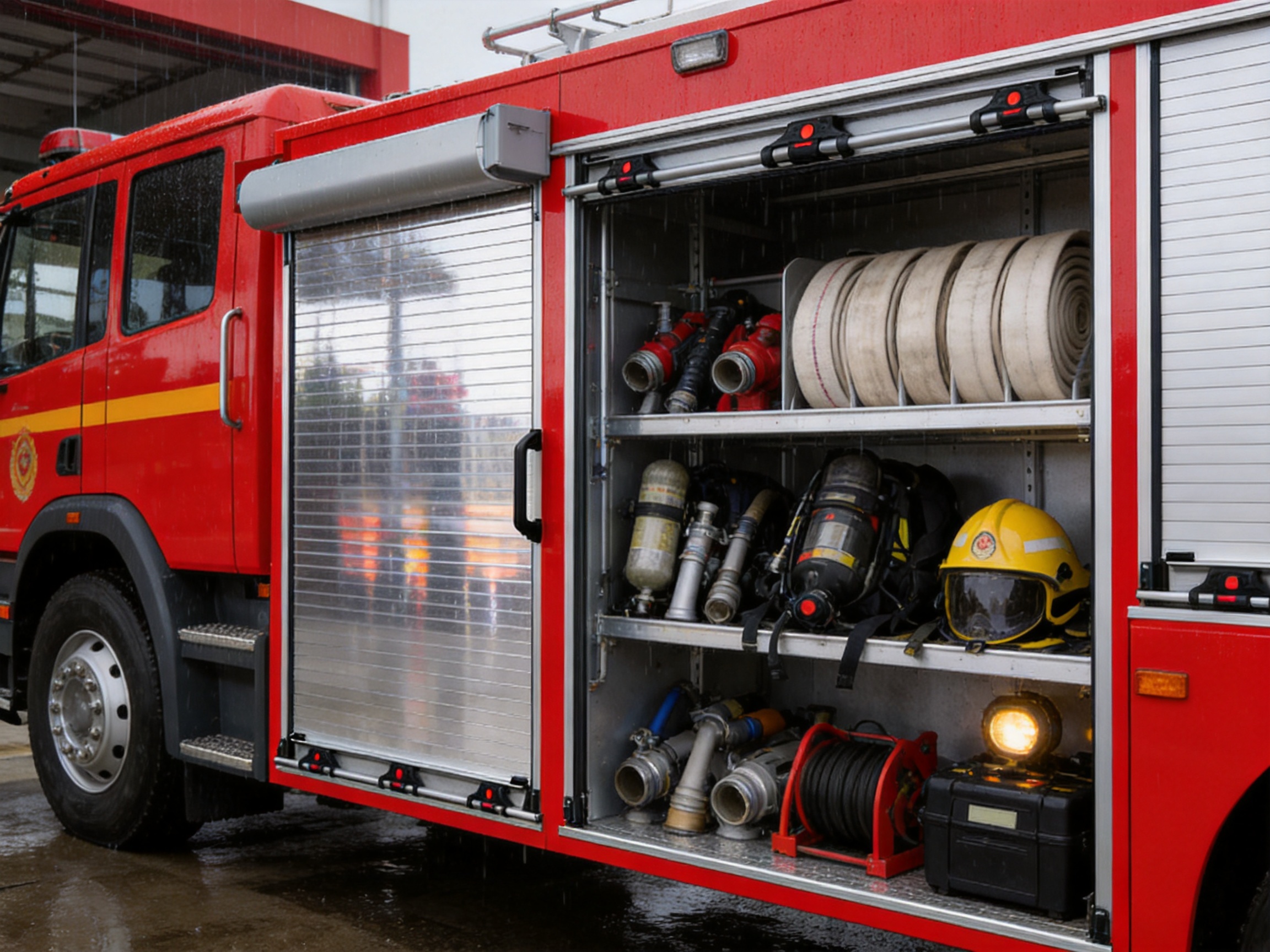
Equipment compartments on fire and rescue vehicles are exposed to more demanding conditions than ordinary commercial storage cabinets. Tools are often placed inside quickly, doors may be opened repeatedly, and water may be present during or after firefighting operations. The roller shutter is designed to provide protection against common forms of operational abuse.
The high-toughness aluminum alloy panels help resist impact from routine contact with stored equipment. Their protective surface treatment helps reduce the visible effects of scratching and weather exposure. Together, these characteristics support a longer-lasting exterior and reduce the need for frequent replacement or cosmetic repair.
The shutter structure is also intended to help resist water penetration. Rain gutters and related structural components can be selected according to the vehicle body and compartment design. Proper integration of the door, tracks, seals where applicable, upper housing, and surrounding bodywork is important to achieve the best practical level of environmental protection.
Water resistance is valuable even when the compartment does not contain sensitive electronics. Damp conditions can contribute to corrosion of tools, deterioration of textile equipment, unpleasant odors, and damage to packaging or consumable supplies. Keeping the storage area as dry as practical helps preserve the readiness of the equipment inside.
For SCBA equipment, nozzles, hoses, and demolition tools, compartment organization and protection are directly connected to operational readiness. A durable shutter helps keep the equipment accessible and reduces the chance that external contamination will interfere with deployment.
Flexible Configuration for Different Vehicle Designs
One of the principal advantages of this product is its configurability. Specialty vehicle manufacturers and body builders do not always use identical compartment dimensions. Storage modules can be integrated into different chassis, body widths, rooflines, and equipment arrangements. A one-size-fits-all door may therefore create compromises in appearance, access, or installation.
The opening width W and height H can be customized according to customer-provided dimensions. This allows the shutter to be planned around the actual compartment rather than forcing the compartment to conform to a fixed door size. Early confirmation of dimensions helps ensure that the tracks, upper housing, rain gutters, sliders, and surrounding structures are correctly coordinated.
Customers can also select from different blades, door heads, tracks, rain gutters, sliders, and connection methods. These elements may have different performance characteristics and may be selected according to operating frequency, available installation space, appearance, environmental exposure, and vehicle body construction.
For example, a fire truck equipment compartment may need a reinforced double-layer blade and a robust track system because it will be opened frequently and used to store heavy equipment. A lighter service compartment may use a different blade configuration to reduce overall vehicle weight. A rescue vehicle operating in wet climates may require particular attention to rainwater management and surface protection.
The ability to develop structural combinations around the application is also useful for fleet standardization. A fleet operator may use the same basic appearance and operating principle across several vehicle models while adjusting the width, height, and installation details for each body. This can simplify operator training and help create a consistent maintenance approach.
Electrical Options for Light Strips and Sensors
The basic product is manually operated, but light strips and sensors can be specified for 12 V or 24 V vehicle electrical systems. This creates a practical way to improve compartment visibility and integrate the shutter with vehicle functions where required.
Interior or edge lighting can help operators identify tools in low-light conditions. Fire response frequently takes place at night, in smoke, in poorly illuminated industrial areas, or in locations where the vehicle’s main work lights do not fully illuminate the equipment compartment. A light strip can make it easier to locate handles, hose couplings, breathing apparatus, nozzles, and other equipment.
Sensors may be used for functions such as door status monitoring or integration with a vehicle control system, depending on the final engineering design. The actual function, wiring method, protection level, and control logic should be confirmed during the customization stage. The 12 V and 24 V options allow the electrical accessories to be matched with different vehicle platforms.
These electrical features complement the manual mechanism rather than replacing it. The door can remain mechanically operated while the lighting or sensing system provides additional convenience and operational information. This approach gives the customer the flexibility to add useful technology without requiring a fully motorized shutter.
Electrical components installed on emergency vehicles should be selected and installed with attention to vibration, moisture, temperature, cable routing, and service access. A professional installation plan should define the location of connectors, protective conduits, switches, and control interfaces before final assembly.
Advantages Compared with Conventional Alternatives
Compared with Hinged Compartment Doors
Hinged doors can be simple and economical, but they require clear space in front of or beside the compartment. This can be inconvenient when the vehicle is parked close to a wall, another vehicle, or an obstacle. A roller shutter moves upward and rolls into its upper housing, preserving the working area directly in front of the compartment.
The roller shutter can also provide a wider uninterrupted opening without requiring a large door leaf to swing outward. This is useful when several crew members need to access tools at the same time or when the compartment is located in a narrow operating area.
Compared with Lightweight General-Purpose Shutters
General-purpose shutters may not be engineered for the vibration, repeated operation, and environmental exposure associated with fire and rescue vehicles. The reinforced construction, high-toughness aluminum alloy, balancing system, precision tracks, and configurable components provide a more application-focused solution.
The product is not merely a cosmetic cover for a storage compartment. Its design addresses the mechanical movement, protection, surface durability, noise control, and installation flexibility required by specialty vehicles.
Compared with Fully Powered Roller Shutters
Powered shutters may be useful for very large openings or special automation requirements, but they add motors, switches, wiring, control devices, and additional maintenance points. A manual shutter can provide dependable access with a simpler mechanical architecture.
For many equipment compartments, direct manual operation is sufficient and may be preferred by operators who want immediate control. The balancing system reduces the effort required, while optional light strips and sensors allow selected electrical functions to be added without making the entire door motorized.
Compared with Poorly Integrated Custom Doors
A door that is designed without adequate attention to tracks, rainwater management, panel alignment, or upper housing space may look acceptable at first but create maintenance problems later. This product is supported by a range of coordinated structural components and by customization based on width, height, and application conditions.
The goal is to provide a complete access system rather than an isolated door panel. This integrated approach improves the likelihood of smooth operation, consistent appearance, and practical serviceability.
Manufacturing Strengths and Production Approach
The manufacturer was established in 2010 and has focused on fire protection accessories for approximately 15 years. Its product scope includes fire truck roller shutters, fire truck equipment, ladders, storage systems, rescue components, and related accessories. This specialized focus provides important experience in understanding the demands of fire apparatus and emergency vehicle integration.
The company operates with advanced production facilities and a complete manufacturing process. A complete process is important because roller shutter performance depends on the coordination of many stages: material selection, profile and panel preparation, machining, surface treatment, component assembly, dimensional inspection, functional testing, packaging, and delivery.
Control of the process from raw material procurement through final product delivery supports more consistent quality. It also makes it easier to trace production requirements and coordinate customized orders. For OEM and ODM customers, process stability is especially important because the product may need to be adapted to a specific vehicle body, fleet standard, or engineering drawing.
The company has passed GB/T 19001-2016 quality certification. A quality management system provides a framework for documenting procedures, controlling production activities, managing nonconformities, and supporting continuous improvement. Certification alone does not replace product engineering or inspection, but it demonstrates that the organization has established a formal quality management approach.
Research and development is another important strength. The company maintains a professional R&D team with industry experience and follows changes in market requirements. This supports the development of efficient and environmentally conscious fire protection equipment for different application scenarios.
Roller shutters for specialty vehicles often require more than a standard catalog selection. R&D capability allows the manufacturer to evaluate new blade structures, track arrangements, connection methods, rainwater solutions, sensor integration, and appearance requirements. This helps customers move from a general requirement to a practical product configuration.
OEM and ODM Customization Capabilities
OEM and ODM services are valuable for fire truck manufacturers, rescue vehicle body builders, fleet integrators, equipment distributors, and specialty vehicle manufacturers. These customers may need products that match their own drawings, dimensions, color systems, branding requirements, or assembly procedures.
For an OEM project, the manufacturer can provide the roller shutter according to agreed technical specifications and customer-defined requirements. For an ODM project, the manufacturer can contribute engineering experience to help develop a suitable product structure for a particular application.
The customization process should begin with accurate technical information. Important inputs include opening width, opening height, available space above the compartment, compartment depth, vehicle voltage, expected operating frequency, desired color, environmental exposure, panel configuration, and required accessories.
Photographs, drawings, samples, and installation constraints can also help engineers understand the application. If the vehicle body has curved surfaces, unusual reinforcement members, limited upper clearance, or special electrical requirements, these details should be identified before production.
After the requirements are reviewed, the manufacturer can recommend suitable combinations of blades, door heads, tracks, rain gutters, sliders, and connection methods. This reduces the risk of selecting components independently without considering their interaction.
Customization also supports replacement and upgrading projects. A fleet may need to replace an older shutter while keeping the existing compartment opening, or it may want to upgrade a service body with improved lighting and sensors. A dimension-based approach can help determine whether the new configuration can be adapted to the existing structure or whether additional modifications are necessary.
Quality Control Considerations
Quality control for a specialty vehicle roller shutter should cover both individual components and the assembled system. Aluminum alloy material should be checked against the required specification, while panels should be inspected for dimensional consistency, surface defects, and connection quality.
Tracks should be checked for straightness, alignment, and correct fit with the rollers. The balancing system should be evaluated for controlled movement and appropriate operating force. Bearings and rollers should rotate smoothly without excessive play, binding, or abnormal noise.
Surface treatment should be inspected for consistency of color, coverage, adhesion, and visible defects. Where the product is intended for outdoor use, the finishing process should be selected and controlled to provide appropriate resistance to weathering and corrosion.
Final assembly inspection should confirm that the shutter opens and closes smoothly, remains stable during operation, and fits the specified dimensions. Optional light strips and sensors should be checked for electrical compatibility with the selected 12 V or 24 V system.
Packaging is also important. Door panels and surface-treated components should be protected against scratching, bending, impact, and moisture during transportation. Correct packaging helps ensure that the product arrives in the same condition in which it passed final inspection.
Installation and Integration Guidance
Successful installation begins with precise measurement. The customer should confirm the clear opening width and height, surrounding frame dimensions, upper rolling space, track positions, body reinforcement, and intended mounting points. Small dimensional errors can affect door alignment and operating force.
The mounting structure should be sufficiently rigid to support the tracks and upper housing under normal vehicle vibration. The tracks should be installed parallel and aligned with the intended path of the curtain. Uneven installation may cause the door to rub on one side, increase noise, or place unnecessary loads on the rollers.
The upper housing should provide adequate clearance for the rolled door curtain. It should not interfere with other vehicle equipment, wiring, roof structures, shelving, or lighting components. If the compartment design includes rain gutters or drainage features, these should be coordinated with the body panel and surrounding seals.
Electrical accessories should be connected to the correct vehicle voltage. The wiring should be routed away from sharp edges, moving parts, excessive heat, and areas where water may accumulate. Sensors should be positioned so that their operation is not affected by panel movement, dirt, or vibration.
After installation, the door should be opened and closed several times to verify smooth movement. The installer should check that the curtain remains centered, the handle or operating area is accessible, and the door can be fully closed without excessive force. Any abnormal resistance, scraping, rattling, or uneven movement should be corrected before the vehicle enters service.
Maintenance and Service Recommendations
Regular inspection helps preserve the performance of the roller shutter. Operators should visually check the panels, tracks, rollers, fasteners, handles, upper housing, rain gutters, and optional electrical accessories. Inspection frequency can be increased for vehicles used in severe weather, coastal regions, industrial sites, or high-frequency emergency operations.
Dirt and debris should be removed from the tracks. Small stones, metal particles, dried mud, and other contaminants can interfere with the rollers and increase operating resistance. Cleaning should be carried out using methods compatible with the surface finish and vehicle body.
The door should not be forced if it becomes difficult to operate. Excessive force may damage the panels, tracks, balancing system, or mounting points. Operators should first look for obstructions, misalignment, loose hardware, or contamination. Persistent problems should be addressed by qualified maintenance personnel.
Surface damage should be evaluated promptly. Scratches that expose the underlying material may be more likely to collect contamination or develop corrosion in harsh environments. Appropriate repair or refinishing procedures should follow the product and coating requirements.
Light strips and sensors should be checked for secure connections and proper operation. If a sensor is used for door status monitoring, the vehicle control system should be inspected whenever the shutter is adjusted or replaced. Maintenance records can help fleet operators identify recurring issues and plan preventive service.
Applications Across Emergency and Specialty Vehicles
Fire trucks are a primary application for this roller shutter. Compartments can be configured for hose storage, nozzles, portable pumps, breathing apparatus, hand tools, forcible entry tools, rescue equipment, and communication accessories. The door provides rapid access while helping protect the equipment from road and weather exposure.
Rescue vehicles can use the shutter for medical response equipment, stabilization tools, cutting equipment, lighting systems, and personal protective equipment. The ability to customize opening dimensions helps body builders create compartments suited to different rescue missions.
Utility and service vehicles may use the product to store tools, inspection instruments, replacement parts, electrical equipment, or maintenance supplies. The manual design and optional lighting can be useful for technicians who frequently access compartments in different locations and lighting conditions.
Specialized engineering vehicles can benefit from the roller shutter when they carry heavy-duty tools and accessories but require a compact exterior access solution. The reinforced panel options and configurable track structures allow the door to be adapted to different body modules.
Public safety, municipal service, airport rescue, industrial emergency response, and infrastructure maintenance fleets may also use specialty vehicle roller shutters. In each application, the correct configuration should be selected according to load, climate, operating frequency, compartment size, vehicle voltage, and installation environment.
How to Specify the Correct Configuration
Customers should first define the opening dimensions. Width W and height H determine the basic size of the shutter and affect the track, upper housing, and balancing requirements. Accurate measurements should be taken from the final vehicle body or confirmed engineering drawings.
The next step is to identify the operating environment. A vehicle working near the coast may require strong attention to corrosion protection. A municipal fleet operating in cold or wet conditions may prioritize weather resistance and easy cleaning. A high-use emergency vehicle may require a reinforced double-layer panel and a robust operating configuration.
Customers should then determine whether a single-layer or double-layer door panel is more appropriate. The selection should consider the desired strength, weight, available installation space, appearance, and expected handling conditions.
Color and finish should be specified early, especially when the shutter must match an existing vehicle body. Aluminum, red, and carbon gray are available options, while other requirements may be reviewed as part of a customization project.
Electrical requirements should be confirmed if light strips or sensors are needed. The customer should identify whether the vehicle uses 12 V or 24 V, what functions are required, and how the accessories will be connected to the vehicle control system.
Finally, the customer should review the surrounding vehicle structure. The location of shelving, reinforcement bars, wiring, hydraulic components, roof equipment, and other compartments can influence the selection of door head, track, rain gutter, slider, and connection method.
Recommended Project Workflow
A practical project workflow begins with an application discussion. The customer explains the vehicle type, compartment purpose, opening dimensions, environment, and expected operating pattern. The manufacturer then evaluates the requirements and identifies suitable product combinations.
Technical confirmation follows. Drawings, dimensions, finish requirements, electrical options, and installation interfaces should be reviewed before production. For complex projects, a sample or prototype may help verify the fit and movement before the complete vehicle fleet is produced.
Production then proceeds through controlled material preparation, component manufacturing, surface treatment, assembly, inspection, and packaging. Clear documentation helps ensure that customized components remain consistent with the approved specification.
After delivery, installation guidance and technical support help the vehicle manufacturer or body builder integrate the shutter correctly. Post-delivery feedback can also support future improvements, replacement orders, and fleet standardization.
Q&A
What is a specialty vehicle roller shutter?
A specialty vehicle roller shutter is a vertical storage compartment door designed for fire trucks, rescue vehicles, utility vehicles, and other specialized platforms. It uses interconnected panels that move along tracks and roll into an upper housing when opened.
Is this product manually operated?
Yes. The product is a reinforced manual roller shutter. Its balancing system helps reduce the effort required to lift and lower the door. Light strips and sensors may be added as electrical accessories, but the primary opening and closing action is manual.
What materials are used for the door panels?
The door panels are made from high-strength, high-toughness aluminum alloy. Single-layer and double-layer blade options can be selected according to the required strength, weight, appearance, and application conditions.
What are the available opening dimensions?
The width W and height H are customizable. Customers should provide accurate opening dimensions and relevant installation information so that the tracks, upper housing, balancing system, and related components can be configured correctly.
What is the door panel width?
The stated door panel width is 35 mm. The overall shutter dimensions and structural combination depend on the customer’s specified opening and application requirements.
Can the roller shutter be used on fire trucks?
Yes. It is designed for applications such as fire trucks, rescue vehicles, and other specialty vehicles that require durable, compact, and weather-resistant equipment access doors.
How does the product resist outdoor conditions?
The aluminum alloy panels and protective finishing processes, including electrophoresis, oxidation, and spraying where applicable, are intended to improve resistance to weathering, aging, rain, and corrosion. Proper installation and regular cleaning are also important.
Can the shutter be supplied in different colors?
Available color options include aluminum, red, and carbon gray. Final color selection should be confirmed during the technical and production review.
Are light strips and sensors available?
Yes. Light strips and sensors can be configured for 12 V or 24 V vehicle electrical systems. Their exact functions and installation method should be confirmed according to the vehicle’s electrical architecture.
What makes this product different from a standard commercial roller shutter?
The product is developed for specialty vehicle requirements, including repeated operation, vibration, outdoor exposure, equipment access, corrosion resistance, compact storage, and integration with fire apparatus bodywork. It also provides reinforced panel options, a balancing system, precision tracks, flexible rollers, and application-specific structural combinations.
Can the manufacturer support OEM and ODM projects?
Yes. The company provides OEM and ODM customization, including dimensional adaptation, structural selection, surface finish coordination, accessory configuration, and technical support for different vehicle applications.
How should the product be maintained?
Maintenance should include cleaning the panels and tracks, checking rollers and fasteners, inspecting the balancing system, removing debris, and verifying optional lights or sensors. The door should not be forced if it develops abnormal resistance or noise.
What information should be provided when requesting a quotation?
Useful information includes opening width and height, vehicle type, compartment purpose, single-layer or double-layer preference, color, operating environment, expected operating frequency, 12 V or 24 V electrical requirements, light or sensor requirements, and installation drawings or photographs.
Conclusion
The reinforced manual specialty vehicle roller shutter provides a practical combination of strength, compact access, environmental protection, smooth operation, and customization. Its high-strength aluminum alloy panels help reduce weight while resisting impact, scratching, and outdoor exposure. Protective surface treatments support long-term appearance and corrosion resistance. The balancing system, precision tracks, flexible rollers, and bearings contribute to controlled and quiet manual operation.
Compared with conventional hinged doors, the roller shutter preserves valuable working space around the vehicle. Compared with less specialized shutters, it is designed around the vibration, repeated access, equipment storage, and weather conditions associated with fire and rescue vehicles. Compared with fully powered systems, the manual configuration offers mechanical simplicity and direct operation while still allowing light strips and sensors to be integrated for additional functionality.
The manufacturer’s experience in fire protection accessories, advanced production facilities, GB/T 19001-2016 quality certification, professional R&D capability, and OEM/ODM support strengthen its ability to provide application-specific solutions. By combining reliable manufacturing with flexible structural configuration, the product can support fire trucks, rescue vehicles, utility bodies, engineering vehicles, and other specialty platforms that require durable equipment access.
For customers selecting a roller shutter, the most important step is to match the product configuration to the vehicle application. Accurate dimensions, correct panel selection, appropriate surface treatment, suitable track and rainwater arrangements, and confirmed electrical requirements all contribute to long-term performance. With careful specification, installation, and maintenance, the reinforced manual specialty vehicle roller shutter can become a dependable part of a professional emergency vehicle storage system.
References
1. Product technical information for the reinforced manual specialty vehicle roller shutter, including panel construction, dimensions, colors, electrical options, and structural components.
2. Tianchang Jinlv Fire Equipment Co., Ltd. company information regarding manufacturing capabilities, product development, quality management, and OEM/ODM services.
3. GB/T 19001-2016, Quality Management Systems—Requirements.
4. General principles of aluminum alloy application in vehicle body structures and specialty vehicle equipment systems.
5. General maintenance principles for manually operated vehicle compartment doors, tracks, rollers, bearings, and protective surface finishes.
6. General engineering practices for integrating 12 V and 24 V electrical accessories into emergency and specialty vehicles.
Product: Reinforced Manual Specialty Vehicle Roller Shutter
News
-
-
It is 02:40, the truck is backed into the bay, and the rear compartment shutter stops about thirty centimetres up and will not move. Inside are the rescue tools for the next call. That is the moment ...
READ MORE -
When a fire apparatus rolls out of the station for a structure fire or a highway rescue, every bolt, hinge, and ladder surface is about to face heat, vibration, moisture, and rough handling. Some com...
READ MORE -
A firefighter opens a compartment door after a long working fire. Inside, the thermal imaging camera has slid under a halligan bar, the hose line is twisted into a knot, and a 20 kg SCBA cylinder is ...
READ MORE -
Every firefighter has opened a compartment door after a rough response only to find nozzles, webbing, and wrenches piled on top of each other. In gloves and low light, with the pump running, that is ...
READ MORE -
Two pumpers of the same model can feel like two different trucks on the same call. On the first, a firefighter reaches into a compartment, releases one latch with a gloved hand, and pulls a tray far ...
READ MORE
Hey! Interested in staying in the loop? Sign up for our updates.
WE WON'T SPAM YOU, PINKY PROMISE.

Tianchang Jinlv Fire Equipment Co., Ltd.
Copyright © Tianchang Jinlv Fire Equipment Co., Ltd. All rights reserved. Custom Fire Truck Equipment Supplier Fire Apparatus Parts Factory
