

 en
 English
 русский
 Español
 عربى

A firefighter opens a compartment door after a long working fire. Inside, the thermal imaging camera has slid under a halligan bar, the hose line is twisted into a knot, and a 20 kg SCBA cylinder is ...
READ MORE
Fire Truck Drawer Systems: Smarter Storage for Modern Emergency Vehicles
2026.10.17
Content
- 1 1. The Role of Organized Storage in Firefighting
- 2 2. Product Structure and Configuration Options
- 3 3. High-Strength Aluminum Alloy Main Frame
- 4 4. 304 Stainless Steel Fasteners
- 5 5. Silent Bearing Guide Rails
- 6 6. Silicone Rubber Buffer Blocks
- 7 7. Integrated Limit Button and Handle
- 8 8. Equipment Storage Applications
- 9 9. Advantages Compared with Basic Storage Solutions
- 10 10. Customization for OEM and ODM Projects
- 11 11. Manufacturing Process and Quality Control
- 12 12. Company Manufacturing Strengths
- 13 13. Installation and Integration Considerations
- 14 14. Maintenance and Service Practices
- 15 15. Use in Different Emergency Vehicle Scenarios
- 16 16. How to Select the Correct Drawer Configuration
- 17 17. Frequently Asked Questions
- 17.1 What is a fire truck drawer used for?
- 17.2 What drawer configurations are available?
- 17.3 Can the drawer dimensions be customized?
- 17.4 What material is used for the main frame?
- 17.5 Why are 304 stainless steel fasteners used?
- 17.6 How do the silent bearing guide rails help?
- 17.7 What is the purpose of the silicone rubber buffer?
- 17.8 Can the drawer be operated with one hand?
- 17.9 Is the product suitable for OEM and ODM projects?
- 17.10 What should be considered before placing an order?
- 17.11 How should the drawer be maintained?
- 17.12 Who manufactures this fire truck drawer?
- 18 18. Why the Product Is a Practical Choice
- 19 Conclusion
- 20 References
- 21 Product: Fire Truck Drawer
Firefighting operations depend on speed, order, reliability, and safe access to equipment. During an emergency, crews may need to locate breathing apparatus, protective clothing, helmets, lifelines, gas masks, nozzles, hand tools, and other accessories within seconds. A disorganized or difficult-to-access compartment can slow response, increase physical strain, and create unnecessary risk. For this reason, equipment stowage has become an important engineering consideration in the design and outfitting of modern fire trucks.
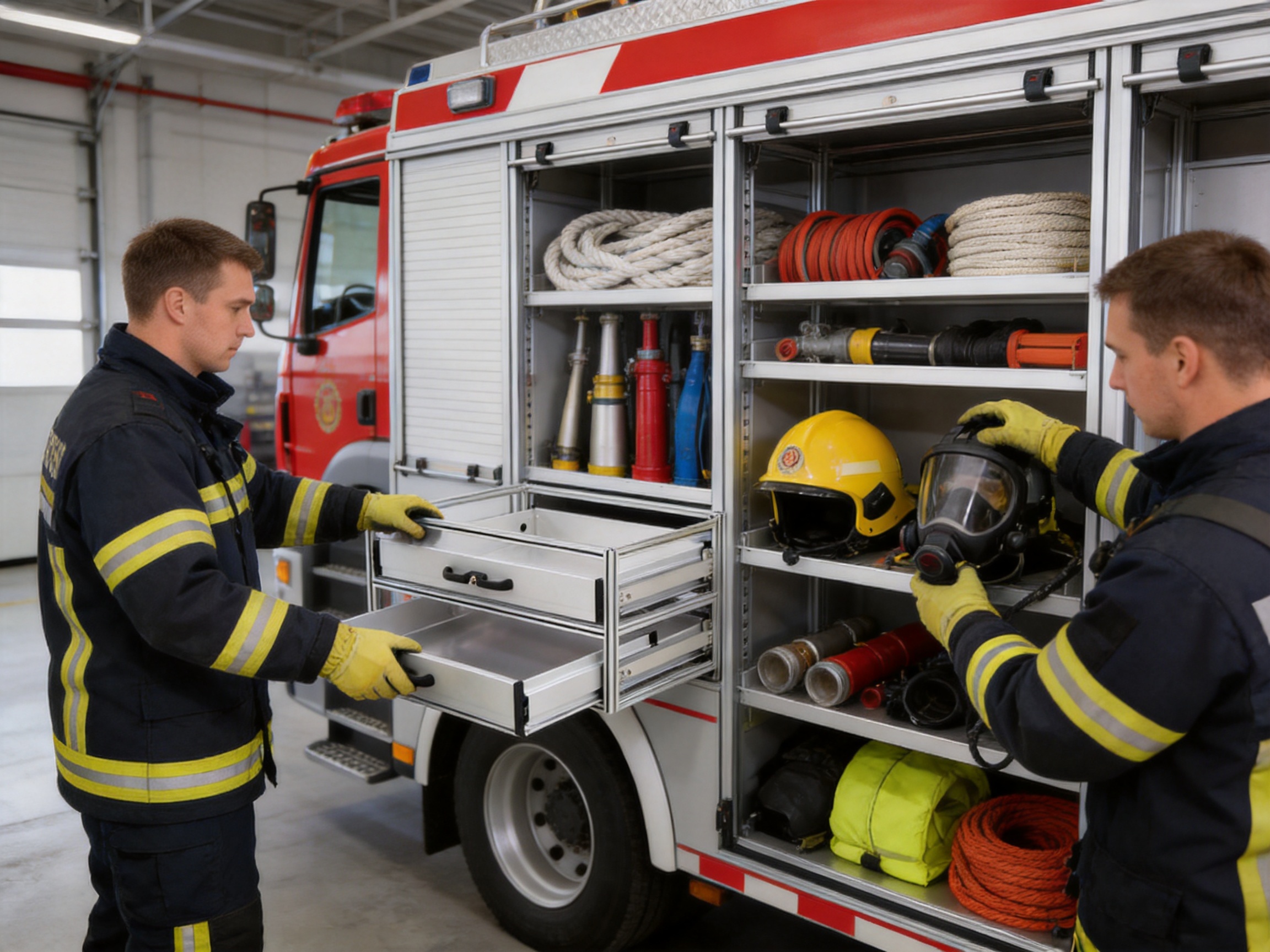
The fire truck drawer is a practical storage solution developed for this demanding environment. It provides organized, pull-out access to firefighting equipment while making efficient use of the limited space available inside a rescue vehicle. Designed with high-strength aluminum alloy profiles, 304 stainless steel fasteners, silent bearing guide rails, silicone rubber buffer blocks, and an integrated handle and limit button, the drawer system combines durability, smooth operation, low noise, and user-friendly control.
Available in single-layer, double-layer, and multi-layer configurations, the system can be adapted to different vehicle bodies, compartment layouts, and equipment loads. Its length, width, height, and related dimensions can be customized to meet customer requirements. This flexibility makes it suitable for fire engines, rescue vehicles, airport fire trucks, municipal emergency fleets, industrial response vehicles, and specialized firefighting platforms.
Manufactured by Tianchang Jinlv Fire Equipment Co., Ltd., the product reflects the company’s long-term focus on fire protection accessories and vehicle-mounted equipment. Since its establishment in 2010, the company has developed manufacturing capabilities covering product design, material selection, fabrication, assembly, quality inspection, and customer support. Its production system is supported by GB/T 19001-2016 quality certification, professional technical personnel, and experience in OEM and ODM projects.
This article examines the construction, advantages, applications, customization options, manufacturing strengths, and selection considerations associated with this fire truck drawer system.
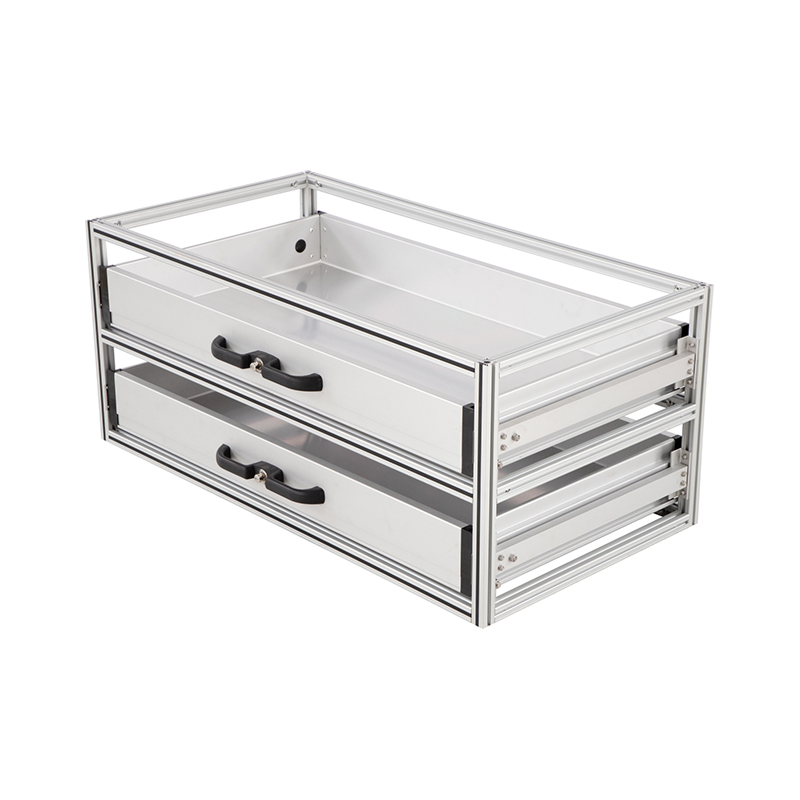
Fire Truck Drawer
1. The Role of Organized Storage in Firefighting
Fire trucks are mobile work platforms carrying a large number of tools and supplies in a restricted amount of space. Every compartment must be planned carefully because the vehicle must remain compact, balanced, and operational while still carrying the equipment required for different emergency scenarios. Storage systems therefore need to do more than hold equipment. They must support rapid deployment, safe transportation, reliable retention, and convenient inspection.
Traditional fixed shelves can provide basic storage, but they may force operators to reach deeply into a compartment. Items stored at the rear or bottom can become difficult to see and retrieve, especially when the compartment is crowded. A pull-out drawer addresses this issue by bringing equipment toward the operator. When the drawer is extended, the entire storage area becomes easier to inspect, allowing firefighters to identify and remove the correct item without unnecessarily disturbing surrounding equipment.
Improved visibility also helps with equipment accountability. Fire departments can arrange items according to response procedures and create clear storage positions for each category of gear. After an operation, crews can check whether helmets, masks, suits, ropes, and tools have been returned to their designated locations. This systematic approach can reduce the likelihood of missing or misplaced equipment during the next emergency response.
Storage organization is particularly important for equipment that must remain clean, dry, and protected from unnecessary impact. Fire suits, breathing equipment accessories, gas masks, lifelines, and smaller firefighting components can be separated into different drawer levels or compartments. The resulting layout can improve both operational efficiency and routine maintenance.
2. Product Structure and Configuration Options
The fire truck drawer is available in three principal arrangements: single-layer drawers, double-layer drawers, and multi-layer drawers. Each configuration responds to a different balance between storage volume, compartment height, access frequency, and vehicle layout.
Single-Layer Drawer
A single-layer drawer is suitable when a vehicle compartment requires one broad, accessible storage level. It can be used for larger items, frequently accessed equipment, or groups of tools that need to be removed together. The open layout makes it easier to arrange equipment according to size and usage priority.
This configuration may also be suitable for compartments with limited vertical clearance. By using one pull-out level, the drawer can offer convenient access without dividing the available height into smaller sections. It is a straightforward choice for rescue trucks and fire engines that need flexible storage in a particular compartment.
Double-Layer Drawer
A double-layer drawer creates two distinct storage levels within the same general compartment area. This arrangement can increase usable storage density while maintaining access to separate groups of equipment. For example, one layer may be assigned to protective clothing and helmets, while the second layer can hold lifelines, masks, nozzles, or smaller accessories.
Separating equipment by function can reduce search time. It also makes it easier for crews to identify whether a particular category of equipment has been returned after use. The two-layer structure is useful when the vehicle requires more organization than a single level can provide but does not need a larger multi-layer system.
Multi-Layer Drawer
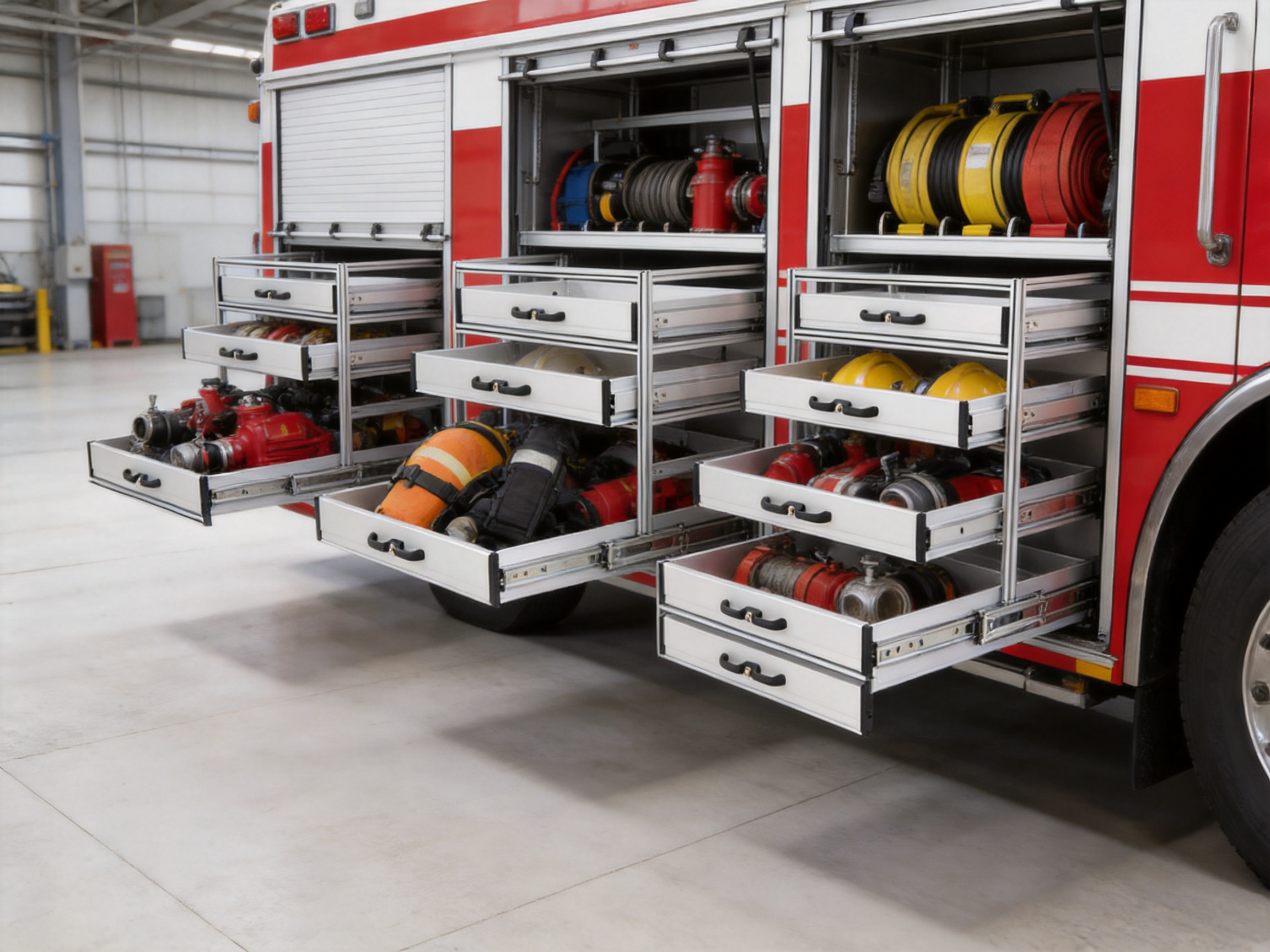
Multi-layer drawers are intended for applications that require a high level of compartment organization. They allow several groups of equipment to be stored in a vertical arrangement, making use of available compartment height. This can be valuable on vehicles carrying a broad range of rescue and firefighting accessories.
A multi-layer system can support a logical equipment hierarchy. Frequently used items can be assigned to the most accessible level, while reserve equipment or specialized accessories can be positioned on other levels. Proper planning is important because the final arrangement should take into account equipment weight, frequency of use, drawer extension, and operator ergonomics.
| Configuration | Typical Benefit | Suitable Storage Strategy |
|---|---|---|
| Single-layer drawer | Broad and simple access | Larger items or frequently used equipment |
| Double-layer drawer | Improved separation and capacity | Two equipment categories in one compartment |
| Multi-layer drawer | High storage density and organization | Multiple equipment groups in taller compartments |
3. High-Strength Aluminum Alloy Main Frame
The main frame is constructed from high-strength aluminum alloy profiles. This material choice is important for a vehicle-mounted storage system because the drawer must remain structurally dependable without adding unnecessary mass to the fire truck.
Aluminum alloy provides a useful combination of strength, low weight, fabrication flexibility, and corrosion resistance. Compared with heavier structural materials, aluminum can help reduce the load placed on the vehicle. Weight management is relevant to emergency vehicles because the truck must carry water, pumps, ladders, hoses, protective equipment, tools, and other systems while remaining within applicable operating limits.
The use of profiles also supports modular construction. Profile-based frames can be designed in different widths, heights, and lengths to match the dimensions of a vehicle compartment. This is especially valuable for OEM and ODM projects in which the available installation space differs from one vehicle model to another.
A well-designed aluminum frame provides a stable foundation for guide rails, drawer panels, handles, and storage surfaces. It also helps maintain alignment during repeated opening and closing cycles. For a drawer system used in a demanding emergency environment, structural consistency is important because misalignment can affect smooth movement, retention, and long-term service performance.
The frame design is not limited to appearance. It must accommodate the practical requirements of installation, loading, vehicle movement, and daily inspection. Engineering teams can consider the drawer dimensions, expected equipment arrangement, available mounting points, and access direction before finalizing the structure.
4. 304 Stainless Steel Fasteners
All fasteners used in the product are made of 304 stainless steel. Fasteners are small components, but they have a major effect on the stability and maintainability of a vehicle-mounted assembly. They secure the structural profiles, guide components, handles, stops, and related hardware in place.
Fire trucks may operate in wet conditions, exposed outdoor environments, industrial areas, coastal regions, and locations where equipment is frequently washed or decontaminated. Stainless steel fasteners provide a suitable material solution for applications in which resistance to corrosion and environmental exposure is important.
Using a consistent fastener material also supports product quality control. It helps establish a clear bill of materials and reduces the risk of unsuitable hardware being introduced during assembly or service. For OEM customers, material consistency can simplify procurement, inspection, and maintenance planning.
304 stainless steel is widely used in equipment exposed to moisture and general atmospheric conditions. Although the final resistance of any installed product depends on the full operating environment, cleaning practices, and exposure conditions, the selection of 304 stainless steel demonstrates attention to long-term reliability rather than only initial appearance.
5. Silent Bearing Guide Rails
The guide rails use silent bearings to provide a smooth operating feel and minimize noise. In a fire station, workshop, or vehicle compartment, low-noise operation is beneficial for routine use. During an emergency, it can also help reduce unnecessary disturbance while the crew prepares equipment.
Silent bearing movement gives the operator a more controlled experience when opening or closing the drawer. Smooth travel can help reduce sudden motion and make it easier to position the drawer accurately. It can also reduce the effort required during repeated access, which matters when personnel are working in protective clothing or carrying other equipment.
Guide rail performance depends on correct installation, alignment, load distribution, and maintenance. The drawer design provides a coordinated frame and rail structure intended to support stable movement. When the drawer is correctly loaded and maintained, the bearing system can contribute to dependable daily operation.
Compared with basic sliding arrangements, a bearing-supported guide rail system can offer a more refined operating feel. It helps transform the drawer from a simple storage box into an accessible equipment management component. For emergency vehicle manufacturers and fleet operators, this difference can influence user acceptance, maintenance workload, and perceived product quality.
Noise reduction is also relevant to service life. Excessive friction, vibration, or impact can increase wear on moving components. By supporting smoother motion and controlled travel, silent bearings can help reduce unnecessary mechanical stress, although regular inspection and appropriate cleaning remain necessary for every vehicle storage system.
6. Silicone Rubber Buffer Blocks
The product includes buffer blocks made of silicone rubber. These components prevent the drawer from directly striking the frame when it reaches the end of its travel or is closed by the operator.
Direct metal-to-metal impact can produce noise, vibration, surface damage, and stress concentration. The silicone buffer creates a cushioning interface between the moving drawer and the surrounding frame. This supports quieter operation and helps protect the structural surfaces from repeated impact.
Silicone rubber is suitable for this purpose because it provides elasticity and resilience. The buffer can absorb part of the closing energy and reduce the harshness of contact. It also contributes to a more comfortable operating experience for personnel who open and close the drawer frequently.
For emergency vehicles, small details such as buffer blocks can have a noticeable effect on long-term usability. A storage system may be opened many times during training, inspections, maintenance, and actual emergency response. Reducing repeated impact can help preserve the finish and alignment of the assembly.
The buffer blocks should be considered part of the overall drawer system rather than optional decorative elements. Their function supports noise control, component protection, and smoother interaction between the operator and the vehicle equipment.
7. Integrated Limit Button and Handle
The limit button and handle are integrated into one component. This design follows ergonomic principles and allows one-hand operation. Combining these functions creates a more direct relationship between the user’s grip and the drawer’s release or movement control.
In an emergency vehicle, operators may be wearing gloves, carrying a tool, or working in a confined position. A control that can be operated with one hand is therefore practical. The user can grip the handle, operate the limit function, and pull the drawer outward without needing to coordinate several separate controls.
An integrated design can also reduce visual complexity. A single coordinated handle assembly is easier to identify during a fast equipment search. It can provide a consistent operating method across several drawers, which is useful when a vehicle contains multiple storage modules.
Ergonomics should address more than appearance. The position, size, and operating movement of a handle affect the amount of force required, the user’s wrist position, and the likelihood of accidental contact. The integrated handle and limit button are intended to make normal operation simple, predictable, and efficient.
For fleet operators, ease of use can influence training. When drawers share a consistent operating principle, firefighters can become familiar with the system more quickly. This can support faster equipment access and reduce confusion when several personnel are working around the same vehicle.
8. Equipment Storage Applications
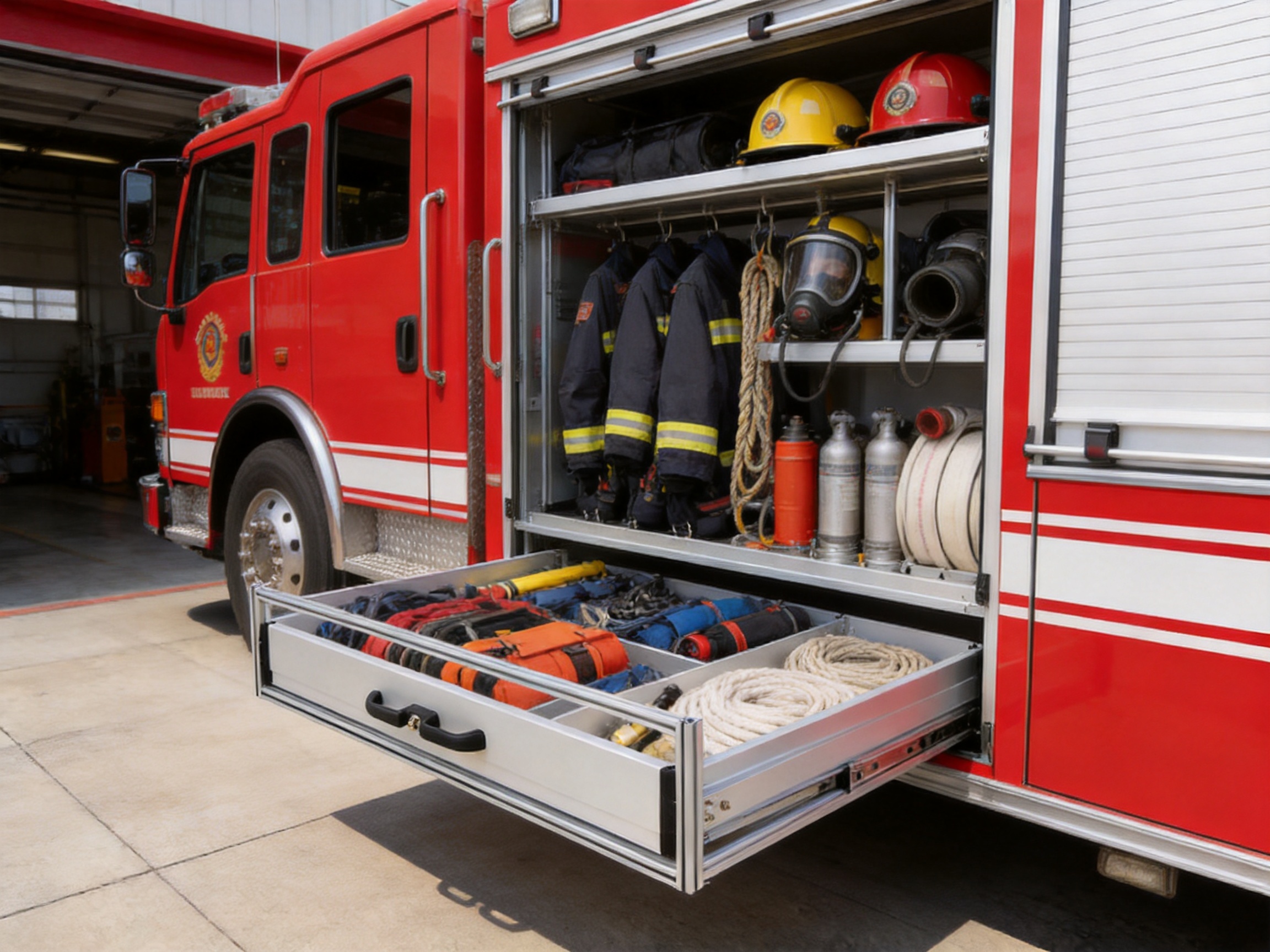
The fire truck drawer is designed for storing fire suits, helmets, lifelines, gas masks, and a variety of firefighting accessories. Its flexible internal arrangement allows customers to assign different storage levels according to the equipment carried by each vehicle.
Protective Clothing and Helmets
Fire suits and helmets require storage that allows them to be retrieved quickly and returned after use. A pull-out drawer can keep these items visible and accessible. Separating protective clothing from smaller tools can also help prevent equipment from becoming tangled or compressed in a deep compartment.
Lifelines and Rope Equipment
Lifelines and related rope equipment benefit from organized storage because they should be kept accessible and protected from unnecessary entanglement. A dedicated drawer level or compartment can give the crew a clear location for these items and simplify post-operation inspection.
Gas Masks and Breathing Accessories
Gas masks and associated accessories should be protected from damage and stored in a manner that allows inspection before deployment. A drawer system can provide a defined location for these items, helping personnel confirm that the required equipment is present and ready.
Firefighting Accessories
Nozzles, hand tools, connectors, protective accessories, and other small components can be arranged according to response procedures. Multi-layer configurations are especially useful when a vehicle carries a broad range of accessories that would otherwise be difficult to separate within one large compartment.
The final storage plan should always be developed according to the equipment list, weight distribution, compartment dimensions, and operating procedures of the specific vehicle. The drawer is a flexible platform, but proper organization remains essential for achieving the best result.
9. Advantages Compared with Basic Storage Solutions
The principal advantage of this drawer system is controlled access. Instead of requiring operators to reach deep into a fixed compartment, the drawer brings the equipment outward. This can improve visibility and reduce unnecessary bending, stretching, and searching.
A second advantage is modular organization. Single-layer, double-layer, and multi-layer options allow the storage solution to match the vehicle’s mission. A rescue vehicle carrying a specialized set of tools may need a different arrangement from a municipal pumper or an industrial fire truck.
A third advantage is material coordination. The high-strength aluminum alloy frame, 304 stainless steel fasteners, silent bearing guide rails, silicone rubber buffers, and integrated handle are selected as parts of one system. This coordinated approach is more effective than combining unrelated storage components with different operating characteristics.
A fourth advantage is customization. The product length L, width W, height H, and related dimension L1 can be customized. This allows manufacturers and fleet owners to work around body structures, existing compartments, door openings, wheel arches, pump systems, and other vehicle-specific limitations.
A fifth advantage is user-oriented operation. The integrated handle and limit button support one-hand use, while the silent guide rails and rubber buffers make opening and closing smoother and quieter. These features may appear simple, but they influence how quickly and confidently firefighters interact with the vehicle.
| Product Feature | Operational Value | Customer Benefit |
|---|---|---|
| Aluminum alloy profile frame | Strong and relatively lightweight structure | Supports vehicle payload management and long-term use |
| 304 stainless steel fasteners | Improved resistance to moisture and general exposure | Supports durability and maintenance consistency |
| Silent bearing guide rails | Smooth, low-noise drawer travel | Improves access comfort and operating quality |
| Silicone rubber buffer blocks | Reduces direct impact against the frame | Helps protect surfaces and limit closing noise |
| Integrated handle and limit button | Enables convenient one-hand operation | Supports fast and ergonomic equipment access |
| Custom dimensions | Adapts to different vehicle compartments | Enables OEM and ODM integration |
10. Customization for OEM and ODM Projects
Fire trucks are rarely identical. Vehicle manufacturers and specialty vehicle integrators may use different body structures, compartment dimensions, access doors, mounting positions, and equipment layouts. A standardized drawer can be useful, but a customizable drawer is more likely to integrate efficiently into a complete vehicle design.
The product dimensions can be customized according to customer requirements. The principal dimensions include length, width, and height, while the L1 dimension can also be defined for the particular installation. This provides a foundation for technical communication between the customer, vehicle builder, and manufacturer.
Customization may begin with the available compartment space. Engineers can evaluate the internal width, vertical clearance, usable depth, door opening, adjacent components, and intended drawer extension. They can then determine the most suitable configuration and storage levels.
Customer requirements may also include the number of drawers, layer arrangement, installation orientation, equipment categories, and access priorities. For example, frequently used protective equipment may need to be placed in a highly accessible position, while less frequently used accessories can be assigned to another level.
OEM and ODM cooperation requires more than producing a different size. It involves communication, drawing confirmation, material coordination, manufacturing control, inspection, packaging, and delivery support. Jinlv Fire’s experience in fire protection accessories allows it to participate in this process with an understanding of the operating environment and the needs of vehicle equipment manufacturers.
A customized storage system can help customers use compartment space more effectively. It can also create a consistent appearance and operating method across a vehicle fleet. When multiple trucks use compatible storage principles, training, inspection, and replacement planning can become more straightforward.
11. Manufacturing Process and Quality Control
The performance of a fire truck drawer depends on the quality of its complete manufacturing process. Material selection alone is not enough. The profiles must be prepared accurately, components must be assembled correctly, moving parts must be aligned, and finished units must be inspected before delivery.
Material Procurement
Production begins with the selection and procurement of appropriate raw materials and hardware. The aluminum alloy profiles, stainless steel fasteners, guide components, buffer materials, handles, and other parts must match the technical requirements of the design.
Stable material procurement supports consistent production. It also allows the manufacturer to maintain clearer quality records and reduce variation between batches. For custom projects, the material plan can be reviewed together with the customer’s specifications and application conditions.
Profile Preparation and Fabrication
Aluminum alloy profiles are prepared according to the required dimensions and frame design. Accurate cutting, drilling, finishing, and fitting are important because small dimensional errors can affect the alignment of guide rails and the final operation of the drawer.
Fabrication should take into account the required tolerances, connection points, mounting surfaces, and overall squareness of the structure. A properly prepared profile frame provides a reliable base for the later assembly stages.
Component Assembly
During assembly, the structural frame, guide rails, drawer body, fasteners, buffer blocks, handle, and limit mechanism are combined into a working unit. Correct tightening and positioning of 304 stainless steel fasteners are important for maintaining structural stability.
The bearing guide rails must be installed in a way that supports parallel movement. The handle and limit button must be positioned for comfortable operation, while the silicone buffers must be located where they can effectively prevent direct impact.
Functional Inspection
Finished units should be checked for dimensions, appearance, structural stability, drawer travel, handle operation, limit function, and buffer contact. The drawer should open and close smoothly without unnecessary interference or abnormal noise.
Quality inspection helps identify issues before the product is installed on a vehicle. It also supports consistent delivery for customers purchasing multiple units or integrating the product into a larger vehicle production program.
Tianchang Jinlv Fire Co., Ltd. operates with a complete production process and has passed GB/T 19001-2016 quality certification. This quality management foundation reflects the company’s emphasis on process control from raw material procurement through final product delivery.
12. Company Manufacturing Strengths
Tianchang Jinlv Fire Equipment Co., Ltd. was established in 2010 and has focused on fire protection accessories for 15 years. Its product experience includes fire truck roller shutters, vehicle equipment, ladders, storage systems, and related components. This specialization gives the company a practical understanding of the space, access, and durability requirements of emergency vehicles.
The company is equipped with advanced production facilities and a complete manufacturing process. A complete process can help coordinate design, production, assembly, inspection, and delivery rather than treating each stage as an isolated activity. This is valuable for products that must integrate into a larger vehicle system.
Professional technical expertise supports the development of customized products. Fire truck equipment often involves non-standard dimensions and application-specific requirements. A technical team with industry experience can help review customer drawings, clarify dimensions, identify installation considerations, and coordinate design improvements.
The company also maintains a research and development team with industry experience. Its development work follows market requirements and focuses on efficient, environmentally considerate, and practical fire protection equipment. Continuous improvement is important because fire departments, vehicle manufacturers, and rescue organizations may require new storage arrangements or improved operating features.
Quality, honesty, innovation, and customer service form the stated foundation of the company’s business philosophy. In practical terms, these principles are reflected in material control, production management, OEM and ODM support, global technical assistance, and communication with customers throughout a project.
For buyers, the value of a supplier is not determined only by a single product feature. It also depends on whether the supplier can communicate effectively, maintain stable quality, support customization, and provide assistance after delivery. Jinlv Fire’s experience in these areas strengthens the product’s suitability for international fire equipment projects.
13. Installation and Integration Considerations
Before installation, the vehicle manufacturer or installer should confirm the compartment dimensions, mounting points, surrounding structures, access direction, and expected operating clearance. The drawer should not interfere with doors, roller shutters, pumps, electrical systems, hoses, ladders, or other vehicle equipment.
Load planning is also important. Heavy items should be positioned in a way that supports stable drawer movement and sensible vehicle weight distribution. The customer should consider the rated capacity and intended use of the selected configuration when assigning equipment to each level.
The installation surface should be sufficiently stable and accurately positioned. Incorrect mounting can place stress on the frame or guide rails and may affect drawer movement. After installation, the drawer should be operated through its full range to confirm clearance, handle function, stop engagement, and buffer contact.
For multi-layer systems, the installer should verify that each level remains accessible and that one open drawer does not obstruct another. The final layout should allow personnel to retrieve equipment without unnecessary twisting or reaching.
Because the product is customizable, installation information should be confirmed before production. Drawings, dimensions, compartment photographs, equipment lists, and mounting requirements can help reduce errors and improve project efficiency.
14. Maintenance and Service Practices
Routine inspection is recommended for every vehicle-mounted drawer system. Personnel should check the frame, fasteners, guide rails, handle, limit button, and silicone rubber buffers at suitable intervals. The inspection schedule can be adjusted according to operating frequency, environmental exposure, cleaning methods, and vehicle service conditions.
The drawer should be kept reasonably clean so that dirt and debris do not interfere with moving components. Any cleaning procedure should be compatible with the materials and with the operating requirements of the vehicle. After cleaning, the operator should confirm that the drawer travels smoothly and closes properly.
Fasteners should be checked for looseness or visible damage. The guide rails should be inspected for abnormal noise, resistance, or misalignment. If operation becomes noticeably rough, the cause should be identified before the drawer is returned to heavy service.
The silicone rubber buffer blocks should also be checked for wear, displacement, or damage. Their condition affects the control of closing impact and noise. A damaged buffer should be replaced according to the manufacturer’s service recommendations.
Equipment arrangement should be reviewed after every major operational use. Items should be returned to their assigned positions, and damaged or contaminated equipment should be removed for service. Good storage discipline complements the mechanical design of the drawer and helps preserve readiness.
15. Use in Different Emergency Vehicle Scenarios
The drawer can be adapted to multiple emergency vehicle types because its dimensions and layer arrangement are customizable. A municipal fire engine may use it for standard protective equipment and accessories. An industrial fire truck may require storage for specialized tools and protective items used in a plant environment.
Airport rescue and firefighting vehicles often carry a wide range of equipment in a carefully planned body layout. A multi-layer drawer can help separate frequently used equipment from reserve items while preserving access within a confined compartment.
Rescue trucks may need to organize tools according to incident type. One level can hold personal protective equipment, another can store ropes and masks, and another can be assigned to smaller accessories. The exact configuration depends on the vehicle’s mission and the customer’s operating procedures.
Industrial emergency fleets may operate in areas with moisture, dust, chemicals, or frequent cleaning. In such applications, material selection and maintenance planning become particularly important. The aluminum alloy frame, stainless steel fasteners, and protective component design provide a suitable foundation, while the final selection should consider the actual exposure environment.
Specialized firefighting vehicles can also use customized drawer systems to create a consistent equipment layout across a fleet. Standardized placement can help crews become familiar with the location and operation of equipment even when they move between vehicles.
16. How to Select the Correct Drawer Configuration
The first selection factor is the type and quantity of equipment to be stored. Customers should prepare an equipment list and group items according to size, weight, frequency of use, and operational function.
The second factor is the available compartment space. The internal length, width, and height should be measured carefully, including any obstructions, door frames, mounting brackets, or neighboring components. The available space should be compared with the required drawer dimensions and extension clearance.
The third factor is access frequency. Equipment needed during the first stages of an emergency should be placed in the most accessible locations. Less frequently used accessories may be stored in other levels, provided that they remain easy to inspect and retrieve.
The fourth factor is weight distribution. Heavier equipment should be assigned according to the drawer structure, vehicle layout, and safe handling requirements. The customer should avoid creating an arrangement that makes the drawer difficult to operate or places excessive load on one part of the vehicle.
The fifth factor is the operating environment. Exposure to water, dust, heat, cleaning agents, vibration, and outdoor storage can influence material and maintenance requirements. Customers should communicate these conditions during the design stage.
The sixth factor is future expansion. If a fleet may add equipment later, a modular or multi-layer configuration may provide more flexibility. Planning for future needs can be more economical than replacing an undersized storage system.
17. Frequently Asked Questions
What is a fire truck drawer used for?
A fire truck drawer is used to organize and store firefighting and rescue equipment inside a vehicle compartment. It provides pull-out access to items such as fire suits, helmets, lifelines, gas masks, nozzles, tools, and other accessories.
What drawer configurations are available?
The product is available in single-layer, double-layer, and multi-layer configurations. The appropriate option depends on the required storage volume, compartment height, equipment categories, and desired level of organization.
Can the drawer dimensions be customized?
Yes. The length L, width W, height H, and L1 dimension can be customized according to customer requirements. Custom dimensions support integration with different fire truck compartments and vehicle body designs.
What material is used for the main frame?
The main frame is made from high-strength aluminum alloy profiles. This provides a strong and relatively lightweight structure suitable for vehicle-mounted equipment storage.
Why are 304 stainless steel fasteners used?
304 stainless steel fasteners provide resistance to moisture and general environmental exposure. They also contribute to consistent assembly quality and long-term maintenance performance.
How do the silent bearing guide rails help?
The silent bearing guide rails support smooth drawer travel and reduce operating noise. They can make repeated access more comfortable and help create a refined user experience.
What is the purpose of the silicone rubber buffer?
The silicone rubber buffer prevents the drawer from striking the frame directly. It helps reduce impact, noise, vibration, and potential surface damage during closing or end-of-travel contact.
Can the drawer be operated with one hand?
The limit button and handle are integrated into one ergonomic component, allowing one-hand operation. This is useful when personnel are wearing gloves or carrying other equipment.
Is the product suitable for OEM and ODM projects?
Yes. The customizable dimensions and product configurations make the drawer suitable for OEM and ODM cooperation. Customers can discuss vehicle layouts, equipment requirements, installation conditions, and technical drawings with the manufacturer.
What should be considered before placing an order?
Customers should provide the available compartment dimensions, required drawer configuration, equipment list, expected load, access direction, mounting requirements, and operating environment. These details help the manufacturer recommend a suitable design.
How should the drawer be maintained?
Routine maintenance should include checking the frame, fasteners, guide rails, handle, limit button, and silicone buffers. The drawer should be kept clean, and any abnormal resistance, noise, looseness, or damage should be investigated promptly.
Who manufactures this fire truck drawer?
The product is manufactured by Tianchang Jinlv Fire Equipment Co., Ltd., a China-based fire protection equipment company established in 2010. The company provides fire truck equipment, storage systems, roller shutters, ladders, and related fire protection accessories.
18. Why the Product Is a Practical Choice
A fire truck drawer should be evaluated as part of the complete emergency vehicle system. Its purpose is not merely to create additional storage. It must help personnel find equipment quickly, use the compartment efficiently, protect stored items, and maintain reliable operation through repeated use.
This product addresses these requirements through a combination of structural and user-oriented features. The aluminum alloy profile frame offers a strong and relatively lightweight foundation. The 304 stainless steel fasteners support reliable assembly in conditions involving moisture and regular cleaning. Silent bearing guide rails improve movement, while silicone rubber buffers reduce direct impact. The integrated handle and limit button make one-hand operation more convenient.
The availability of single-layer, double-layer, and multi-layer versions gives customers the flexibility to match the drawer to their equipment plan. Customizable dimensions further improve compatibility with different fire truck models and compartment designs.
Just as important, the product is supported by a manufacturer with experience in fire protection accessories, professional technical personnel, established production facilities, a complete manufacturing process, quality certification, and OEM/ODM service capabilities. This combination of product design and manufacturing support can help fire truck builders and fleet operators develop more practical, organized, and maintainable vehicle storage systems.
Conclusion
Efficient equipment storage is an essential part of fire truck design. Firefighters need to access protective clothing, helmets, lifelines, gas masks, and other accessories quickly and safely, often in difficult conditions. A well-designed pull-out drawer can improve visibility, organization, ergonomics, and operational readiness.
The fire truck drawer described in this article combines high-strength aluminum alloy profiles, 304 stainless steel fasteners, silent bearing guide rails, silicone rubber buffer blocks, and an integrated handle and limit button. These features work together to provide smooth operation, reduced noise, impact control, structural reliability, and one-hand access.
With single-layer, double-layer, and multi-layer configurations, the system can be adapted to different equipment plans and vehicle compartments. Customizable L, W, H, and L1 dimensions make it suitable for OEM and ODM applications involving fire engines, rescue trucks, airport firefighting vehicles, industrial emergency vehicles, and other specialized platforms.
Backed by Tianchang Jinlv Fire Equipment Co., Ltd.’s experience since 2010, complete production process, GB/T 19001-2016 quality certification, research and development capabilities, and customer-focused technical support, the product offers a practical solution for modern fire apparatus equipment stowage. For vehicle manufacturers and emergency service operators seeking organized, durable, and adaptable storage, a customized fire truck drawer can be a valuable improvement to the overall rescue equipment system.
References
1. Product information supplied for the Fire Truck Drawer, including configuration, materials, operating features, applications, and customizable dimensions.
2. Tianchang Jinlv Fire Equipment Co., Ltd. company information, manufacturing profile, product capabilities, quality certification, and OEM/ODM service description.
3. GB/T 19001-2016, Quality Management Systems—Requirements.
4. General engineering principles for emergency vehicle equipment storage, compartment organization, ergonomic access, and vehicle payload management.
5. General material information relating to aluminum alloy profiles, 304 stainless steel fasteners, bearing guide systems, and silicone rubber cushioning components.
Product: Fire Truck Drawer
News
-
-
Two minutes into a working fire, a crew stands in front of a locked steel security door with a crowbar that is too short to pull with both hands. Nothing about the tool is broken. It was simply speci...
READ MORE -
Three rungs up the rear of a pumper, a firefighter in wet gloves misses the grab and catches the handrail instead. Whether that rail holds was decided months earlier, at the bench: by tube wall thick...
READ MORE -
01 Choosing the right fire truck equipment comes down to three things: matching gear to your call volume, verifying it meets NFPA and GB fire apparatus standards, and working with a fire truck equip...
READ MORE -
Quick Answer The right fire fighting nozzle depends on three factors: the flow rate your pump can deliver, the pattern your crew needs on the fireground, and the thread standard your hose already us...
READ MORE -
Quick Answer The right fire truck boarding ladder is a fixed, upward-folding, or rotating step assembly mounted at the rear or side of the apparatus that gives firefighters a stable, non-slip surface ...
READ MORE
Hey! Interested in staying in the loop? Sign up for our updates.
WE WON'T SPAM YOU, PINKY PROMISE.

Tianchang Jinlv Fire Equipment Co., Ltd.
Copyright © Tianchang Jinlv Fire Equipment Co., Ltd. All rights reserved. Custom Fire Truck Equipment Supplier Fire Apparatus Parts Factory
