

 en
 English
 русский
 Español
 عربى

Every firefighter has opened a compartment door after a rough response only to find nozzles, webbing, and wrenches piled on top of each other. In gloves and low light, with the pump running, that is ...
READ MORE
Multifunctional Fire-Fighting Nozzles: Performance, Applications, and Manufacturing Excellence
2026.10.23
Content
- 1 1. The Role of a Fire-Fighting Nozzle in Emergency Response
- 2 2. Product Overview
- 3 3. Multiple Spray Patterns for Changing Fire Conditions
- 4 4. One-Hand Operation and Operator Control
- 5 5. Rotating Water Inlet for Better Hose Handling
- 6 6. Materials and Construction Options
- 7 7. Performance Parameters
- 8 8. Advantages Compared with Conventional Single-Function Nozzles
- 9 9. Advanced Manufacturing Process
- 10 10. Quality Management and Company Manufacturing Strengths
- 11 11. OEM and ODM Support
- 12 12. Applications
- 13 13. Installation and Operating Considerations
- 14 14. Maintenance and Service Life
- 15 15. Selection Guide for Buyers
- 16 16. Why Manufacturing Partnership Matters
- 17 17. Frequently Asked Questions
- 17.1 Q1: What spray patterns are available?
- 17.2 Q2: Can the nozzle be operated with one hand?
- 17.3 Q3: What materials are available?
- 17.4 Q4: Is the nozzle suitable for fire trucks?
- 17.5 Q5: What is the reference rated pressure?
- 17.6 Q6: What is the reference flow rate?
- 17.7 Q7: What is the reference range?
- 17.8 Q8: Why is the rotating water inlet useful?
- 17.9 Q9: Can the nozzle be customized for OEM projects?
- 17.10 Q10: Does flush mode replace maintenance?
- 17.11 Q11: How should buyers choose between aluminum and brass?
- 17.12 Q12: What information should be supplied for an OEM quotation?
- 18 18. Conclusion
- 19 References
- 20 Product: Multifunctional Fire-Fighting Nozzles
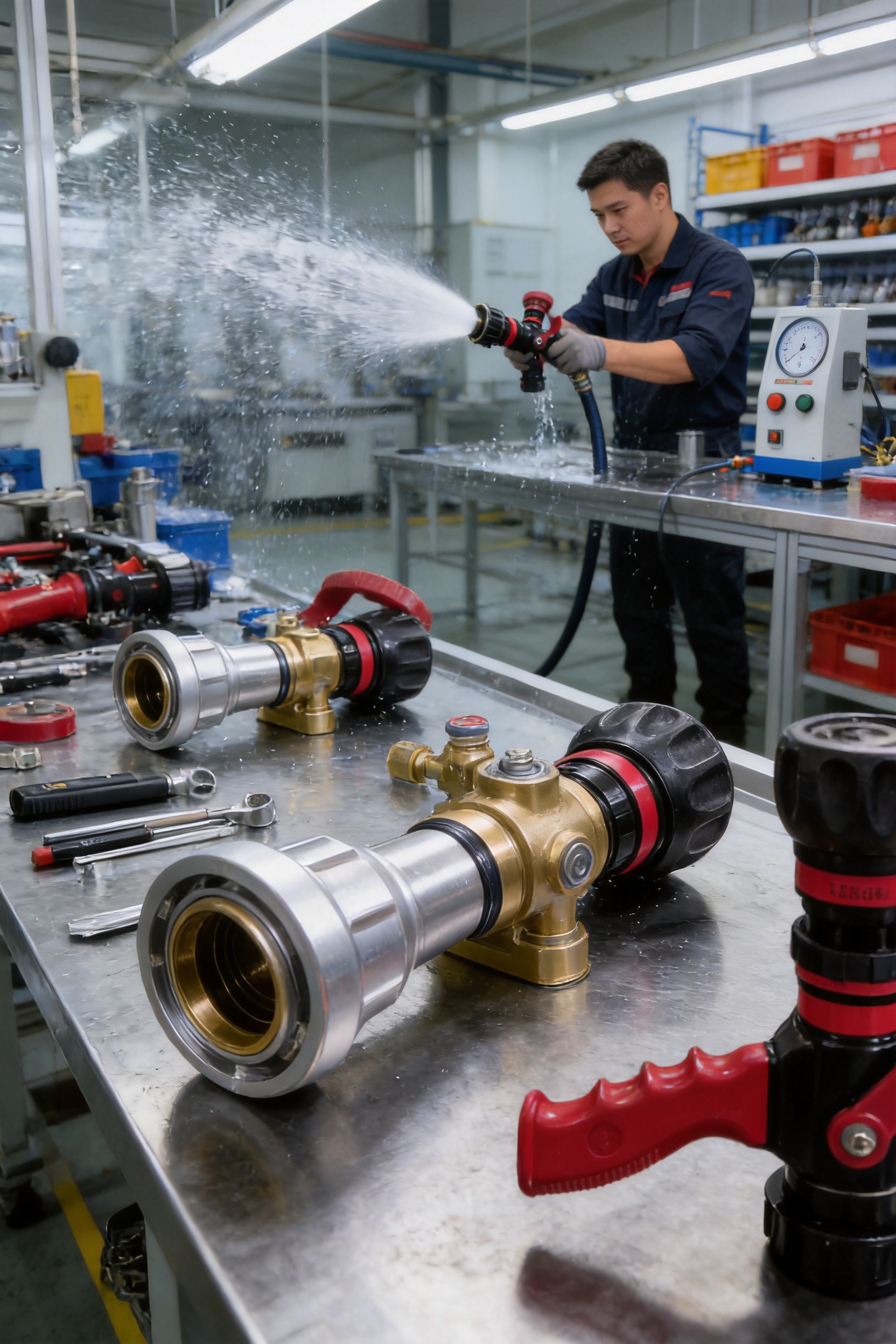
Multifunctional fire-fighting nozzles are essential components in modern fire response systems. They connect the firefighter, hose line, pump, and water supply into one controllable discharge system. Although a nozzle is compact compared with a fire truck or pump assembly, its design has a direct influence on water application, operator safety, fire control speed, and the efficient use of limited water resources.
Professional firefighters may need to change rapidly from a concentrated straight stream to a protective fog pattern, flush debris from the waterway, or stop the flow while repositioning the hose. A nozzle that supports these functions without requiring a tool change can improve operational flexibility and reduce unnecessary delay. The multifunctional fire-fighting nozzles described in this article are designed for fire trucks, pump trucks, emergency vehicles, and related firefighting systems where dependable water delivery and simple operation are essential.
These nozzles combine multiple spray patterns, one-hand operation, flow adjustment, rotating water inlet functionality, and durable metal construction. Depending on the selected configuration, the body can be manufactured from lightweight hard-anodized aluminum or corrosion-resistant brass. The result is a practical product for fire departments, vehicle manufacturers, firefighting equipment distributors, industrial emergency teams, and OEM customers.
1. The Role of a Fire-Fighting Nozzle in Emergency Response
A fire hose nozzle is more than an outlet at the end of a hose. It determines how water is shaped, directed, and controlled after leaving the hose line. A well-designed nozzle must convert the available water pressure into a useful discharge pattern while remaining manageable for the operator.
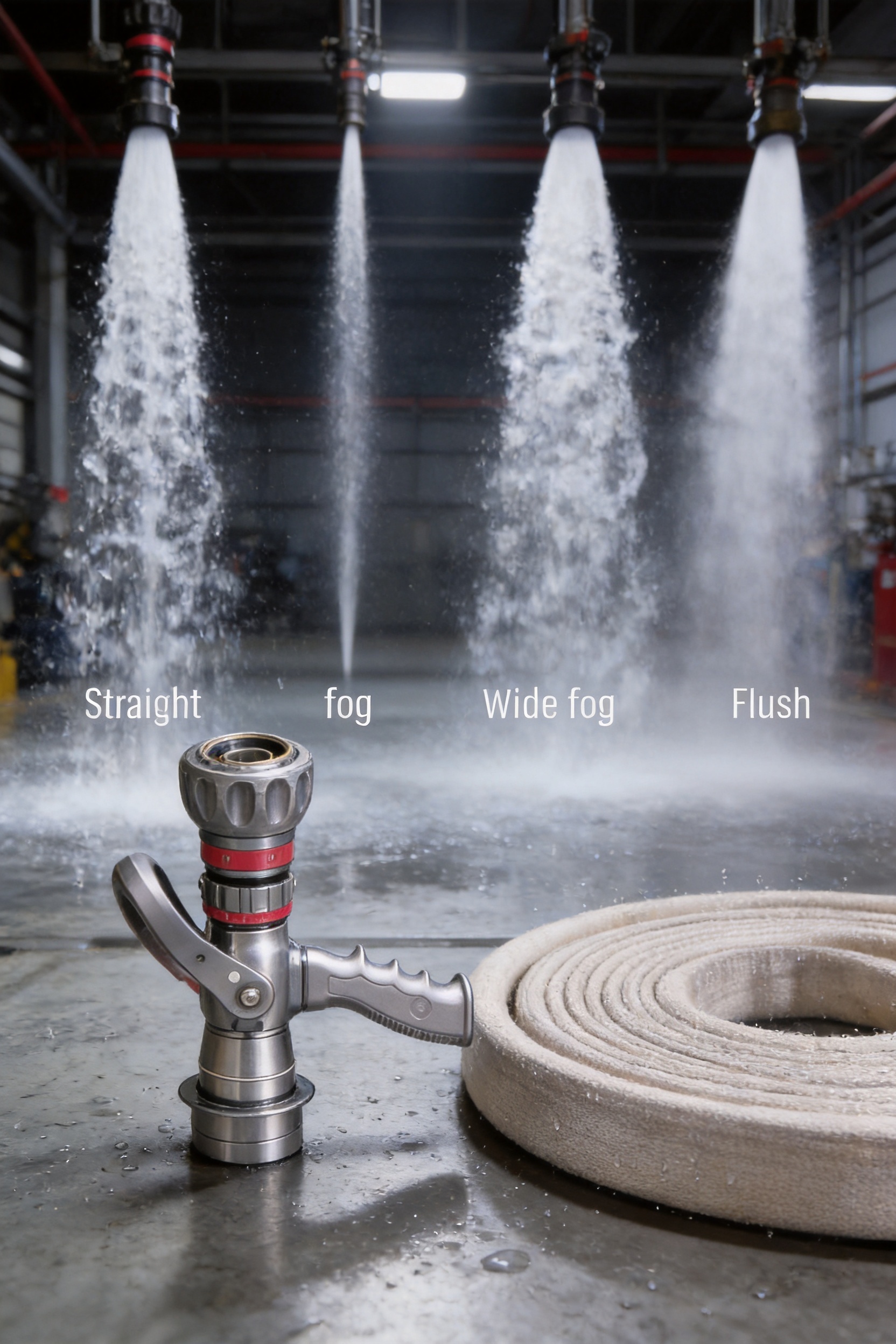
In a structural fire, the best stream for one phase of the operation may not be suitable for another. A straight stream can provide long reach and concentrated penetration. A narrow fog pattern can help firefighters adjust the water distribution while maintaining directional control. A wide fog pattern can cover a larger area and may provide a degree of protection for personnel working near heat and smoke. A flush mode can help remove small obstructions or contaminants from the waterway.
Traditional single-pattern nozzles can perform one primary function effectively, but they may require replacement or additional equipment when conditions change. Multifunctional nozzles reduce this limitation by integrating several operating modes into one compact unit. The firefighter can select the desired pattern by rotating the nozzle ring or operating the lever, depending on the model configuration.
This design is especially valuable on emergency vehicles, where storage space is limited and every piece of equipment must justify its weight and footprint. One multifunctional nozzle can support several water application requirements without requiring a separate nozzle for each function. The reduced equipment burden can simplify vehicle layout, hose deployment, and equipment inventory management.
2. Product Overview
The multifunctional fire-fighting nozzles supplied by Tianchang Jinlv Fire Equipment Co., Ltd. are developed for professional use in mobile firefighting systems. They are suitable for fire trucks, pump trucks, emergency vehicles, and related water discharge applications.
The core operating concept is simple: the user controls water discharge and selects a spray pattern through an integrated mechanism. The nozzle can be operated from fully closed to fully open, allowing the operator to regulate flow according to the fire situation, pump output, hose configuration, and tactical requirements.
Key features include:
• Multiple spray patterns, including straight stream, narrow fog, wide fog, and flush mode.
• A rotating nozzle ring or lever mechanism for quick pattern selection.
• A trigger switch designed for one-hand operation.
• A rotating water inlet to reduce hose twisting and improve handling.
• Flow control from fully closed to fully open.
• Lightweight hard-anodized aluminum or corrosion-resistant brass body options.
• Suitability for fire truck, pump truck, and emergency vehicle systems.
• OEM supply for fire truck body manufacturers and firefighting equipment distributors.
• Professional manufacturing supported by a complete production process and quality management practices.
By combining these functions into a single product, the nozzle is designed to offer a balance between flexibility, durability, operator control, and installation compatibility.
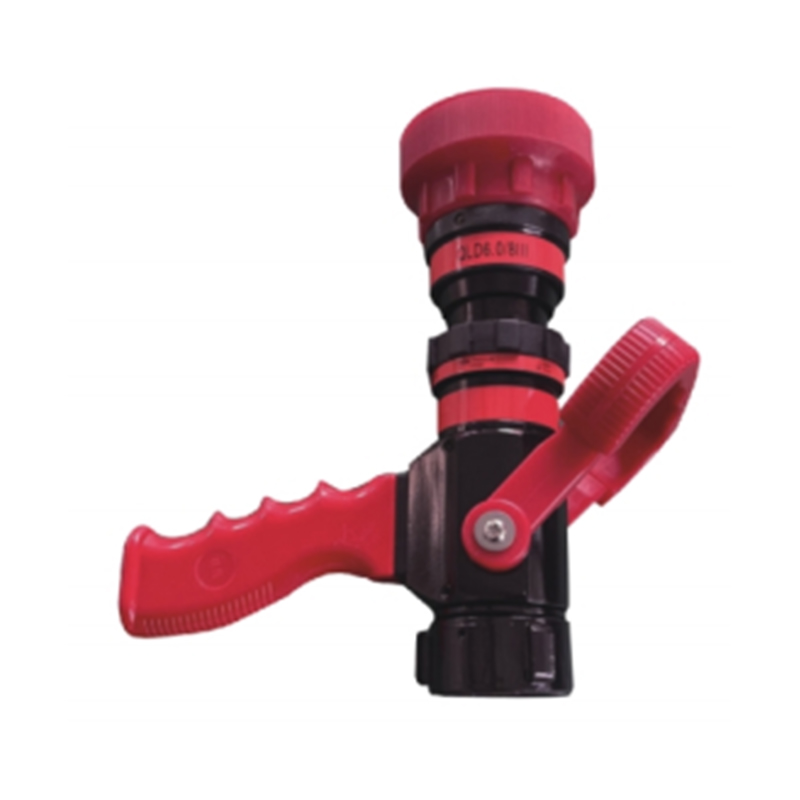
Multifunctional Fire-Fighting Nozzles
3. Multiple Spray Patterns for Changing Fire Conditions
3.1 Straight Stream
The straight stream setting produces a concentrated flow of water designed for directional reach. It can be useful when firefighters need to project water toward a distant target, reach through an opening, or apply water to a specific area rather than dispersing it broadly.
A concentrated stream can also support more accurate application when the operator has a clear line of sight. Instead of distributing water over a wide area, the operator can aim the discharge at a particular seat of fire or hot surface. This may help reduce water waste and support controlled fire attack tactics.
3.2 Narrow Fog
The narrow fog setting produces a more dispersed pattern than a straight stream while retaining a relatively focused direction. This intermediate setting is useful when the operator needs some water distribution without immediately switching to the broadest available pattern.
Narrow fog can provide flexibility during interior or exterior firefighting operations. It may help the operator adjust coverage, manage radiant heat, and adapt to changing visibility or access conditions. The exact performance of the spray pattern depends on pressure, flow, nozzle design, hose length, pump capacity, and operating technique.
3.3 Wide Fog
The wide fog setting disperses water across a larger angle. It can be selected when broader coverage is required, such as when cooling a wider surface area, applying water around an opening, or creating a larger protective water pattern.
A wide fog setting also gives the operator an alternative to carrying a separate fog nozzle. This can simplify equipment planning for fire trucks and emergency vehicles. The user should always select the pattern appropriate for the fire environment and follow the operating procedures of the responsible fire department or emergency organization.
3.4 Flush Mode
Firefighting water may contain particles, sediment, rust, or other contaminants, especially when the supply source or hose system is exposed to demanding field conditions. Flush mode is intended to support the removal of minor obstructions from the nozzle waterway.
Being able to flush the nozzle without dismantling it can help restore water flow more quickly. It may also reduce the need for immediate field disassembly. Regular inspection and maintenance remain necessary, but an integrated flush function adds practical value during active operations.
4. One-Hand Operation and Operator Control
Firefighters often need to maintain control of a hose line while adjusting the nozzle. A trigger switch designed for one-hand operation allows the operator to open, close, or regulate the discharge while keeping the other hand available for hose support, communication, balance, or movement.
One-hand operation is particularly important in confined spaces, on ladders, near vehicle compartments, and during rapid repositioning. It may also reduce the need for complicated hand movements when wearing protective gloves. The control system should be operated according to the user’s training and the specific nozzle configuration supplied.
The ability to move from fully closed to fully open provides more than a simple on-off function. Flow control can help the operator adjust the discharge to the available pump pressure and the immediate firefighting objective. For example, a lower flow setting may be selected during initial positioning, while a higher flow setting may be required when sufficient water supply and stable footing are available.
Flow control also benefits pump operators and vehicle system designers. When a nozzle is used with a pump truck, water demand can change as the operator adjusts the discharge. A controllable nozzle can therefore form part of a more responsive water delivery system, although the complete performance must be evaluated together with the pump, hose, fittings, and water source.
5. Rotating Water Inlet for Better Hose Handling
A rotating water inlet is another practical feature for mobile firefighting equipment. Hose lines can twist as firefighters move, turn, or change position. Without a rotating connection, torsional force may be transferred directly to the nozzle body and the operator’s hands.
The rotating inlet is designed to allow relative movement between the hose connection and the nozzle. This can make hose handling more comfortable and help reduce unwanted twisting during operation. It is particularly useful when a firefighter must rotate the nozzle to change the spray pattern or redirect the stream.
For vehicle manufacturers, the rotating inlet can also support more convenient hose routing. Fire truck compartments and pump panels often have limited space, and the ability to orient the hose connection can make storage and deployment easier. The final connection specification should be confirmed before ordering to ensure compatibility with the intended hose, coupling, and vehicle system.
6. Materials and Construction Options
6.1 Hard-Anodized Aluminum
Hard-anodized aluminum is a practical material option when low weight is a major priority. Firefighters must carry and control equipment while wearing protective clothing, breathing apparatus, gloves, and other gear. Reducing unnecessary equipment weight can support easier handling and reduce fatigue during extended operations.
The hard-anodized surface provides an additional protective layer for the aluminum body. It is intended to improve surface durability and resistance to normal wear compared with untreated aluminum. The material is suitable for applications where a balance between lightweight construction, corrosion resistance, and operational strength is required.
Aluminum construction may also be advantageous for fire truck equipment packages that include several nozzles, hose lines, ladders, tools, and storage components. Every kilogram saved in an accessory can contribute to more efficient vehicle weight management, provided the product meets the operational requirements of the application.
6.2 Corrosion-Resistant Brass
Corrosion-resistant brass provides an alternative for customers who prefer a robust metal construction with a substantial feel. Brass is widely used in water-handling components because of its durability and resistance to many common service environments.
A brass nozzle may be selected for installations where long service life, rugged handling, and resistance to repeated exposure to water are important considerations. The appropriate material depends on the customer’s weight requirements, budget, operating environment, maintenance program, and vehicle design.
Offering both aluminum and brass options gives OEM customers and distributors greater flexibility. A fire department focused on minimizing carried weight may prefer aluminum, while another customer may prioritize the heavy-duty characteristics of brass. Providing material choices is one way to adapt the same multifunctional concept to different purchasing requirements.
7. Performance Parameters
The available performance information identifies a nominal inlet diameter of 40 mm, a rated spray pressure of 0.6 MPa, a rated flow rate of 2.5 L/s, a flow rate tolerance of ±8 percent, and a range of at least 21 m for the listed configuration. Additional listed flow and range values include higher flow levels and corresponding longer ranges.
The table below presents the available data in a clear reference format. Because nozzle performance is affected by the complete water delivery system, buyers should confirm the final specification, connection size, pressure requirement, flow rating, and test method before placing a production order.
| Reference Item | Available Parameter | Unit or Note |
|---|---|---|
| Nominal inlet diameter | 40 | mm |
| Rated spray pressure | 0.6 | MPa |
| Rated flow rate | 2.5 | L/s |
| Flow rate tolerance | ±8 | % |
| Reference range | ≥21 | m |
| Additional listed flow level | 4 | Reference value; confirm final configuration |
| Additional listed flow level | 5 | Reference value; confirm final configuration |
| Additional listed flow level | 6.5 | Reference value; confirm final configuration |
| Additional listed flow level | 8 | Reference value; confirm final configuration |
| Additional listed flow level | 10 | Reference value; confirm final configuration |
| Additional listed flow level | 13 | Reference value; confirm final configuration |
| Listed higher range values | ≥25, ≥27, ≥30, ≥32, ≥34, ≥37 | m; match to final tested configuration |
The table should be used as an initial product reference rather than a substitute for a technical data sheet or acceptance test. For OEM projects, the customer and manufacturer can confirm the exact nozzle model, inlet connection, spray pattern performance, pressure-flow relationship, range, dimensions, materials, finish, and inspection requirements.
8. Advantages Compared with Conventional Single-Function Nozzles
8.1 More Functions in One Unit
The most direct advantage is functional integration. Straight stream, narrow fog, wide fog, and flush mode are available through one nozzle rather than through several separate attachments. This can reduce the amount of equipment that must be stored on the vehicle and carried to the incident.
A multifunctional design can also simplify training and equipment organization. Personnel learn how to operate one primary nozzle platform instead of managing several different mechanisms. Standardized storage and replacement planning may become easier when a vehicle fleet uses a common product family.
8.2 Faster Adaptation at the Fire Scene
Fire conditions can change quickly. Smoke movement, heat, building access, wind, water supply, and the position of personnel may all require a different discharge pattern. The ability to change the spray setting directly on the nozzle can be faster than disconnecting a hose and installing a different nozzle.
This does not eliminate the need for proper tactical judgment. Instead, it gives the trained operator more immediate control over the water pattern. Faster adjustment can be particularly valuable when the hose line is already charged and the operating team must maintain continuity of action.
8.3 Improved Equipment Efficiency
Fire trucks must carry a large range of equipment within a limited body layout. A nozzle that supports several functions can improve the value of each storage position. It may reduce duplication and allow vehicle designers to allocate space to other essential tools, rescue equipment, or hose systems.
The actual benefit depends on the vehicle’s equipment list and the operating policies of the fire department. Nevertheless, multifunctionality is an important consideration for customers seeking to optimize vehicle storage and operational readiness.
8.4 Balanced Weight and Durability Options
Competing products may offer only one material or construction format. By supplying aluminum and brass options, this product family can serve different preferences. The aluminum version emphasizes manageable weight, while the brass version offers a more substantial construction choice for customers who favor rugged metal equipment.
8.5 Practical Maintenance Support
The flush mode can help operators address minor flow obstructions without immediately disassembling the nozzle. The rotating inlet can reduce handling stress, while the simple pattern selection concept supports routine operation. These features can contribute to easier field use when the nozzle is maintained according to the manufacturer’s instructions.
9. Advanced Manufacturing Process
Product performance depends not only on the design concept but also on how consistently each nozzle is manufactured. A multifunctional nozzle contains several interacting elements, including the body, inlet, flow-control mechanism, trigger or lever, pattern-selection components, seals, internal water passages, and surface finish. Accuracy in production is therefore important for dependable operation.
9.1 Material Selection and Incoming Inspection
The manufacturing process begins with the selection and inspection of raw materials. Aluminum or brass materials must be suitable for the intended application and compatible with machining, finishing, assembly, and water service requirements.
Incoming inspection helps identify material inconsistencies, surface defects, dimensional problems, or contamination before components enter production. Controlled material sourcing is particularly important for OEM projects, where customers may require repeatable performance across multiple production batches.
9.2 Precision Forming and Machining
Nozzle bodies and connection components must be shaped accurately so that the hose connection, internal waterway, operating mechanism, and external controls work together. Depending on the design and production arrangement, forming, cutting, drilling, turning, milling, threading, and other machining operations may be used.
Machining accuracy affects the fit of rotating parts, the smoothness of control movement, the reliability of sealing surfaces, and the consistency of water passage dimensions. A carefully controlled process helps reduce variation between individual units.
9.3 Surface Treatment
For aluminum models, hard anodizing provides a protective surface treatment intended to improve resistance to wear and environmental exposure. Surface preparation and finishing consistency are important because the treatment must cover the relevant areas evenly and maintain the required appearance and functional fit.
Brass models require appropriate cleaning, finishing, and protection procedures to preserve the surface and support long-term use. The final treatment should be selected according to the material, customer requirements, and intended operating environment.
9.4 Component Assembly
After machining and finishing, the nozzle components are assembled into a complete operating unit. Assembly requires attention to the orientation of the pattern selector, trigger or lever, rotating inlet, internal seals, and flow-control elements.
Correct assembly is essential because a nozzle is a dynamic product. The user must be able to rotate or operate the controls without excessive resistance, while the internal waterway must remain properly sealed under pressure. Assembly procedures should be standardized so that each unit receives the correct components and adjustment.
9.5 Functional Testing
Functional testing may include checking the opening and closing action, pattern selection, flow control, rotating inlet movement, and general water passage. Pressure and flow verification can be used to compare the finished product with the applicable reference requirements.
Testing is especially important for multifunctional equipment because a defect in one mechanism can affect more than one operating mode. A nozzle may appear acceptable in a static inspection but fail to provide the expected pattern change, flow regulation, or sealing performance during operation. A complete inspection approach therefore combines visual, dimensional, functional, and pressure-related checks as appropriate.
9.6 Final Inspection and Packaging
Before delivery, the product should be inspected for surface quality, connection condition, control movement, labeling, packaging integrity, and order accuracy. Packaging must protect the nozzle from impact, moisture, and contamination during storage and transportation.
For export and OEM customers, packaging may be adapted to shipment quantity, container loading, private labeling, documentation, and installation requirements. Proper packaging is part of product quality because even a well-manufactured nozzle can be damaged by poor handling after it leaves the factory.
10. Quality Management and Company Manufacturing Strengths
Tianchang Jinlv Fire Equipment Co., Ltd. was established in 2010 and has focused on fire protection accessories for approximately 15 years. The company’s product scope includes fire truck roller shutters, fire truck equipment, ladders, storage systems, rescue components, firefighting nozzles, and related accessories.
The company operates with professional production facilities and a complete manufacturing process. It has passed GB/T 19001-2016 quality certification and states that it controls the stages from raw material procurement through final delivery. This process-oriented approach is important for firefighting equipment because customers need stable quality, repeatable supply, and traceable production practices.
Quality management is particularly relevant to OEM and vehicle integration projects. A fire truck manufacturer may need repeated deliveries of compatible components over an extended production cycle. Consistency in dimensions, materials, finish, connections, and operating feel helps reduce integration difficulties and supports more predictable assembly work.
The company also maintains a professional research and development team with industry experience. Its development approach includes monitoring market requirements, introducing advanced technologies, and creating products for different application scenarios. For multifunctional nozzles, this orientation supports continued improvement in ergonomics, water control, material selection, and compatibility with emergency vehicle systems.
11. OEM and ODM Support
Fire truck body manufacturers and firefighting equipment distributors often require more than an off-the-shelf product. They may need specific inlet connections, dimensions, materials, colors, packaging, labels, documentation, or delivery quantities. OEM and ODM support allows the nozzle to be adapted to the customer’s product structure and sales requirements.
During an OEM project, the customer can provide the target application, vehicle type, hose specification, nominal connection size, operating pressure, desired flow range, storage limitations, and branding requirements. The manufacturer can then review the technical details and determine the most suitable configuration.
Customization discussions may cover:
• Aluminum or brass body selection.
• Connection and inlet requirements.
• Spray pattern configuration.
• Trigger or lever operating arrangement.
• Surface finish and color.
• Product markings and packaging.
• Inspection and acceptance standards.
• Sample approval and production scheduling.
• Spare parts and maintenance requirements.
• Shipping documentation and order quantities.
A clear technical confirmation before production helps avoid misunderstandings. Customers should provide drawings, samples, applicable standards, or performance expectations whenever available. The manufacturer can then confirm what can be produced and identify any details requiring further engineering review.
12. Applications
12.1 Fire Trucks
Fire trucks are the primary application for this type of nozzle. The product can be carried in hose compartments, installed as part of a vehicle equipment package, or used with a pump discharge system. Its multiple patterns are suitable for different stages of water application during emergency response.
12.2 Pump Trucks
Pump trucks require equipment that works with the vehicle’s water delivery system. A multifunctional nozzle can provide a controllable outlet for hose lines supplied by the onboard pump. Customers should match the nozzle’s rated pressure and flow requirements with the pump’s actual operating range.
12.3 Emergency Vehicles
Specialized emergency vehicles may have limited storage space and varied operating requirements. The compact multifunctional concept can help these vehicles carry a flexible water discharge tool without adding multiple single-purpose nozzles.
12.4 Industrial Fire Brigades
Factories, warehouses, energy facilities, logistics centers, and other industrial sites may maintain their own emergency response teams. A professional nozzle can support hose operations in industrial fire protection systems, subject to the site’s risk assessment, training procedures, and equipment standards.
12.5 Firefighting Equipment Distribution
Distributors can offer the nozzle to fire departments, vehicle manufacturers, industrial users, and emergency equipment contractors. The availability of different materials and OEM support can make the product suitable for multiple market segments.
13. Installation and Operating Considerations
Before use, the nozzle should be checked for visible damage, contamination, loose components, damaged seals, and connection compatibility. The hose or coupling must be correctly matched to the nozzle inlet. Improper connections can result in leakage, poor performance, or unsafe hose movement.
Operators should be trained to understand the direction of the spray pattern, the operation of the trigger or lever, the function of the nozzle ring, and the method for using flush mode. The nozzle should be opened and adjusted in a controlled manner, particularly when connected to a charged hose line.
Firefighters must consider reaction force, footing, hose pressure, water supply, heat, smoke, and surrounding hazards. A nozzle is only one component of a complete firefighting system. Product specifications do not replace operational training, risk assessment, or the procedures established by the responsible authority.
After use, the nozzle should be flushed with clean water when necessary, inspected, drained, and stored in a clean and protected location. If the equipment has been exposed to corrosive substances, contaminated water, impact, or extreme heat, a more detailed inspection may be required before returning it to service.
14. Maintenance and Service Life
Regular maintenance helps preserve the performance of any firefighting nozzle. Maintenance should include inspection of the body, inlet, pattern selector, trigger, lever, seals, and internal waterway. Controls should move smoothly without unusual binding or excessive looseness.
Where the nozzle is used in dusty, muddy, salty, or chemically aggressive environments, cleaning frequency may need to increase. Residue should not be allowed to remain on moving parts or sealing surfaces. Any cleaning agent used should be compatible with the aluminum finish, brass surface, seals, and other product materials.
Wear parts should be replaced when inspection shows deterioration. Customers operating large fleets may benefit from maintaining a small inventory of appropriate spare components. The exact replacement procedure should follow the manufacturer’s instructions so that the waterway and sealing system are not damaged.
Service life depends on usage frequency, water quality, operating pressure, storage conditions, impact exposure, cleaning practices, and maintenance quality. A durable material alone cannot compensate for severe misuse or inadequate inspection. A complete equipment management program should record inspections and remove questionable products from service until they have been evaluated.
15. Selection Guide for Buyers
Buyers should begin by identifying the intended vehicle or application. A nozzle for a municipal fire truck may have different requirements from one used on an industrial emergency vehicle or a pump truck. The available water source, hose size, pump pressure, expected flow, storage location, and operating environment should all be reviewed.
The material decision is also important. Hard-anodized aluminum is appropriate when low weight and manageable handling are priorities. Corrosion-resistant brass may be preferred when the customer wants a robust metal construction with a substantial feel. Both options should be evaluated against the vehicle’s total weight, budget, maintenance system, and service conditions.
Buyers should confirm whether they need a standard product or an OEM configuration. For OEM projects, it is useful to define the connection, external dimensions, control layout, finish, markings, package quantity, documentation, and inspection criteria at the beginning of the project.
Performance data should be reviewed as a complete system. Rated pressure, flow, range, hose friction, pump capacity, elevation, coupling design, and water source all influence actual field results. A nozzle should not be selected solely by its maximum stated range or flow figure.
16. Why Manufacturing Partnership Matters
For distributors and vehicle manufacturers, supplier capability is as important as product design. A supplier that understands fire truck equipment can provide more useful support than a general metal component factory unfamiliar with emergency vehicle requirements.
Tianchang Jinlv Fire Equipment Co., Ltd. focuses on fire protection accessories and related fire truck equipment. Its product range gives it experience with the broader environment in which a firefighting nozzle is used, including vehicle storage, roller shutters, ladders, rescue components, and mounting systems.
This product knowledge can support better communication during OEM projects. Customers may need to discuss not only the nozzle itself but also how it will be stored, connected, accessed, labeled, and maintained on the vehicle. A supplier with experience across related equipment categories can help coordinate these requirements more efficiently.
The company’s stated emphasis on honesty, innovation, quality, and service is supported by its quality certification, production facilities, research and development capability, and global technical support. These factors are valuable for customers seeking a long-term supply relationship rather than a single isolated purchase.
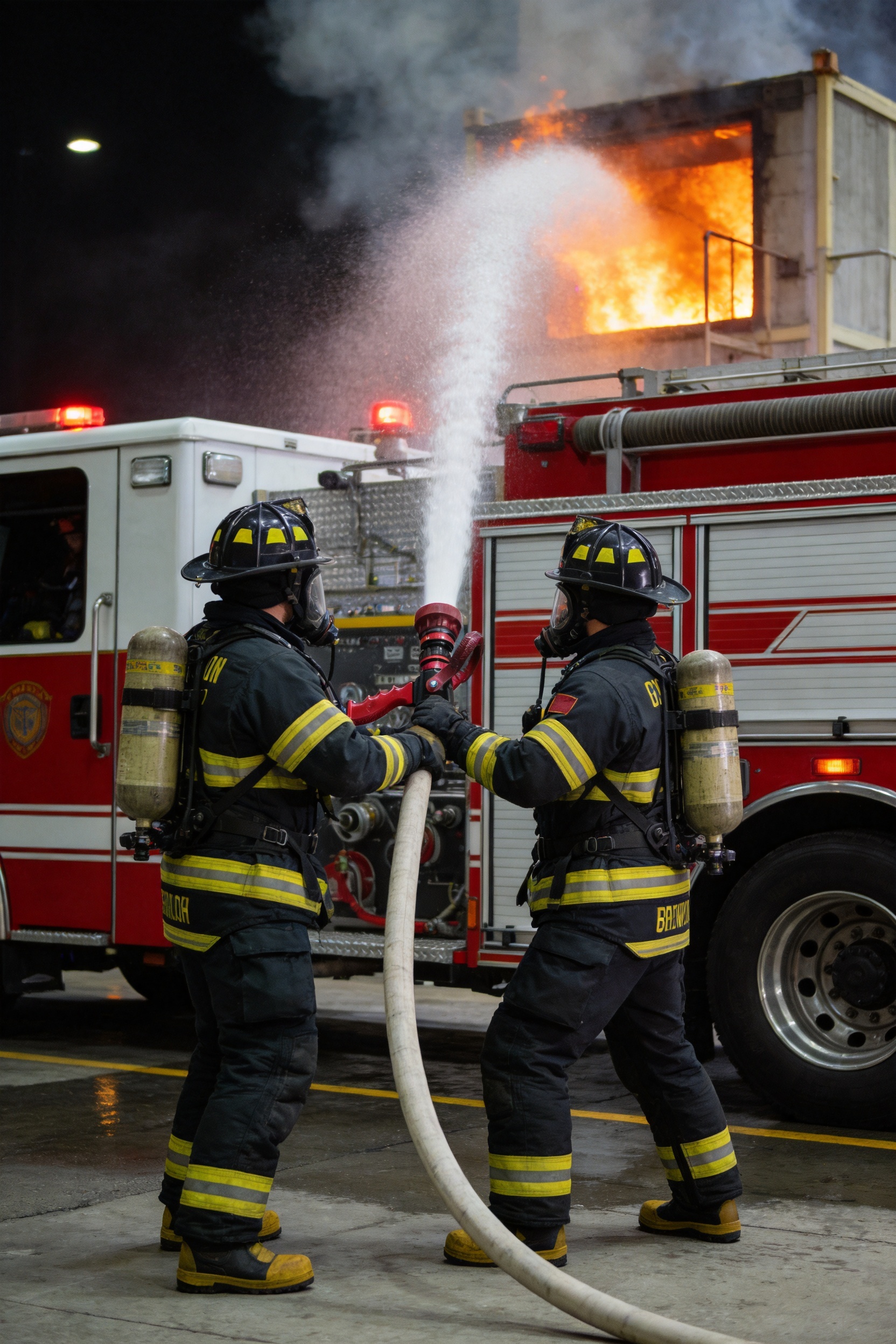
17. Frequently Asked Questions
Q1: What spray patterns are available?
The multifunctional nozzle supports straight stream, narrow fog, wide fog, and flush mode. The selected pattern is changed by rotating the nozzle ring or operating the lever, depending on the configuration.
Q2: Can the nozzle be operated with one hand?
Yes. The nozzle includes a trigger switch designed for one-hand operation. Operators should receive proper training and follow their organization’s safety procedures when handling a charged hose line.
Q3: What materials are available?
The product can be supplied in lightweight hard-anodized aluminum or corrosion-resistant brass. The best option depends on the customer’s priorities for weight, durability, handling, cost, and operating environment.
Q4: Is the nozzle suitable for fire trucks?
Yes. It is designed for use with fire trucks, pump trucks, emergency vehicles, and related firefighting water delivery systems. The final connection and performance requirements should be confirmed for the specific vehicle.
Q5: What is the reference rated pressure?
The available performance information lists a rated spray pressure of 0.6 MPa for the reference configuration. Customers should confirm the final pressure requirement for the exact model and application.
Q6: What is the reference flow rate?
The listed reference flow rate is 2.5 L/s with a flow rate tolerance of ±8 percent. Additional flow values are also listed for other configurations. Buyers should request a confirmed technical specification before ordering.
Q7: What is the reference range?
The reference configuration lists a range of at least 21 m. Other listed configurations show higher reference ranges, including at least 25 m, 27 m, 30 m, 32 m, 34 m, and 37 m. Actual performance depends on the selected configuration and operating conditions.
Q8: Why is the rotating water inlet useful?
The rotating inlet can help reduce hose twisting and make the nozzle easier to handle when the operator changes direction or adjusts the spray pattern. It may also make hose routing more convenient in a fire truck compartment.
Q9: Can the nozzle be customized for OEM projects?
Yes. OEM supply is available for fire truck body manufacturers and firefighting equipment distributors. Customization may include materials, connections, finish, labeling, packaging, and other agreed technical requirements.
Q10: Does flush mode replace maintenance?
No. Flush mode can help clear minor obstructions from the waterway, but it does not replace regular cleaning, inspection, seal replacement, pressure testing, or professional maintenance when required.
Q11: How should buyers choose between aluminum and brass?
Aluminum is generally selected when lower weight and easier handling are important. Brass may be chosen for a more substantial construction and long-term water-handling use. The decision should consider the application, vehicle payload, operating environment, maintenance plan, and customer preference.
Q12: What information should be supplied for an OEM quotation?
Useful information includes the intended vehicle type, hose and coupling specification, required inlet diameter, operating pressure, target flow, spray patterns, material preference, finish, quantity, packaging needs, delivery destination, and any drawings or applicable standards.
18. Conclusion
Multifunctional fire-fighting nozzles provide a practical combination of water pattern flexibility, flow control, one-hand operation, rotating inlet functionality, and durable metal construction. By integrating straight stream, narrow fog, wide fog, and flush mode into one product, they can help fire departments and vehicle manufacturers reduce equipment duplication while improving operational adaptability.
The use of hard-anodized aluminum or corrosion-resistant brass allows customers to select a construction suited to their priorities. The reference performance data provides a starting point for evaluating pressure, flow, tolerance, and range, while final selection should always be based on a confirmed technical configuration.
Manufacturing quality is central to nozzle performance. Accurate machining, suitable materials, controlled surface treatment, careful assembly, functional testing, and final inspection all contribute to dependable equipment. Tianchang Jinlv Fire Equipment Co., Ltd. combines experience in fire protection accessories with a complete production process, GB/T 19001-2016 quality certification, research and development capability, OEM support, and technical service for international customers.
For fire truck manufacturers, emergency vehicle integrators, distributors, and professional firefighting organizations, the product offers a flexible solution for modern water delivery requirements. With correct system matching, proper operator training, and regular maintenance, multifunctional fire-fighting nozzles can become a valuable part of a reliable emergency response equipment package.
References
1. Product performance information for multifunctional fire hose nozzles supplied by Tianchang Jinlv Fire Equipment Co., Ltd.
2. Manufacturer information regarding fire truck equipment, firefighting accessories, OEM/ODM services, and production capabilities.
3. GB/T 19001-2016, Quality Management Systems — Requirements.
4. General principles of fire hose nozzle selection, water discharge control, equipment inspection, and emergency response practice.
5. General engineering guidance on aluminum surface treatment, brass water-handling components, pressure-flow relationships, and hose system compatibility.
Product: Multifunctional Fire-Fighting Nozzles
News
-
-
Quick Answer The right fire fighting nozzle depends on three factors: the flow rate your pump can deliver, the pattern your crew needs on the fireground, and the thread standard your hose already us...
READ MORE -
Two pumpers of the same model can feel like two different trucks on the same call. On the first, a firefighter reaches into a compartment, releases one latch with a gloved hand, and pulls a tray far ...
READ MORE -
Two minutes into a working fire, a crew stands in front of a locked steel security door with a crowbar that is too short to pull with both hands. Nothing about the tool is broken. It was simply speci...
READ MORE -
A builder fitting out a pumper asks one question before ordering anything: fixed deck monitor or portable cannon? The answer should follow the attack, not the catalog. A fire hose cannon earns its p...
READ MORE -
Three rungs up the rear of a pumper, a firefighter in wet gloves misses the grab and catches the handrail instead. Whether that rail holds was decided months earlier, at the bench: by tube wall thick...
READ MORE
Hey! Interested in staying in the loop? Sign up for our updates.
WE WON'T SPAM YOU, PINKY PROMISE.

Tianchang Jinlv Fire Equipment Co., Ltd.
Copyright © Tianchang Jinlv Fire Equipment Co., Ltd. All rights reserved. Custom Fire Truck Equipment Supplier Fire Apparatus Parts Factory
