

 en
 English
 русский
 Español
 عربى

Specification meetings usually park the ladder rack near the bottom of the option sheet, a few lines above the license plate bracket. That is also why ladder racks become the complaint in year three:...
READ MORE
Fire Truck Water Hose Storage Rack: Modular Organization for Faster, Safer Emergency Response
2026.10.07
Content
- 1 1. The Role of Organized Hose Storage in Fire Apparatus
- 2 2. Product Overview
- 3 3. High-Quality PVC Construction
- 4 4. Advantages of Injection Molding
- 5 5. Modular Storage for Different Hose Diameters
- 6 6. Comparison with Conventional Storage Solutions
- 7 7. Benefits for Fire Truck Manufacturers
- 8 8. Benefits for Fire Departments and Fleet Operators
- 9 9. Manufacturing Strengths and Quality Management
- 10 10. Installation and Layout Considerations
- 11 11. Maintenance and Service Practices
- 12 12. Applications Beyond Standard Fire Engines
- 13 13. Why This Product Is a Competitive Choice
- 14 14. Purchasing Guide for Fleet and OEM Customers
- 15 15. Frequently Asked Questions
- 15.1 Q1: What is the main purpose of the Fire Truck Water Hose Storage Rack?
- 15.2 Q2: Which hose sizes are supported?
- 15.3 Q3: Is the product made from metal?
- 15.4 Q4: Can the partitions be combined?
- 15.5 Q5: Can different colors be supplied?
- 15.6 Q6: Can the product be customized?
- 15.7 Q7: Is this storage system suitable for existing fire trucks?
- 15.8 Q8: Does the partition replace hose inspection and maintenance?
- 15.9 Q9: What are the advantages of injection molding for this product?
- 15.10 Q10: Is the product suitable for OEM vehicle manufacturers?
- 15.11 Q11: How should customers determine the correct quantity?
- 15.12 Q12: What company support is available?
- 16 16. Conclusion
- 17 References
- 18 Product: Fire Truck Water Hose Storage Rack
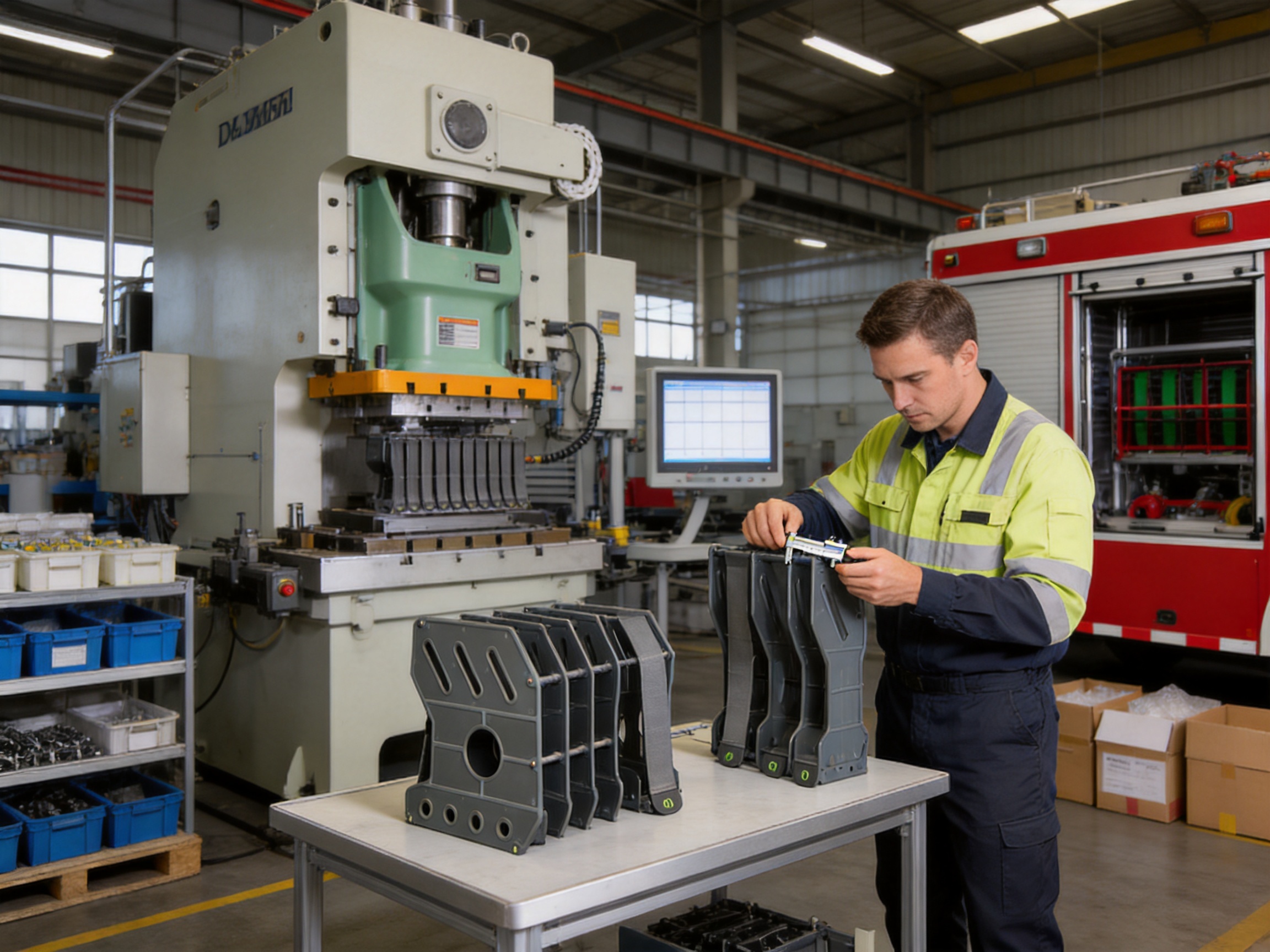
Firefighting operations depend on speed, order, and reliable access to equipment. A fire hose that is poorly arranged, difficult to remove, or exposed to unnecessary abrasion can delay deployment when every second matters. The Fire Truck Water Hose Storage Rack is designed to solve this practical challenge by providing a structured, durable, and adaptable storage system for fire hoses inside emergency vehicles.
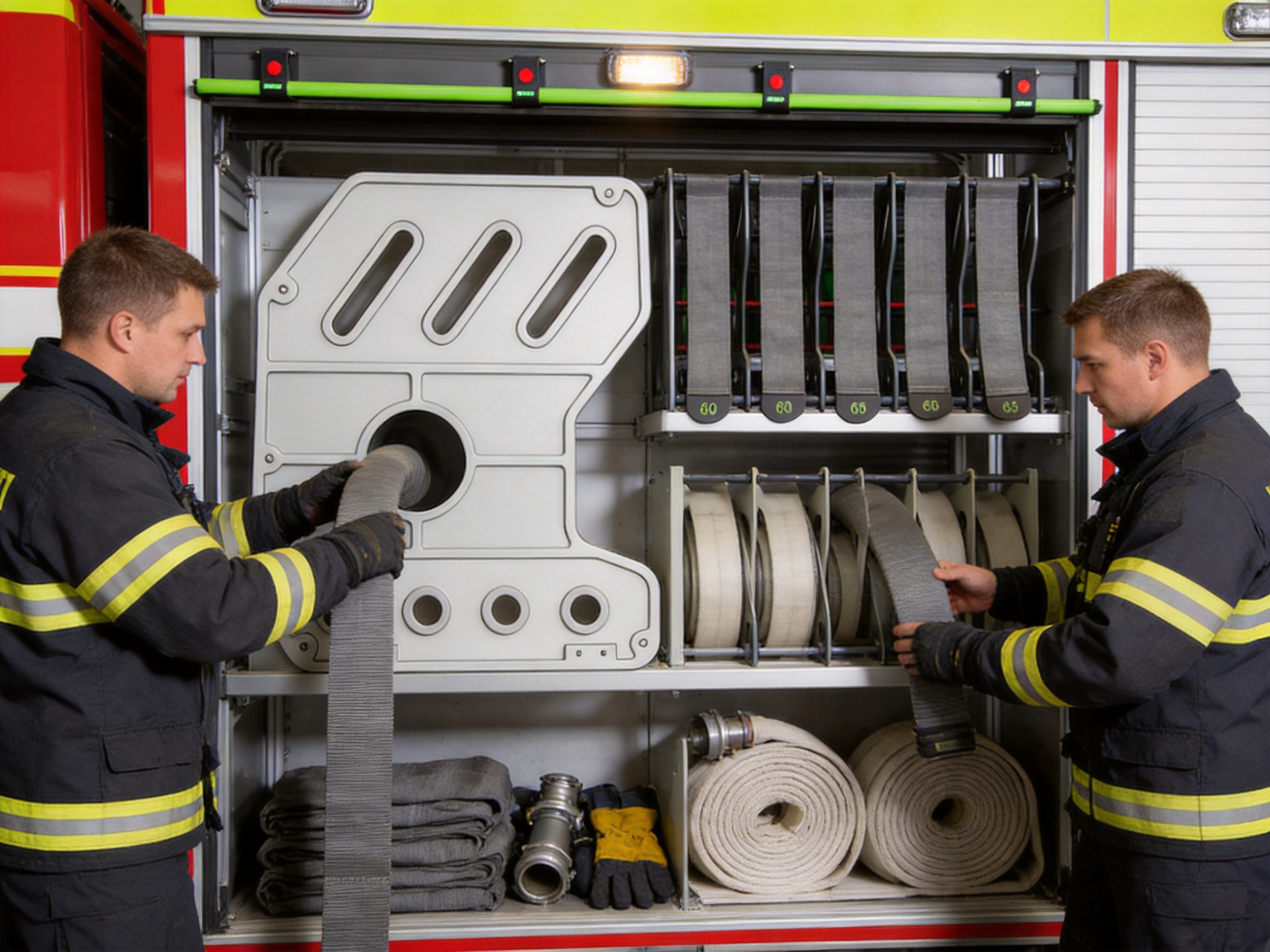
More than a simple divider, this product is a purpose-designed water hose partition for fire apparatus equipment compartments. It helps crews store hoses in a consistent position, separate different hose sizes, improve visual organization, and make loading and unloading more efficient. Manufactured from high-quality PVC plastic through injection molding, the partition combines structural stability, attractive appearance, dimensional consistency, and flexible installation possibilities.
The system is suitable for DN80 (3-inch), DN65 (2.5-inch), and DN40 (1.5-inch) fire hoses. Its modular design allows users to combine sections according to the size of the equipment compartment, the number of hoses carried, and the operational requirements of the vehicle. This makes it suitable for a wide range of fire trucks, rescue vehicles, municipal emergency fleets, industrial firefighting vehicles, and custom apparatus bodies.
For fire apparatus manufacturers, fleet managers, and emergency equipment distributors, the product offers a practical way to increase compartment efficiency without adding unnecessary mechanical complexity. For firefighters, its greatest value is straightforward: the hose is easier to identify, easier to reach, and easier to return to its proper position after use.
1. The Role of Organized Hose Storage in Fire Apparatus
Fire hoses are essential emergency tools, but they can be difficult to manage because they are flexible, heavy, and often stored in limited compartment space. A hose may be folded, rolled, or arranged in sections depending on the vehicle design and the crew’s operating procedure. Without suitable internal organization, hoses can shift during vehicle movement, become mixed with other equipment, or obstruct access to adjacent tools.
Uncontrolled movement inside a compartment can also create avoidable wear. Hoses may rub against sharp edges, metal brackets, fasteners, or other equipment. Repeated friction and compression can reduce service life, particularly when the compartment is frequently opened, closed, loaded, and unloaded.
A dedicated partition system creates defined storage zones. It gives each hose size a recognizable position and helps maintain a consistent loading method. This consistency is valuable during emergency response because crew members can locate the required hose quickly without searching through an unstructured compartment.
Organized storage also supports post-incident procedures. After a response, hoses must be inspected, cleaned, dried, folded or rolled, and returned to the vehicle. A compartment with clear divisions makes it easier to confirm whether all hoses have been replaced. It can also help crews identify missing or incorrectly positioned equipment before the next dispatch.
The Fire Truck Water Hose Storage Rack is designed around these operational needs. Its purpose is not only to hold hoses but also to contribute to a more efficient equipment management system within the fire truck.
2. Product Overview
The Fire Truck Water Hose Storage Rack uses molded PVC partitions to form stable internal separation for fire hose storage. Each partition section can be used independently or combined with other sections to create a larger arrangement. The modular structure provides flexibility for different compartment widths and hose quantities.
The product supports three common hose diameters:
| Hose designation | Imperial equivalent | Typical storage purpose |
|---|---|---|
| DN80 | 3 inches | Large-diameter water delivery and high-flow applications |
| DN65 | 2.5 inches | General fire attack, supply, and operational hose storage |
| DN40 | 1.5 inches | Smaller attack, auxiliary, or specialized hose storage |
Because the partitions are available for different hose sizes, users can establish a storage arrangement based on the actual hose inventory carried by a particular vehicle. A truck configured for high-flow operations may require more DN80 storage positions, while a municipal response vehicle may use a mixed arrangement of DN65 and DN40 hoses.
The system is particularly useful where a clean, standardized compartment layout is required. It can be integrated into a new vehicle body during manufacturing or considered for equipment compartment upgrades and refurbishment projects.
The product’s appearance is also suitable for professional fire apparatus. Injection-molded surfaces provide a clean and consistent finish, while the availability of different colors can support vehicle customization, visual coding, or coordination with the interior design of the apparatus body.
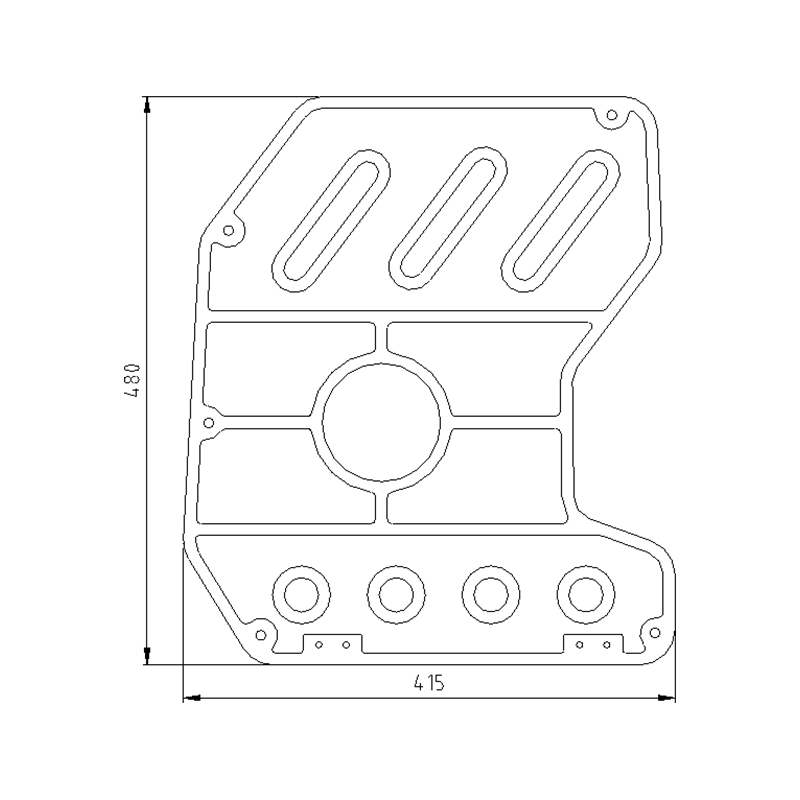
Fire Truck Water Hose Storage Rack
3. High-Quality PVC Construction
The partition is manufactured from high-quality PVC plastic. PVC is widely used in industrial equipment components because it offers a useful balance of strength, weight, processability, and resistance to common environmental conditions. In a fire apparatus compartment, these characteristics are valuable because the storage system must remain functional during vibration, repeated handling, temperature changes, and exposure to moisture.
Compared with untreated wooden dividers or improvised sheet materials, molded PVC provides more consistent geometry and a cleaner finished surface. It does not require the same type of surface treatment associated with many metal components, and its relatively low weight can help reduce unnecessary load within the vehicle.
The material also allows the partition to be produced in different colors. This gives vehicle manufacturers and fleet operators more design options. Color can be selected for visual coordination, equipment classification, or easier identification within a compartment.
A suitable plastic component should not be judged only by appearance. Its performance depends on material selection, wall thickness, mold accuracy, connection design, and quality control. The manufacturing process used for this product is therefore important because injection molding can produce repeatable parts when the mold, material, machine settings, and inspection procedures are properly managed.
3.1 Strength and Durability
The partition is designed to withstand routine handling and the physical demands associated with fire truck equipment storage. A well-designed divider helps keep hoses in position and reduces uncontrolled contact between stored items. Its molded form provides a defined structure rather than a loose sheet that can bend or shift easily.
Durability is also influenced by the way the product is installed. The vehicle manufacturer or installer should select suitable fasteners, support points, and compartment surfaces. When properly fitted, the partition can provide dependable service throughout repeated loading and unloading cycles.
Its practical durability is especially important for fleets that operate frequently. Emergency vehicles may experience daily road vibration, rapid equipment access, wet hose handling, and repeated compartment use. A storage component that is difficult to maintain or easily damaged can create additional costs and downtime. The PVC partition is intended to provide a long-term organizational solution with limited maintenance requirements.
3.2 Lightweight Design
Fire trucks carry pumps, tanks, ladders, nozzles, breathing apparatus, tools, and many other items. Every component contributes to the total vehicle weight. A hose partition made from an efficient molded plastic can provide organization without the mass of a heavy steel framework.
Reducing unnecessary weight may assist vehicle builders in managing payload capacity, compartment loading, and overall equipment balance. The exact weight benefit depends on the final system design and the quantity of partitions installed, but lightweight construction is a meaningful advantage when multiple storage sections are required.
3.3 Smooth and Professional Appearance
Injection molding produces a repeatable surface and consistent shape. This supports a uniform appearance across multiple compartments and multiple vehicles. A clean interior finish can make the apparatus easier to inspect and maintain, while also reinforcing a professional standard for the entire vehicle.
The smooth appearance may also reduce the visual complexity of a compartment. Clearly divided hose positions make it easier for crew members to recognize where each item belongs, supporting faster checks before and after an operation.
4. Advantages of Injection Molding
Injection molding is a highly suitable process for producing repeated plastic components for fire apparatus. During the process, prepared PVC material is heated and injected into a mold cavity under controlled conditions. Once the material cools and solidifies, the molded component is removed, inspected, and prepared for assembly or shipment.
One of the main benefits of this process is repeatability. When production parameters are properly controlled, each partition can maintain consistent dimensions. Consistency is important for modular products because sections must fit together or align correctly within the intended equipment compartment.
Injection molding also supports the creation of formed edges, reinforcing features, connection points, and other details that would be more difficult or costly to produce through basic cutting and bending operations. The mold can be designed to provide a functional shape with a clean appearance.
For OEM and ODM projects, injection molding offers a foundation for controlled customization. Customers may have different compartment widths, hose combinations, mounting preferences, or color requirements. Depending on the project, design adjustments can be evaluated at the product development stage to create a solution that better matches the vehicle body and operating environment.
4.1 Consistent Dimensions
Dimensional consistency helps reduce installation problems. If each divider varies significantly in width, height, or connection position, installers may need extra adjustment during vehicle assembly. A stable molded design supports more predictable production planning and helps manufacturers maintain consistent layouts across vehicle batches.
This is especially helpful for fire truck manufacturers that produce several units with the same compartment specification. A standardized storage component can simplify assembly instructions, inventory control, and replacement planning.
4.2 Efficient Repeat Production
Once the mold and production parameters have been established, injection molding can support efficient production of repeated parts. This may benefit distributors and vehicle builders that need consistent quantities for multiple apparatus projects.
Efficient production does not mean that quality inspection can be omitted. Proper manufacturing requires monitoring of raw materials, molding conditions, part appearance, dimensional accuracy, and finished-product integrity. Production efficiency is valuable only when it is combined with reliable quality control.
4.3 Design Flexibility
Plastic molding allows product designers to consider details such as rounded edges, reinforcing ribs, interlocking features, and mounting interfaces. These details can improve handling and reduce the possibility of damage to stored hoses or nearby equipment.
Rounded or carefully finished edges are particularly useful in compartments where hoses are repeatedly moved. A storage component should not introduce unnecessary abrasion points. The final design must be evaluated as part of the complete vehicle compartment, including adjacent brackets, hinges, latches, and tools.
5. Modular Storage for Different Hose Diameters
One of the product’s most practical advantages is its ability to support multiple hose diameters. Fire departments and rescue organizations do not all use the same equipment configuration. Vehicle size, pump capacity, operating environment, local standards, and mission requirements can influence the types of hose carried.
A fixed, one-size storage system may be unsuitable when a fleet uses a mixture of hose diameters. The modular partition approach allows the storage layout to be adapted instead of forcing all hoses into the same space.
For DN80 hoses, the storage arrangement must accommodate larger external dimensions and the greater volume associated with high-capacity water delivery. DN65 hoses are commonly used in general firefighting arrangements and may form the main part of a standard hose inventory. DN40 hoses require smaller storage positions and may be arranged in a more compact section of the compartment.
The partitions can be combined according to the available space. A vehicle builder may create separate rows for each hose type, divide one large compartment into multiple zones, or use a mixed layout based on the apparatus’s operational plan.
This flexibility provides several competitive advantages compared with rigid storage structures. It can simplify vehicle customization, support different fleet specifications, and reduce the need to develop an entirely new storage frame for every hose combination.
5.1 Faster Equipment Identification
When each hose diameter has a defined location, the crew can identify the required equipment more quickly. A clear arrangement is particularly beneficial during night operations, poor weather, smoke exposure, or high-pressure response conditions, when searching through a cluttered compartment is undesirable.
Visual organization also helps new or rotating crew members understand the vehicle layout. Although every department should provide equipment training, a logical storage system reinforces the training by making the intended location of each hose apparent.
5.2 Better Space Utilization
Compartment space on a fire truck is valuable. It must accommodate many tools while preserving access and maintaining vehicle balance. Modular dividers help operators use the available volume more effectively by keeping hoses aligned and preventing them from spreading into neighboring storage areas.
A properly planned layout can reduce unused gaps while still leaving enough clearance for safe removal. The final arrangement should always be tested with the actual hoses and associated equipment because hose stiffness, coupling size, folding method, and compartment geometry affect the required space.
5.3 Simplified Reconfiguration
Emergency fleets can change over time. A department may add different hoses, modify its response strategy, or acquire a new vehicle body. Modular storage components are easier to reconsider than a fully welded and permanently fixed framework. Sections can potentially be rearranged, added, or replaced according to the new configuration, subject to proper installation requirements.
6. Comparison with Conventional Storage Solutions
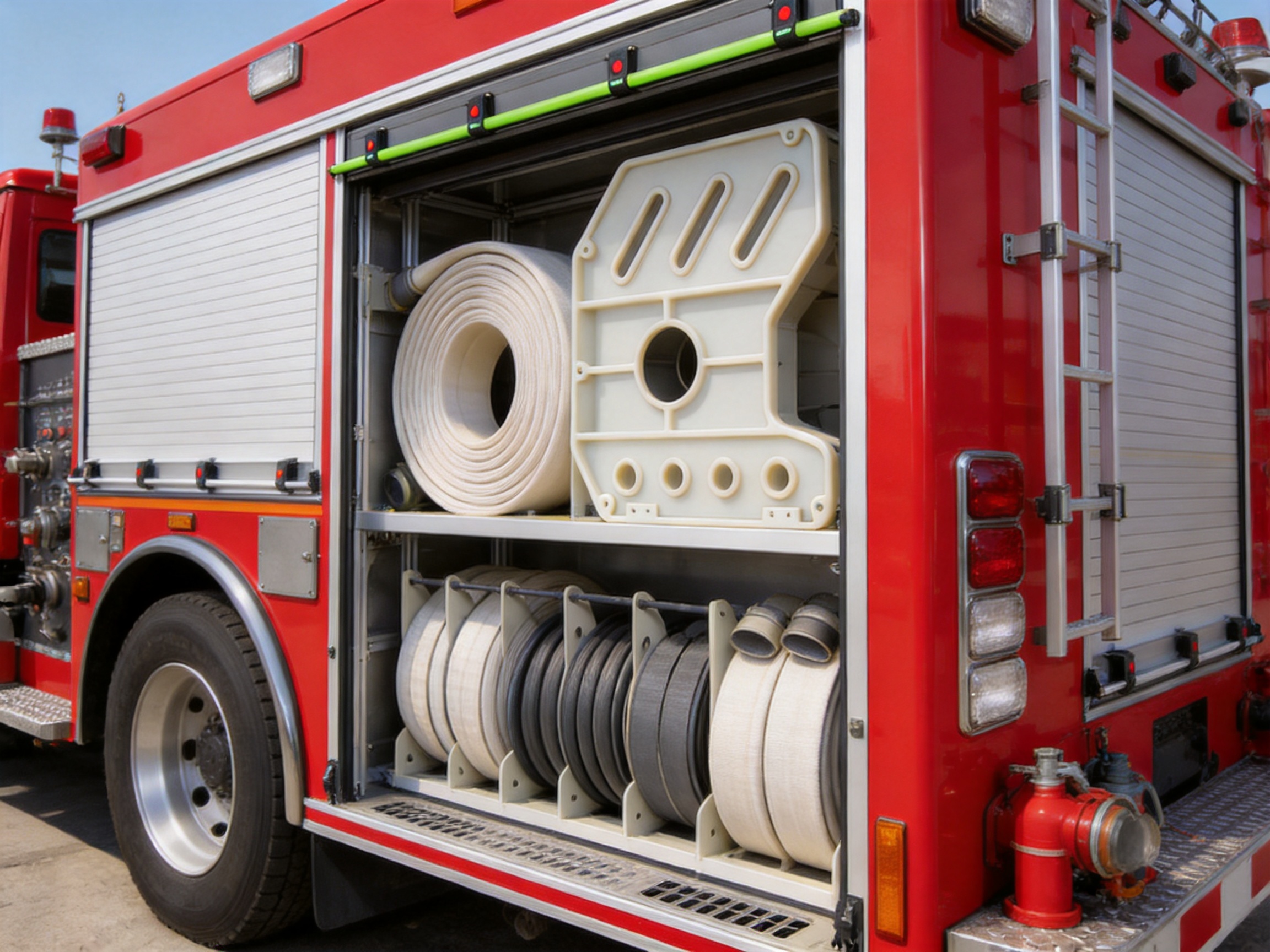
Fire hose storage can be created using several approaches, including open shelves, metal cages, loose dividers, wooden panels, fabric restraints, and custom welded frames. Each method has possible applications, but the Fire Truck Water Hose Storage Rack is designed to address common weaknesses in less specialized solutions.
| Storage approach | Typical limitation | Potential advantage of the molded partition system |
|---|---|---|
| Loose or temporary dividers | May shift during vehicle movement and provide inconsistent separation | Provides a more structured and repeatable storage arrangement |
| Untreated wooden panels | May absorb moisture, require more maintenance, and vary in finish | Uses molded PVC for a clean, consistent, and moisture-tolerant component |
| Heavy metal frames | Can add weight and may require more fabrication work | Offers a lightweight molded alternative for internal organization |
| Single-size storage racks | May not adapt well to mixed hose diameters | Supports DN80, DN65, and DN40 hose arrangements |
| Improvised compartment layouts | Can make inspection and equipment retrieval more difficult | Creates recognizable positions and a standardized appearance |
The comparison should be considered in relation to the complete vehicle design. A metal frame may be appropriate in some heavy-duty applications, while a custom shelf may suit a unique compartment. However, where the objective is lightweight, modular, clean, and efficient hose organization, a molded PVC partition offers a strong balance of advantages.
The product is also more specialized than a general-purpose storage divider. Its purpose is connected directly to fire hose dimensions and fire apparatus compartment use. That specialization helps manufacturers and users select a component that matches the practical requirements of emergency equipment storage.
7. Benefits for Fire Truck Manufacturers
Fire truck manufacturers must manage many design considerations at the same time. They need to integrate pumps, tanks, valves, electrical systems, ladders, tools, breathing equipment, hose lines, and access doors into a vehicle that remains safe and serviceable. Internal storage components should support the overall design rather than create additional assembly difficulties.
The Fire Truck Water Hose Storage Rack can assist manufacturers in several ways.
7.1 Standardized Production
A standardized partition system can be included in vehicle design drawings, assembly procedures, and parts lists. This may help reduce variation between vehicles built to the same specification. Standardization can also make training easier because operators encounter a more consistent compartment layout across a fleet.
7.2 OEM and ODM Support
The manufacturer provides OEM and ODM services. OEM production is useful when a customer requires a component supplied under a specific project or vehicle specification. ODM support is valuable when the customer needs assistance developing or adapting a product concept for a particular application.
Customization may involve dimensions, colors, layout combinations, mounting details, packaging, or other project requirements. Any modification should be reviewed through a technical process that considers the compartment structure, hose dimensions, installation method, and expected operating conditions.
7.3 Improved Assembly Planning
A component manufactured to repeatable dimensions can help vehicle builders plan installation more efficiently. Instead of fabricating every divider manually inside the apparatus body, the builder can use a prepared molded component and focus on the correct mounting arrangement.
This may reduce fabrication variability and support more predictable project schedules. It can also make replacement easier when a partition is damaged or a compartment is upgraded.
7.4 Professional Vehicle Presentation
Customers often evaluate fire apparatus based not only on technical performance but also on the quality of the interior and exterior finish. An orderly equipment compartment demonstrates attention to detail. Clean hose separation can contribute to a more professional vehicle presentation during acceptance inspection, training, and daily operations.
8. Benefits for Fire Departments and Fleet Operators
For end users, the primary value of the product is operational practicality. Fire departments need equipment that can be used quickly and returned to service efficiently. A well-organized hose compartment supports both objectives.
8.1 Faster Access During Response
Defined storage positions help crew members recognize and retrieve the correct hose without unnecessary handling of other equipment. Faster access can improve the efficiency of hose deployment, especially when multiple hose diameters are carried in the same apparatus.
8.2 Easier Inspection
A structured compartment makes it easier to check whether hoses are present, correctly positioned, and ready for use. Supervisors can conduct visual inspections more efficiently, while individual crew members can follow a consistent equipment checklist.
8.3 Reduced Compartment Clutter
When hoses are allowed to spread or shift, they may interfere with nozzles, tools, valves, or protective equipment. Partitions help limit this movement and maintain separation between hose storage and neighboring items.
8.4 Improved Return-to-Service Procedures
After an incident, hoses may be wet, dirty, or temporarily arranged for cleaning and drying. Once they are ready to return to the apparatus, a defined storage layout helps crews restore the standard configuration. This reduces the risk that a hose is placed in an unsuitable location or left outside the vehicle.
8.5 Color and Identification Options
Different colors can be used to coordinate with the apparatus or support a visual organization plan. For example, an operator may choose one color for a primary hose section and another for a specialized compartment, provided the system remains clear and consistent for all crew members.
9. Manufacturing Strengths and Quality Management
The product is manufactured by Tianchang Jinlv Fire Equipment Co., Ltd., a company established in 2010 and focused on fire protection accessories and fire apparatus components. Its product scope includes fire truck equipment, roller shutters, ladders, storage systems, mounting components, nozzles, tools, and related rescue equipment.
The company operates with advanced production facilities and a complete manufacturing process. For a product such as a molded hose partition, a complete process is important because quality is influenced at every stage, from material procurement to final delivery.
The company states that it has passed GB/T 19001-2016 quality certification and applies controlled procedures to production. Quality management in this context may include supplier evaluation, incoming material checks, production monitoring, dimensional inspection, appearance inspection, packaging control, and traceable delivery procedures.
A reliable manufacturing partner should be able to provide more than a finished component. It should understand the application, communicate clearly about specifications, identify potential installation issues, and support the customer when a project requires adaptation.
9.1 Raw Material Control
Plastic performance begins with material selection. The PVC used for the partition should be managed according to the intended application and required physical characteristics. Consistent raw material helps support stable color, surface finish, molding behavior, and product dimensions.
Material control is particularly important when different colors or production batches are required. Proper handling and storage procedures can help reduce contamination, moisture-related issues, and variation between batches.
9.2 Process Control
Injection molding requires attention to temperature, pressure, filling behavior, cooling time, mold condition, and cycle consistency. If these factors are not controlled, parts may show warping, incomplete filling, surface defects, dimensional changes, or other quality problems.
A controlled production process helps ensure that the partition maintains its intended form and can be assembled correctly. Process records and routine inspection provide useful evidence that production is being managed systematically.
9.3 Finished-Product Inspection
Finished parts should be checked for visible defects, sharp edges, deformation, incomplete molding, color inconsistency, and critical dimensions. Inspection standards should be connected to the product drawing and customer requirements.
For OEM or ODM orders, additional checks may be required. These can include trial fitting, sample approval, packaging verification, or inspection against a customer-supplied compartment design. Clear approval procedures help reduce misunderstandings before mass production.
9.4 Continuous Research and Development
The company maintains a professional research and development team and follows market trends in fire protection equipment. Continued product development is valuable because fire apparatus designs evolve. Vehicle bodies become more integrated, storage demands change, and customers increasingly request lighter, more modular, and more visually organized equipment solutions.
Research and development can support improvements in materials, structural details, installation methods, and compatibility with different vehicle configurations. It also allows the manufacturer to respond to customer feedback rather than treating the product as a fixed, one-time design.
10. Installation and Layout Considerations
The Fire Truck Water Hose Storage Rack should be installed as part of a planned compartment system. Before installation, the vehicle builder or operator should measure the available compartment space and confirm the quantity and dimensions of the hoses to be stored.
Important planning factors include compartment width, height, depth, access-door movement, adjacent equipment, hose coupling dimensions, drainage, ventilation, and the preferred hose loading method. It is also important to confirm that the partition does not obstruct emergency equipment that must be accessed independently.
10.1 Confirming Hose Sizes
The system supports DN80, DN65, and DN40 hose categories. The actual hose construction and coupling arrangement may influence the required storage clearance. Users should verify the outside diameter, rolled or folded dimensions, and removal direction of the specific hoses used by the department.
10.2 Planning Retrieval Direction
A hose should be stored in a way that allows it to be removed without excessive force or interference. The partition layout should support the crew’s normal operating method. If hoses are intended to be removed from the front of the compartment, the dividers should not create an unnecessary obstruction at the access point.
10.3 Maintaining Safe Clearance
Clearance should be provided around latches, hinges, doors, lighting, electrical components, and other equipment. The storage system must not interfere with the secure closing of the compartment or create a condition where equipment can fall during vehicle movement.
10.4 Selecting Mounting Hardware
Mounting hardware should be selected according to the compartment material and expected loads. The installer should consider vibration, repeated impact, moisture, and the weight of wet hoses. The partition itself is an organizational component, but the complete installed assembly must be secure and suitable for the vehicle environment.
10.5 Trial Loading and Inspection
After installation, the compartment should be loaded with the actual hoses and nearby tools. Doors should be opened and closed repeatedly, and the hoses should be removed and replaced using the normal crew procedure. This trial can identify interference, insufficient clearance, or an arrangement that is technically possible but inconvenient in practice.
11. Maintenance and Service Practices
The molded PVC partition is designed for practical use with routine maintenance. Operators should periodically inspect the component for cracks, deformation, loose mounting hardware, sharp damage, or interference caused by neighboring equipment.
Hose compartments should be kept reasonably clean. Dirt, sand, oil, and residue can accumulate around storage components and contribute to abrasion or make equipment inspection more difficult. Cleaning methods should be compatible with the PVC material and should avoid chemicals that may damage plastic surfaces.
Wet hoses should be managed according to the fire department’s established cleaning and drying procedures. The partition is not a substitute for proper hose care. Hoses should be dried, inspected, and stored in accordance with applicable operational guidance before being returned to the vehicle.
If a partition is damaged, the operator should assess whether it remains safe and functional. A cracked or severely deformed part should be replaced rather than left in service if it can affect hose access, compartment security, or adjacent equipment.
12. Applications Beyond Standard Fire Engines
Although the product is primarily intended for fire truck equipment compartments, its modular design may also be useful in other emergency and industrial applications where water hoses must be stored in an organized manner.
Potential applications include rescue vehicles, airport firefighting vehicles, industrial emergency response trucks, municipal service vehicles, training vehicles, and specialized equipment trailers. Any alternative application should be evaluated according to the relevant hose dimensions, storage loads, environmental conditions, and installation requirements.
Industrial facilities may benefit from organized hose storage where emergency response equipment is distributed across large sites. A clear storage system can assist inspection teams in confirming that hoses are present and ready for deployment. Airport and infrastructure operators may also require compact storage arrangements that use vehicle space efficiently.
The product’s adaptability is particularly useful for manufacturers serving multiple markets. Instead of relying on a completely different storage concept for each vehicle, they can use a common partition principle while adjusting the quantity, color, and arrangement of sections.
13. Why This Product Is a Competitive Choice
The Fire Truck Water Hose Storage Rack competes through a combination of application-specific design, material efficiency, modularity, and manufacturing support.
First, it is designed specifically for fire hose organization rather than being adapted from a general household or industrial divider. Its hose-size options correspond to DN80, DN65, and DN40 requirements, making it more relevant to fire apparatus builders and emergency equipment users.
Second, the PVC injection-molded construction provides a balance of strength, low weight, surface quality, and repeatable production. This is useful where a vehicle requires many storage positions but cannot afford unnecessary structural mass.
Third, the modular arrangement allows users to combine sections according to their own equipment layout. This is more flexible than a rigid rack designed around one fixed hose inventory.
Fourth, the product supports professional OEM and ODM cooperation. Customers can discuss project-specific requirements with a manufacturer that understands fire apparatus components and related storage systems.
Fifth, the company’s broader product experience creates opportunities for coordinated sourcing. A customer purchasing hose partitions may also require roller shutters, ladders, handrails, nozzles, tools, SCBA-related components, or other fire truck equipment. A supplier with a wider product range may help simplify communication and project management.
These advantages do not eliminate the importance of correct installation or appropriate vehicle design. Instead, they provide a strong component foundation that can be integrated into a complete and reliable fire apparatus system.
14. Purchasing Guide for Fleet and OEM Customers
Before ordering, customers should prepare clear technical information. The supplier will be better able to recommend a suitable configuration when the following details are available:
1. The number and type of hoses to be stored.
2. The outside dimensions of the hoses, including couplings where applicable.
3. The internal dimensions of the equipment compartment.
4. The preferred loading and retrieval direction.
5. The required color or visual identification plan.
6. The intended mounting method and compartment material.
7. The number of vehicles or replacement parts required.
8. Any OEM drawings, samples, or vehicle body specifications.
9. Packaging, labeling, and delivery requirements.
10. Any inspection, documentation, or approval requirements for the project.
For a new fire truck project, it is advisable to evaluate the partition during the design stage rather than after the compartment has been completed. Early coordination can help confirm that the storage layout works with the door opening, neighboring equipment, drainage, and vehicle operating procedure.
For an existing vehicle, customers should provide photographs, measurements, and details of the current compartment. A trial sample may be useful when the available space is limited or when the vehicle uses an unusual hose arrangement.
15. Frequently Asked Questions
Q1: What is the main purpose of the Fire Truck Water Hose Storage Rack?
The main purpose is to organize and separate fire hoses inside a fire apparatus equipment compartment. It helps create defined storage positions, improves visual order, supports faster access, and assists crews in returning hoses to the correct location after use.
Q2: Which hose sizes are supported?
The product is suitable for DN80, DN65, and DN40 fire hoses, corresponding approximately to 3-inch, 2.5-inch, and 1.5-inch hose categories. Customers should still confirm the actual outside dimensions and coupling arrangement of their hoses before finalizing a layout.
Q3: Is the product made from metal?
No. The partition is made from high-quality PVC plastic through injection molding. This construction provides a lightweight alternative to many heavy metal storage frames while maintaining a structured form for hose organization.
Q4: Can the partitions be combined?
Yes. The product is designed for flexible combination. Users can arrange sections according to the compartment size, hose quantity, and mixture of DN80, DN65, and DN40 hoses.
Q5: Can different colors be supplied?
The product is available in a variety of colors. Color requirements should be confirmed during the quotation and technical review process, especially for OEM projects or fleet-wide visual coding.
Q6: Can the product be customized?
The manufacturer provides OEM and ODM support. Depending on the project, customization may be considered for dimensions, layout, color, mounting details, packaging, or other technical requirements. Custom designs should be evaluated against the vehicle compartment and actual hose specifications.
Q7: Is this storage system suitable for existing fire trucks?
It may be suitable for new and existing vehicles. Before installation, the customer should measure the compartment, check neighboring equipment, verify access-door movement, and confirm the mounting method. A technical review is recommended for retrofit projects.
Q8: Does the partition replace hose inspection and maintenance?
No. It is a storage and organization component. Fire hoses must still be cleaned, dried, inspected, tested, and maintained according to the fire department’s procedures and applicable technical requirements.
Q9: What are the advantages of injection molding for this product?
Injection molding supports repeatable dimensions, consistent appearance, efficient production, and the integration of formed details such as rounded edges or reinforcing features. These benefits are useful for modular components installed in multiple fire apparatus compartments.
Q10: Is the product suitable for OEM vehicle manufacturers?
Yes. Its modular structure and the manufacturer’s OEM/ODM capabilities make it suitable for fire truck builders, rescue vehicle manufacturers, equipment distributors, and fleet projects that require repeatable hose storage components.
Q11: How should customers determine the correct quantity?
Quantity depends on the number of hoses, the hose diameter mix, the compartment dimensions, and the desired arrangement. Customers should prepare a compartment drawing or measurements and identify the number of DN80, DN65, and DN40 hoses to be stored.
Q12: What company support is available?
Tianchang Jinlv Fire Equipment Co., Ltd. provides product communication, OEM/ODM cooperation, technical coordination, and customer service for fire apparatus equipment projects. Customers can contact the company to discuss specifications, samples, production, and delivery requirements.
16. Conclusion
The Fire Truck Water Hose Storage Rack is a practical component for improving the organization, accessibility, and appearance of fire apparatus equipment compartments. Its high-quality PVC construction, injection-molded manufacturing process, modular combination method, and compatibility with DN80, DN65, and DN40 hoses make it adaptable to a wide range of vehicle configurations.
Compared with improvised dividers, heavy structures, or fixed single-size racks, the product offers a balanced solution for customers seeking lightweight organization, consistent production, flexible layout planning, and easier equipment management. It can help fire crews locate hoses more quickly, support inspection routines, reduce compartment clutter, and maintain a standardized vehicle layout.
Its value is strengthened by the manufacturing capabilities of Tianchang Jinlv Fire Equipment Co., Ltd. The company’s experience in fire protection accessories, advanced production facilities, quality management procedures, research and development capabilities, and OEM/ODM services provide a solid foundation for both standard orders and customized vehicle projects.
For fire truck manufacturers, distributors, and fleet operators, a well-designed hose storage system is a small component with an important operational role. By giving every hose a clear and secure position, the Fire Truck Water Hose Storage Rack contributes to faster response preparation, better equipment control, and a more professional emergency vehicle.
References
1. Product specification information for the Fire Truck Water Hose Storage Rack, including DN80, DN65, and DN40 hose compatibility.
2. Manufacturing information supplied by Tianchang Jinlv Fire Equipment Co., Ltd., including PVC injection molding, OEM/ODM support, and quality management practices.
3. General fire apparatus equipment compartment planning principles concerning accessibility, organization, inspection, and safe equipment retention.
4. General industrial guidance on plastic injection molding, dimensional repeatability, material control, and finished-product inspection.
5. General fire hose care and maintenance practices concerning cleaning, drying, inspection, storage, and readiness for service.
Product: Fire Truck Water Hose Storage Rack
News
-
-
Fire truck ladder racks are roof-mounted storage and deployment systems that hold ground ladders securely in transit and let firefighters lower them to the side or rear of the apparatus in seconds. ...
READ MORE -
Two minutes into a working fire, a crew stands in front of a locked steel security door with a crowbar that is too short to pull with both hands. Nothing about the tool is broken. It was simply speci...
READ MORE -
A builder fitting out a pumper asks one question before ordering anything: fixed deck monitor or portable cannon? The answer should follow the attack, not the catalog. A fire hose cannon earns its p...
READ MORE -
Three rungs up the rear of a pumper, a firefighter in wet gloves misses the grab and catches the handrail instead. Whether that rail holds was decided months earlier, at the bench: by tube wall thick...
READ MORE -
Quick Answer The right fire fighting nozzle depends on three factors: the flow rate your pump can deliver, the pattern your crew needs on the fireground, and the thread standard your hose already us...
READ MORE
Hey! Interested in staying in the loop? Sign up for our updates.
WE WON'T SPAM YOU, PINKY PROMISE.

Tianchang Jinlv Fire Equipment Co., Ltd.
Copyright © Tianchang Jinlv Fire Equipment Co., Ltd. All rights reserved. Custom Fire Truck Equipment Supplier Fire Apparatus Parts Factory
