

 en
 English
 русский
 Español
 عربى

Three rungs up the rear of a pumper, a firefighter in wet gloves misses the grab and catches the handrail instead. Whether that rail holds was decided months earlier, at the bench: by tube wall thick...
READ MORE
Fire Truck Pull-Out Horizontal Tray: A Reliable Heavy-Duty Storage Solution for Emergency Vehicles
2026.11.04
Content
- 1 1. The Role of Equipment Storage in Fire Apparatus Design
- 2 2. Product Construction and Material Selection
- 3 3. Guide Rail Performance and Load Support
- 4 4. Integrated Limit Button and Handle
- 5 5. Equipment Applications
- 6 6. Customization for Fire Truck Compartments
- 7 7. Advantages Compared with Conventional Fixed Shelves
- 8 8. Manufacturing Capabilities and Quality Control
- 9 9. Research, Development, and OEM/ODM Strengths
- 10 10. Installation Considerations
- 11 11. Maintenance and Service Recommendations
- 12 12. Selection Guide for Buyers and Vehicle Manufacturers
- 13 13. Why This Product Is a Strong Competitive Choice
- 14 14. Frequently Asked Questions
- 14.1 Q1: What is the primary purpose of the fire truck pull-out horizontal tray?
- 14.2 Q2: What material is used for the main frame?
- 14.3 Q3: What type of fasteners are used?
- 14.4 Q4: How much weight can the guide rail system support?
- 14.5 Q5: Can the tray dimensions be customized?
- 14.6 Q6: Can the tray be used for equipment other than the examples listed?
- 14.7 Q7: Is the tray difficult to operate while wearing gloves?
- 14.8 Q8: Does the tray replace equipment restraints?
- 14.9 Q9: What information should be provided for a customized order?
- 14.10 Q10: What manufacturing support is available?
- 14.11 Q11: How should the tray be maintained?
- 14.12 Q12: Is the product suitable for integration with other fire truck equipment?
- 15 15. Conclusion
- 16 References
- 17 Product: Fire Truck Pull-Out Horizontal Tray
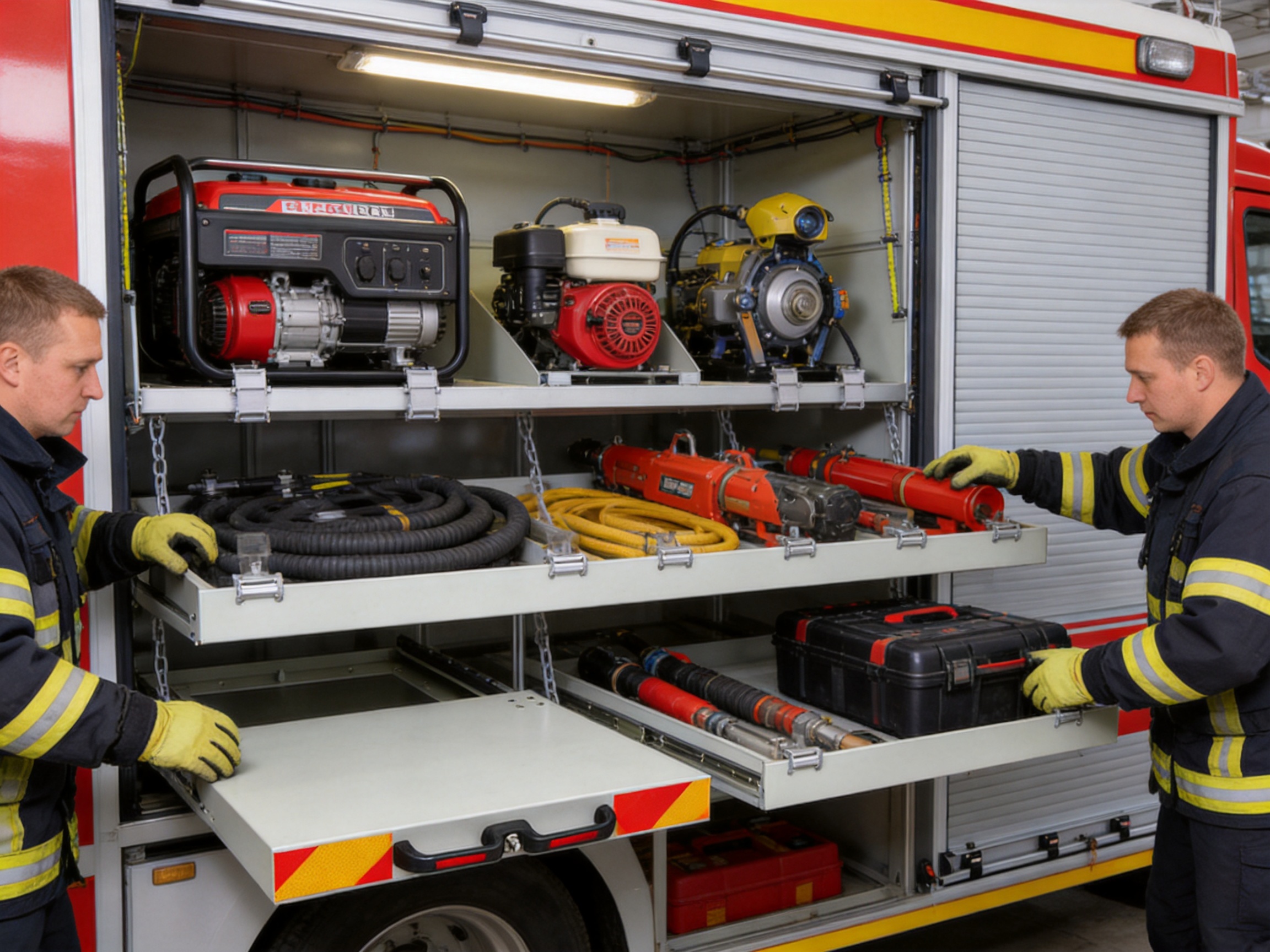
Fire and rescue vehicles must carry a large quantity of equipment in a limited amount of space. Portable generators, manual water pumps, hydraulic spreaders, breakers, robots, breathing apparatus, rescue tools, hoses, and accessories all need to be stored securely while remaining immediately accessible. In an emergency, equipment storage is not simply a matter of convenience. It directly affects response speed, operator safety, vehicle organization, and the efficiency of the entire rescue team.
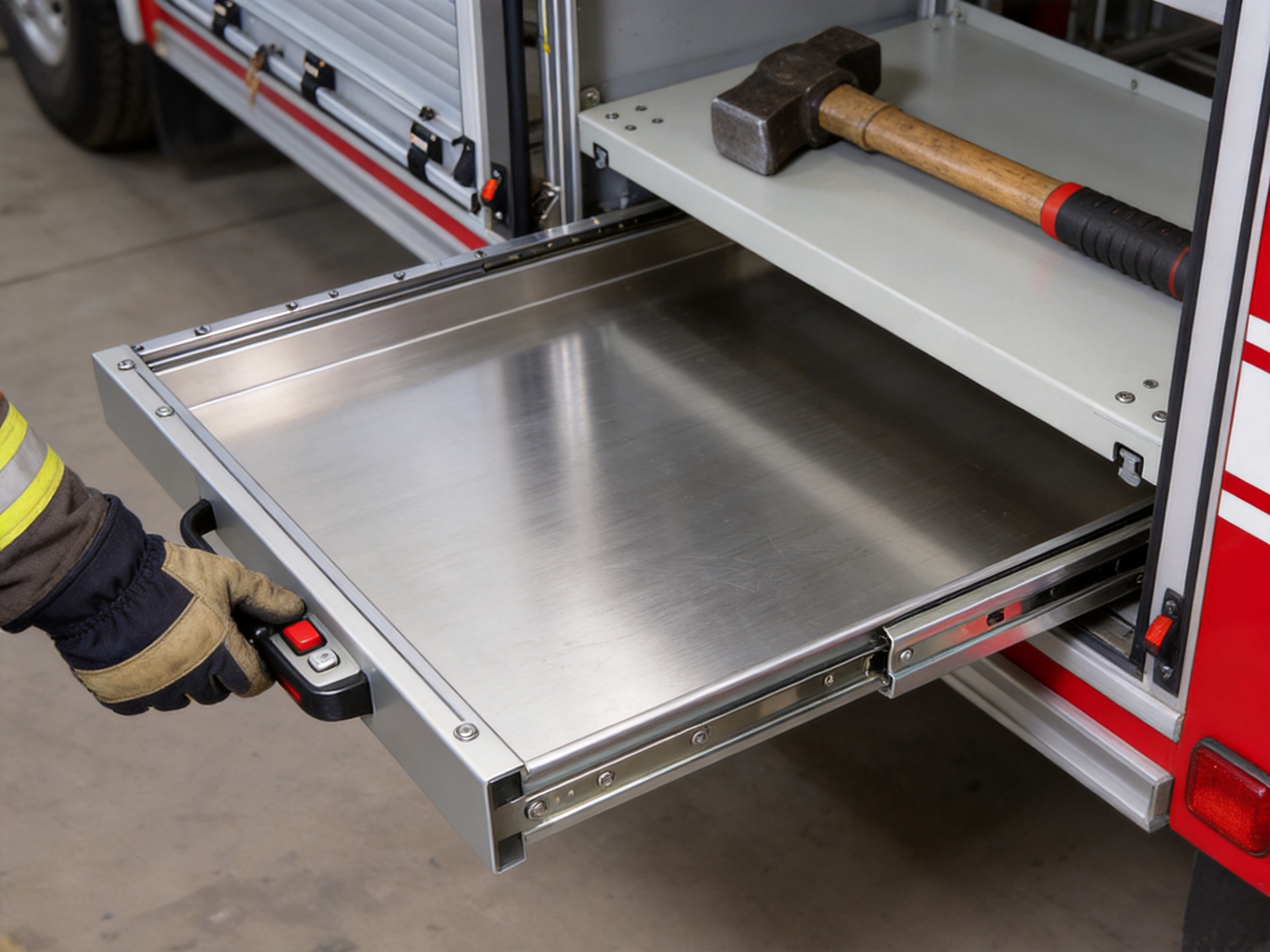
The fire truck pull-out horizontal tray is designed to solve these challenges. It creates a practical, sliding storage platform that allows heavy equipment to be moved outward from a compartment instead of requiring personnel to reach deep inside the vehicle. Constructed from high-strength aluminum alloy profiles and fitted with 304 stainless steel fasteners, the tray combines structural strength, corrosion resistance, quiet operation, and ease of use.
With guide rails capable of supporting approximately 200 kilograms, the system is suitable for many types of compact but heavy emergency equipment. Its integrated limit button and handle support one-hand operation, while the customizable length and width allow the tray to be adapted to different fire truck compartments and equipment layouts.
This article examines the construction, operating principles, practical advantages, customization options, manufacturing strengths, maintenance requirements, and application value of this fire apparatus equipment stowage system.
1. The Role of Equipment Storage in Fire Apparatus Design
Fire apparatus are mobile work platforms that must perform under demanding conditions. A truck may travel over uneven roads, stop suddenly, operate in rain or extreme heat, and arrive at scenes where visibility and working space are limited. Every item inside the vehicle must therefore be positioned, protected, and secured according to its function.
Traditional fixed shelves can provide basic storage, but they may create several operational problems. Equipment stored toward the rear of a compartment can be difficult to reach. Operators may need to bend, kneel, stretch, or place their upper body inside the compartment to retrieve a heavy item. This can slow down deployment and increase the possibility of strain or accidental contact with nearby equipment.
A pull-out horizontal tray changes the way equipment is accessed. When the tray is released, it moves outward along guide rails and brings the stored equipment toward the operator. The contents can be viewed more clearly, handled more safely, and returned to the same organized position after use.
This arrangement is especially valuable when a vehicle carries several pieces of equipment with similar shapes or when a compartment is deep relative to its opening. By improving visibility and accessibility, a sliding tray can help crews identify the correct equipment without unnecessary searching.
1.1 Improving response efficiency
Emergency response is time-sensitive. A few seconds saved during equipment deployment may contribute to faster water supply, quicker access, or more efficient rescue work. A horizontal pull-out tray allows operators to retrieve equipment with fewer movements and less physical effort.
The system also supports standardized vehicle organization. When each piece of equipment has a defined location, firefighters can develop consistent habits for loading and unloading. This reduces confusion between shifts and makes it easier to verify whether all equipment has been returned after an operation.
1.2 Supporting safer manual handling
Heavy equipment should not be pulled from a deep compartment at an awkward angle. Sliding the equipment outward can make lifting and carrying more controlled. The tray does not eliminate the need for safe lifting practices, but it can reduce unnecessary reaching and improve the operator’s position before the equipment is handled.
The approximately 200-kilogram guide rail capacity also provides flexibility for equipment selection. Depending on the actual equipment weight, tray dimensions, vehicle structure, and installation method, the system can accommodate a broad range of portable rescue and firefighting devices.
2. Product Construction and Material Selection
The main frame of the fire truck pull-out horizontal tray is constructed from high-strength aluminum alloy profiles. This material choice is important because fire apparatus storage systems must balance load-bearing performance with vehicle weight, corrosion resistance, and long-term serviceability.
2.1 High-strength aluminum alloy profiles
Aluminum alloy profiles offer a favorable combination of strength and low density. Compared with many conventional steel structures, aluminum can help reduce unnecessary weight while maintaining the rigidity required for a heavy-duty storage platform. Lower component weight can also make installation, inspection, and replacement more manageable.
The profile-based construction method allows the frame to be assembled with consistent sections and controlled dimensions. It also supports customized tray lengths and widths. Rather than relying only on one fixed size, the manufacturer can adapt the frame to the available compartment and the dimensions of the customer’s equipment.
Aluminum alloy also provides useful resistance to moisture and many environmental conditions encountered by emergency vehicles. Fire trucks may be exposed to rain, road spray, water from firefighting operations, mud, dust, cleaning agents, and changing temperatures. Properly selected and processed aluminum profiles can help the storage system maintain its appearance and structural performance in these conditions.
2.2 304 stainless steel fasteners
All fasteners used in the product are made of 304 stainless steel. Fasteners are small components, but they are essential to the stability of the entire assembly. They hold frame sections, brackets, rails, handles, and limit mechanisms together. If fasteners corrode, loosen, or become difficult to remove, maintenance and safety may be affected.
304 stainless steel is widely used in equipment exposed to moisture because of its corrosion resistance and durability. It is suitable for many fire apparatus applications where water, humidity, and outdoor exposure are common. Using a consistent stainless steel fastener specification also helps simplify maintenance and supports a clean, professional appearance.
Material selection must always be considered together with the actual operating environment. Regular inspection remains important, especially where salt, aggressive chemicals, abrasive dust, or prolonged water exposure may be present. Nevertheless, the combination of aluminum alloy profiles and 304 stainless steel fasteners provides a well-balanced foundation for a fire truck storage system.
2.3 Structural integration
The frame, guide rails, limit mechanism, handle, and mounting points are designed to function as an integrated system. The purpose is not merely to produce a platform that can slide. The tray must also remain stable under load, operate smoothly, stop at the intended positions, and withstand repeated use.
Proper structural integration reduces unnecessary movement between components. It can also help reduce noise and vibration during vehicle travel. A stable tray is particularly important when transporting equipment with sensitive parts, electrical components, or precision mechanisms.
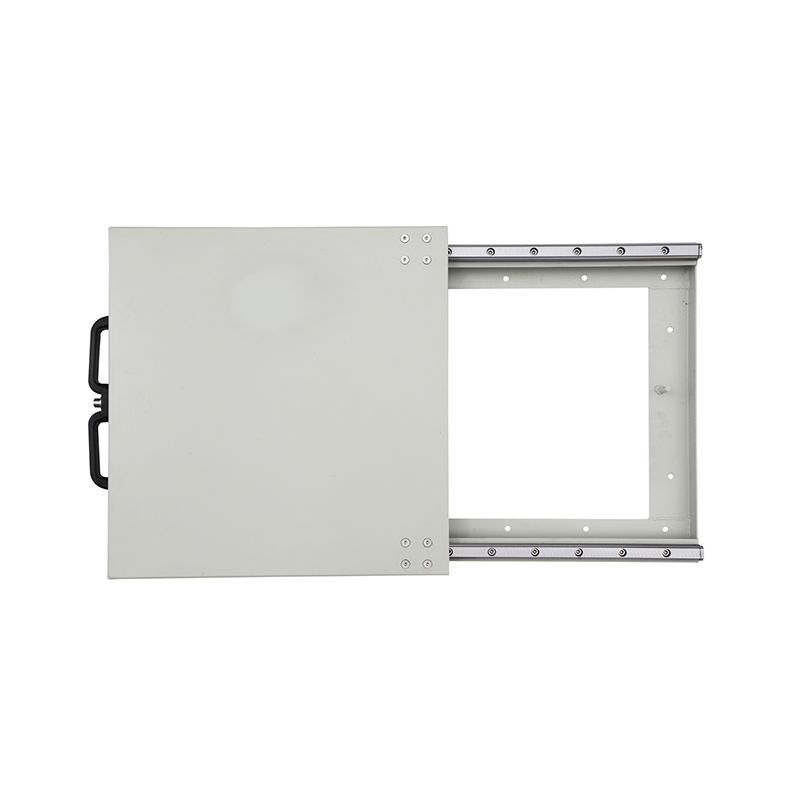
Fire Truck Pull-Out Horizontal Tray
3. Guide Rail Performance and Load Support
The guide rails are among the most important parts of a pull-out tray. They determine how smoothly the platform moves, how much load it can support, and how reliably it returns to its stored position. In this product, the guide rails are designed for quiet and smooth operation and can support approximately 200 kilograms.
3.1 Smooth extension and retraction
A tray used on a fire truck may be opened many times each day. Smooth movement helps reduce operator effort and makes the system easier to use while wearing gloves or protective equipment. It also reduces the risk of sudden movement that could cause stored equipment to shift or fall.
Quiet operation is another practical advantage. Fire stations and emergency vehicles may operate in residential areas, enclosed facilities, or locations where unnecessary noise is undesirable. A tray that opens and closes with controlled movement contributes to a more professional and less disruptive working environment.
3.2 Load-bearing capability
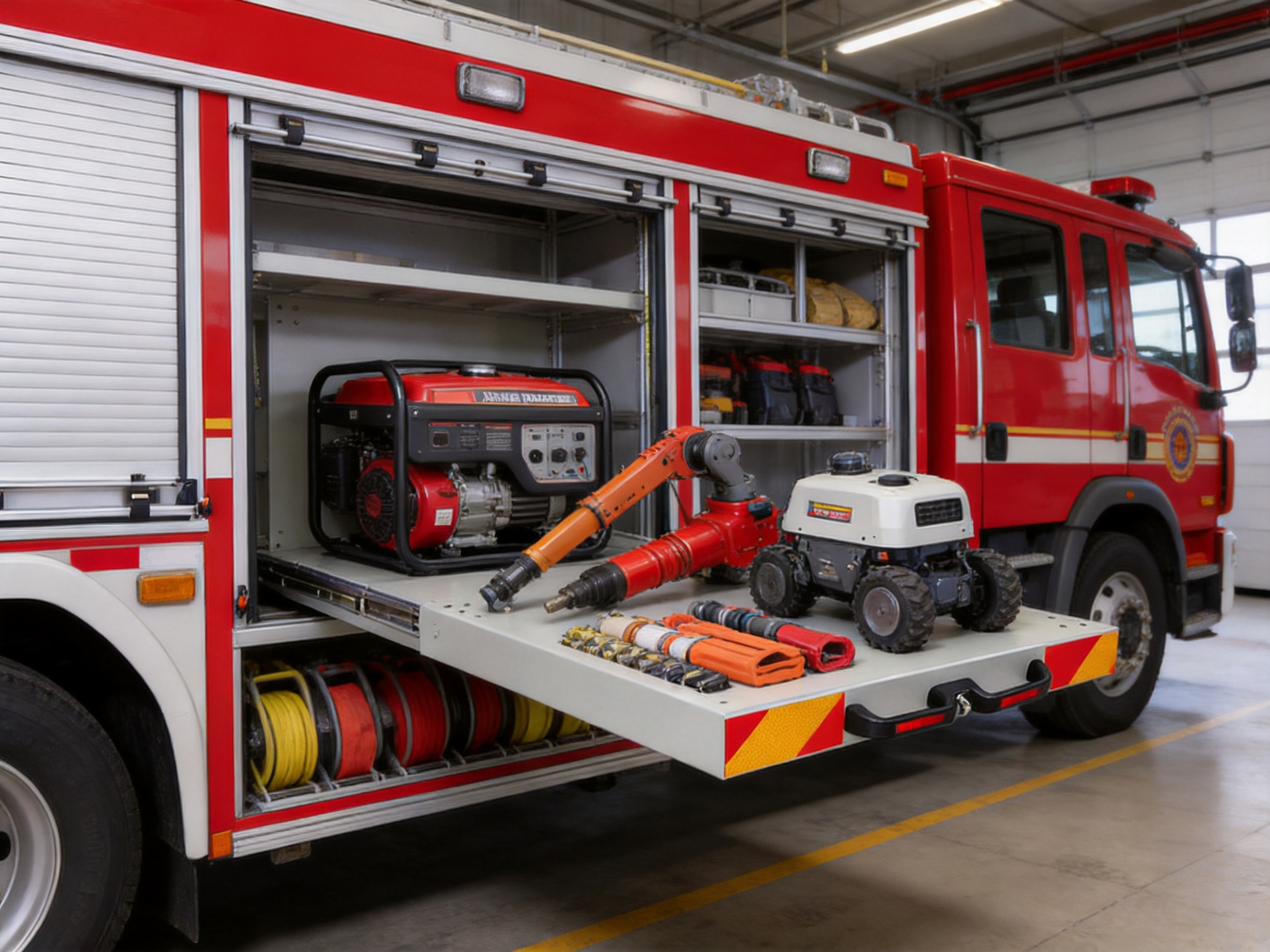
The approximate 200-kilogram support capacity makes the tray suitable for compact heavy equipment. Typical applications may include portable generators, manual water pumps, rescue robots, hydraulic spreaders, hydraulic breakers, and other specialized tools.
Load capacity should be evaluated together with the tray dimensions, the equipment’s center of gravity, the mounting structure, and the installation position inside the vehicle. A concentrated load placed near one edge may affect performance differently from a distributed load. Customers should provide accurate equipment information during the customization stage so that the tray can be configured appropriately.
The stated capacity is also valuable from a planning perspective. Fire apparatus designers can use the tray for equipment that would be inconvenient to place on a standard shelf. The pull-out format makes heavy devices more visible and accessible while preserving the vertical storage space above or below the platform.
3.3 Stability during transport
When a fire truck is moving, stored equipment is exposed to acceleration, braking, turning, and road vibration. The tray must therefore remain controlled when closed. The limit mechanism helps define the tray’s operating positions and supports consistent handling.
Equipment should still be secured according to its shape and weight. The tray is a storage and access platform, not a replacement for all equipment restraints. Depending on the application, straps, brackets, retaining bars, protective padding, or dedicated mounting fixtures may be added to prevent movement.
4. Integrated Limit Button and Handle
The limit button and handle are integrated into one piece. This design follows ergonomic principles and allows one-hand operation. Combining these functions creates a simple control point that is easy to identify and use.
4.1 One-hand operation
Firefighters often work while wearing gloves, carrying other items, or coordinating with team members. A control that can be operated with one hand makes the tray more practical in real-world situations. The user can release the mechanism and pull the tray forward without searching for separate controls.
One-hand operation may also improve the speed of routine inspections. At the beginning of a shift, an operator can open the tray, confirm the presence and condition of the equipment, and close it again with minimal effort.
4.2 Ergonomic access
An ergonomic handle should be easy to locate, comfortable to grip, and positioned so that the operator does not need to twist the wrist excessively. Integrating the button and handle reduces the number of actions required to operate the system.
The design is particularly useful when equipment compartments are positioned at different heights. Operators may need to open a tray from a standing, crouching, or partially kneeling position. A unified handle and release mechanism supports more natural movement across these conditions.
4.3 Reliable limit control
A limit mechanism helps control the tray’s movement and contributes to reliable positioning. It can help prevent uncontrolled extension and provide a repeatable operating experience. Consistent positioning is useful when the tray is loaded with equipment that must remain aligned with the compartment opening.
As with any mechanical component, the limit mechanism should be kept clean and inspected periodically. Dirt, sand, ice, or hardened residue may affect operation. Routine cleaning and functional checks can help maintain dependable performance.
5. Equipment Applications
The pull-out horizontal tray is intended for small heavy equipment and compact rescue devices. Its design allows fire apparatus manufacturers, fleet operators, and emergency organizations to create organized storage areas for tools that are too heavy or inconvenient to access from a fixed shelf.
5.1 Portable generators
Portable generators are often dense and difficult to handle. They may be required to supply power for lighting, pumps, communications equipment, or rescue tools at locations where grid power is unavailable. A pull-out tray can position the generator near the compartment opening, making it easier to inspect, remove, and return.
5.2 Manual water pumps
Manual water pumps and auxiliary pumping devices may be used in specialized water supply situations. These devices can be heavy and may have handles, hoses, or fittings that require careful storage. A custom tray can be dimensioned to support the pump while leaving adequate clearance for connected accessories.
5.3 Rescue robots
Rescue robots may contain sensitive electronic and mechanical components. A stable horizontal storage surface can provide a designated location for the robot and help prevent it from being mixed with heavier tools. Additional padding or retaining fixtures may be incorporated according to the robot’s design.
5.4 Hydraulic spreaders and breakers
Hydraulic spreaders, breakers, and similar rescue tools are compact but heavy. They are commonly used in vehicle extrication and structural rescue. Their weight makes deep fixed compartments inconvenient, particularly when rapid deployment is necessary. A pull-out tray can bring these tools forward and make their handles and connection points easier to reach.
5.5 Other compact heavy equipment
Customers may also use the tray for specialized equipment such as battery systems, cutting tools, compact compressors, tool cases, or other rescue accessories. The suitability of each application depends on load, dimensions, center of gravity, environmental exposure, and the vehicle’s available mounting structure.
| Application | Storage Challenge | Tray Advantage |
|---|---|---|
| Portable generator | High weight and limited handling space | Pull-out access and customizable platform dimensions |
| Manual water pump | Bulky shape and attached accessories | Dedicated horizontal storage with easier inspection |
| Rescue robot | Requires stable and organized placement | Controlled access and potential for protective fixtures |
| Hydraulic spreader | Dense, heavy, and frequently deployed | Reduced reaching into deep compartments |
| Hydraulic breaker | Heavy tool with demanding handling requirements | Heavy-duty support and convenient retrieval |
6. Customization for Fire Truck Compartments
Fire apparatus manufacturers do not all use the same compartment dimensions. Vehicle chassis, body structures, equipment layouts, door openings, electrical systems, and water or foam tanks can all affect available storage space. For this reason, the product length and width can be customized according to customer requirements.
6.1 Customizable dimensions
The product information identifies the primary dimensions as W, W1, L, and L1. These dimensions are customizable. The exact meaning and measurement method for each dimension should be confirmed during the technical drawing and approval process.
Customization allows the tray to fit a particular compartment rather than forcing the vehicle designer to adapt the entire body around a standard product. This is especially beneficial for replacement projects, special-purpose rescue vehicles, and fleet upgrades where existing compartment dimensions must be preserved.
6.2 Equipment-based design
The best tray configuration begins with the equipment that will be stored. Customers should provide the equipment’s overall length, width, height, weight, handle position, connection points, and center of gravity. Photographs, technical drawings, or sample units can further improve design accuracy.
Clearance should be considered around all sides of the equipment. There must be enough room for the operator to grip handles, connect hoses, remove cables, and perform basic inspection. The tray should also allow the equipment to be loaded and unloaded without colliding with the compartment frame or neighboring tools.
6.3 Vehicle integration
Installation requires attention to the vehicle’s mounting structure. The tray must be secured to a sufficiently rigid surface, and the installation should not interfere with wiring, plumbing, lighting, doors, shutters, or other equipment. Vehicle movement and dynamic loading should be considered during the design review.
For OEM and ODM projects, the manufacturer can communicate with the vehicle builder or equipment integrator to confirm interface dimensions and mounting requirements. Early coordination helps avoid modifications after production and supports a cleaner final installation.
6.4 Customized quantities and project support
Customization can involve more than dimensions. Depending on the project, customers may discuss surface treatment, mounting brackets, retaining components, handle position, tray configuration, packaging, labeling, and delivery requirements. A professional supplier should be able to review the application and recommend a practical configuration instead of simply supplying a standard part.
7. Advantages Compared with Conventional Fixed Shelves
The main competitive advantage of a pull-out horizontal tray is improved access. A fixed shelf can store equipment, but it does not move the equipment toward the operator. In a deep compartment, the rear portion of the shelf may remain difficult to reach.
7.1 Better visibility
When the tray extends outward, more of the stored equipment becomes visible. Operators can identify tools quickly and check whether anything is missing. Improved visibility is useful during pre-departure inspections, emergency deployment, and post-operation inventory.
7.2 Reduced reaching distance
The pull-out design reduces the need to reach deeply into a compartment. This can help lower physical strain and make the equipment easier to grip. It is especially valuable for dense tools that cannot be safely dragged across a fixed shelf.
7.3 More organized compartments
A tray can create a dedicated position for a particular class of equipment. When several trays are used in one vehicle, each can be assigned to a different tool group. This supports consistent organization and can reduce the time needed to locate equipment.
7.4 Efficient use of vehicle volume
Because the tray moves horizontally, it can make better use of deep compartment space without requiring a large outward-opening door or a separate lifting platform. The design may be combined with roller shutters, hinged doors, vertical racks, and other fire truck storage accessories.
7.5 Heavy-duty performance in a practical form
The approximate 200-kilogram guide rail capacity provides a useful balance between heavy-duty functionality and compact construction. The aluminum alloy frame helps control weight, while stainless steel fasteners support durability. This combination distinguishes the product from lightweight household drawer systems that are not intended for emergency vehicle service.
7.6 Simple user interaction
The integrated limit button and handle make the product easy to understand. There is no complicated operating sequence. A clear, ergonomic control supports rapid use by different operators and reduces training requirements.
8. Manufacturing Capabilities and Quality Control
The performance of a fire apparatus storage system depends not only on its design but also on how it is manufactured. Dimensional accuracy, material consistency, assembly quality, and inspection discipline all affect the finished product.
Tianchang Jinlv Fire Equipment Co., Ltd. was established in 2010 and has specialized in fire protection accessories for approximately 15 years. The company manufactures fire truck equipment and related products, including roller shutters, ladders, storage systems, rescue components, and other vehicle-mounted accessories.
8.1 Advanced production facilities
The company is equipped with advanced production facilities and a complete production process. A complete process helps connect the main stages of manufacturing, from material procurement and preparation to fabrication, assembly, inspection, and delivery.
For a pull-out tray, production may include profile processing, component preparation, rail installation, fastener assembly, limit mechanism installation, dimensional verification, functional testing, and packaging. Maintaining control across these stages helps reduce variation between batches.
8.2 Raw material control
Material quality is the foundation of product reliability. The use of high-strength aluminum alloy profiles and 304 stainless steel fasteners requires appropriate procurement and incoming inspection. Material specifications should be confirmed before production, and components should be checked for visible defects, dimensional conformity, and suitability for the intended application.
Good raw material control helps prevent problems such as profile deformation, inconsistent fastener quality, poor surface condition, or incompatible component dimensions. It also supports traceability and more efficient corrective action if a quality issue is identified.
8.3 Process consistency
Consistency is essential for components that must fit into fire truck compartments and align with other vehicle structures. A controlled production process helps ensure that the tray length, width, rail position, handle location, and mounting points correspond to the approved drawing.
Process control is especially important for customized products. While dimensions may vary from one order to another, the manufacturing standard should remain consistent. Customization should change the approved configuration, not reduce the level of quality control.
8.4 Assembly and functional inspection
After assembly, the tray should be checked for smooth extension and retraction, correct limit function, handle operation, fastener condition, structural stability, and overall appearance. Functional inspection is important because a product can meet dimensional requirements and still require adjustment if the moving parts do not operate correctly.
Load-related verification should be conducted according to the manufacturer’s testing procedures and the agreed product specification. Customers using the tray for unusually concentrated or dynamic loads should communicate those requirements in advance.
8.5 Quality management certification
The company has passed GB/T 19001-2016 quality certification. A quality management system provides a structured framework for controlling processes, documenting requirements, managing nonconformities, and supporting continuous improvement.
Certification does not replace product-specific inspection, but it demonstrates that the organization has established a formal approach to quality management. For OEM and ODM customers, this can provide additional confidence when evaluating a long-term manufacturing partner.
9. Research, Development, and OEM/ODM Strengths
Fire apparatus equipment must evolve with vehicle design, emergency response practices, and customer expectations. A manufacturer with research and development capability can respond more effectively to special installation conditions and new equipment requirements.
Tianchang Jinlv Fire Equipment Co., Ltd. has a professional research and development team with industry experience. The company follows market trends, invests in product development, and introduces advanced technologies to improve fire protection equipment for different application scenarios.
9.1 Application-focused development
Effective research and development begins with actual operating conditions. A tray intended for a municipal fire engine may have different requirements from one used on an industrial rescue vehicle, airport emergency vehicle, forest firefighting truck, or specialized disaster-response platform.
Application-focused development considers compartment dimensions, equipment weight, access height, environmental exposure, operator habits, and maintenance practices. This approach helps create products that are practical in the field instead of merely attractive in a catalog.
9.2 OEM and ODM cooperation
OEM and ODM services allow customers to purchase products configured for their own vehicle programs or equipment brands. The customizable length and width of the horizontal tray make it suitable for project-based cooperation.
An OEM/ODM process may include requirement confirmation, preliminary design, drawing review, prototype or sample production, functional testing, approval, batch manufacturing, and after-sales support. Clear communication at each stage helps align the product with the customer’s technical and commercial objectives.
9.3 Technical communication
Successful customization depends on accurate information exchange. Customers should provide compartment drawings, installation photographs, equipment specifications, vehicle model information, expected load, and required operating clearance. The manufacturer can then evaluate the design and identify possible interference before production.
Technical communication is also important when a tray will be integrated with roller shutters, internal lighting, charging systems, ventilation, locking devices, or other storage components. Coordinated planning can produce a cleaner and more efficient vehicle layout.
10. Installation Considerations
Installation should be performed by qualified personnel familiar with fire truck body structures and vehicle equipment. The tray must be mounted to a stable support surface capable of handling the expected static and dynamic loads.
10.1 Mounting surface
The mounting surface should be flat, rigid, and free from obstructions. Any irregularity may affect rail alignment and produce friction, noise, or uneven movement. If reinforcement is required, it should be designed so that the vehicle body remains structurally sound.
10.2 Alignment
Guide rail alignment is critical. Rails that are not parallel may create resistance and uneven loading. The tray should be checked throughout its operating range to confirm that it extends and retracts smoothly without rubbing against the compartment structure.
10.3 Clearance
There should be sufficient clearance above, below, and around the tray. Operators need room to grip the handle and remove equipment. The tray should not interfere with adjacent doors, roller shutters, wiring, hoses, or other moving components.
10.4 Load distribution
Equipment should be positioned so that its weight is distributed appropriately. Heavy items should not be placed in a way that creates excessive side loading or an unstable center of gravity. If a particular tool has an unusual shape, a dedicated bracket or retaining device may be advisable.
11. Maintenance and Service Recommendations
Regular maintenance helps preserve smooth movement and reliable operation. Fire trucks often work in dirty and wet environments, so inspection should be included in the vehicle’s routine equipment maintenance program.
11.1 Cleaning
Remove dust, sand, mud, and residue from the tray surface and moving areas. Cleaning is especially important after operations in construction sites, flood zones, industrial facilities, or areas with fine abrasive particles.
11.2 Fastener inspection
Check visible fasteners for looseness, damage, or signs of corrosion. Although 304 stainless steel provides good corrosion resistance, fasteners should still be inspected because mechanical vibration and environmental contamination can affect any fastening system.
11.3 Guide rail inspection
Open and close the tray to check for abnormal noise, resistance, uneven movement, or excessive play. Any change in operation should be investigated before the tray is returned to heavy service.
11.4 Limit mechanism inspection
Confirm that the integrated button and handle operate correctly and that the tray reaches its intended positions. Do not force the handle if the mechanism is blocked. Remove contamination or arrange professional service when necessary.
11.5 Equipment restraint inspection
If brackets, straps, or retaining devices are used, inspect them at the same time as the tray. The storage system and the equipment restraints must work together to keep the load secure during vehicle movement.
12. Selection Guide for Buyers and Vehicle Manufacturers
Before ordering a pull-out horizontal tray, customers should evaluate the intended application carefully. A clear specification reduces design changes and helps ensure that the final product matches the vehicle.
12.1 Define the equipment
Prepare a list of all equipment that will be stored on the tray. Record each item’s dimensions, weight, shape, center of gravity, handles, hoses, cables, and required accessories. If multiple tools will share one tray, calculate the combined load and determine whether they can be safely arranged together.
12.2 Measure the compartment
Measure the available width, depth, height, opening size, and mounting area. Record any obstacles such as structural beams, wiring channels, lighting units, locks, or adjacent doors. The measurement process should use the actual vehicle or approved body drawings.
12.3 Consider the operator
Think about how firefighters will use the tray while wearing gloves, helmets, protective clothing, or breathing apparatus. The handle position should be reachable, and the tray should extend far enough to make the equipment accessible without unsafe bending or twisting.
12.4 Confirm environmental conditions
Identify whether the vehicle will operate near seawater, industrial chemicals, extreme dust, freezing conditions, high heat, or frequent washdown. This information can influence material selection, surface treatment, drainage, lubrication, and maintenance planning.
12.5 Plan for future equipment
Emergency organizations often add or replace tools over the service life of a vehicle. If possible, leave reasonable flexibility in the tray design. However, future capacity should not lead to excessive empty space or an improperly supported load. The best solution balances current requirements with realistic fleet planning.
13. Why This Product Is a Strong Competitive Choice
The fire truck pull-out horizontal tray offers a combination of features that make it suitable for professional fire apparatus applications. Its advantages are based on practical engineering rather than unnecessary complexity.
First, the high-strength aluminum alloy frame provides a durable and relatively lightweight foundation. Second, 304 stainless steel fasteners improve resistance to moisture and support long-term serviceability. Third, the guide rails are designed for quiet, smooth movement and approximately 200-kilogram support. Fourth, the integrated handle and limit button enable convenient one-hand operation. Fifth, customizable dimensions allow the system to fit different compartments and equipment layouts.
Compared with generic drawer mechanisms, the product is developed for the requirements of emergency vehicle storage. It is intended to support heavy equipment, repeated access, vehicle vibration, and professional maintenance routines. Compared with fixed shelves, it improves access and visibility. Compared with overly complex powered systems, it offers a straightforward mechanical operating method that can be easier to inspect and maintain.
The company’s manufacturing history, quality management certification, production facilities, technical team, and OEM/ODM experience further strengthen the product’s value. Customers are not only purchasing a tray; they are working with a supplier capable of supporting customized fire truck equipment projects.
14. Frequently Asked Questions
Q1: What is the primary purpose of the fire truck pull-out horizontal tray?
The tray is designed to store and provide convenient access to compact heavy equipment inside fire and rescue vehicle compartments. It can help organize and retrieve portable generators, manual water pumps, rescue robots, hydraulic spreaders, breakers, and similar tools.
Q2: What material is used for the main frame?
The main frame is constructed from high-strength aluminum alloy profiles. This provides a balance of structural strength, low weight, corrosion resistance, and customization flexibility.
Q3: What type of fasteners are used?
The product uses 304 stainless steel fasteners. These fasteners are selected for their durability and resistance to moisture and many common environmental conditions.
Q4: How much weight can the guide rail system support?
The guide rails can support approximately 200 kilograms. The actual application should also consider tray dimensions, load distribution, installation structure, and the equipment’s center of gravity.
Q5: Can the tray dimensions be customized?
Yes. The product length and width can be customized according to customer requirements. The dimensions identified as W, W1, L, and L1 are listed as customizable in the product information.
Q6: Can the tray be used for equipment other than the examples listed?
Yes, provided that the equipment’s weight, dimensions, shape, and operating requirements are suitable. Customers should submit complete equipment information so that the tray can be evaluated and configured correctly.
Q7: Is the tray difficult to operate while wearing gloves?
The limit button and handle are integrated into one ergonomic component, allowing one-hand operation. This design is intended to make the tray convenient to use during professional emergency response conditions.
Q8: Does the tray replace equipment restraints?
No. The tray provides a storage and access platform, but equipment should be secured according to its shape, weight, and vehicle application. Additional brackets, straps, retaining bars, or protective fixtures may be required.
Q9: What information should be provided for a customized order?
Useful information includes the compartment dimensions, available mounting space, equipment dimensions, equipment weight, center of gravity, intended load, operating clearance, vehicle model, installation photographs, and any special environmental requirements.
Q10: What manufacturing support is available?
The manufacturer provides fire truck equipment manufacturing, OEM/ODM customization, technical communication, production coordination, quality control, and customer service. Customized projects can be developed through requirement confirmation, drawing review, production, inspection, and delivery.
Q11: How should the tray be maintained?
Keep the tray clean, inspect the guide rails, check fasteners, confirm the handle and limit mechanism operate correctly, and examine any equipment restraints. Maintenance should be included in the vehicle’s regular inspection program.
Q12: Is the product suitable for integration with other fire truck equipment?
Yes. The tray can be considered alongside roller shutters, fixed shelves, ladder racks, tool mounts, lighting, and other compartment systems. Integration should be planned through a complete vehicle layout and technical drawing review.
15. Conclusion
The fire truck pull-out horizontal tray is a practical solution for improving equipment access, organization, and handling in emergency vehicles. Its high-strength aluminum alloy frame, 304 stainless steel fasteners, smooth guide rails, approximately 200-kilogram support capacity, and integrated one-hand operating handle make it suitable for demanding fire apparatus applications.
Its customizable dimensions allow the tray to adapt to different vehicle compartments and equipment requirements. By bringing heavy tools outward from deep storage areas, it can improve visibility, reduce unnecessary reaching, and support faster deployment. The product is appropriate for portable generators, manual water pumps, rescue robots, hydraulic spreaders, breakers, and other compact heavy equipment.
The manufacturing capabilities of Tianchang Jinlv Fire Equipment Co., Ltd. add further value. With experience in fire protection accessories since 2010, advanced production facilities, a complete manufacturing process, GB/T 19001-2016 quality certification, an experienced research and development team, and OEM/ODM support, the company is positioned to serve both standard product orders and customized fire truck equipment projects.
For fire apparatus manufacturers, fleet operators, rescue organizations, and vehicle integrators, the product offers a combination of strength, accessibility, customization, and manufacturing support. Properly specified, installed, and maintained, it can become an important part of a safer and more efficient emergency vehicle storage system.
References
1. Product technical information for the fire truck pull-out horizontal tray, including material, load capacity, operating mechanism, and customizable dimensions.
2. Tianchang Jinlv Fire Equipment Co., Ltd. company profile and manufacturing information.
3. GB/T 19001-2016, Quality Management Systems—Requirements.
4. General principles of fire apparatus equipment storage, compartment organization, and emergency vehicle ergonomics.
5. General engineering practices for aluminum alloy structures, stainless steel fasteners, guide rail systems, and mechanical equipment maintenance.
6. General recommendations for safe loading, restraint, inspection, and maintenance of rescue equipment in emergency vehicles.
Product: Fire Truck Pull-Out Horizontal Tray
News
-
-
Two minutes into a working fire, a crew stands in front of a locked steel security door with a crowbar that is too short to pull with both hands. Nothing about the tool is broken. It was simply speci...
READ MORE -
Specification meetings usually park the ladder rack near the bottom of the option sheet, a few lines above the license plate bracket. That is also why ladder racks become the complaint in year three:...
READ MORE -
A firefighter opens a compartment door after a long working fire. Inside, the thermal imaging camera has slid under a halligan bar, the hose line is twisted into a knot, and a 20 kg SCBA cylinder is ...
READ MORE -
Quick Answer The right fire fighting nozzle depends on three factors: the flow rate your pump can deliver, the pattern your crew needs on the fireground, and the thread standard your hose already us...
READ MORE -
Quick Answer The right fire truck boarding ladder is a fixed, upward-folding, or rotating step assembly mounted at the rear or side of the apparatus that gives firefighters a stable, non-slip surface ...
READ MORE
Hey! Interested in staying in the loop? Sign up for our updates.
WE WON'T SPAM YOU, PINKY PROMISE.

Tianchang Jinlv Fire Equipment Co., Ltd.
Copyright © Tianchang Jinlv Fire Equipment Co., Ltd. All rights reserved. Custom Fire Truck Equipment Supplier Fire Apparatus Parts Factory
