

 en
 English
 русский
 Español
 عربى

Specification meetings usually park the ladder rack near the bottom of the option sheet, a few lines above the license plate bracket. That is also why ladder racks become the complaint in year three:...
READ MORE
Electric Fire Truck Ladder Racks: Safer, Faster, and More Efficient Equipment Deployment
2026.11.02
Content
- 1 Why Ladder Deployment Efficiency Matters in Fire and Rescue Operations
- 2 Product Overview
- 3 Key Technical Specifications
- 4 Configuration Options for Different Fire Truck Applications
- 5 Material Selection and Structural Advantages
- 6 Operational Advantages Compared with Conventional Manual Racks
- 7 Safety and Ergonomic Considerations
- 8 Manufacturing Strengths of Tianchang Jinlv Fire Equipment Co., Ltd.
- 9 Manufacturing Process Considerations
- 10 Installation and Integration Guidance
- 11 Maintenance and Service Recommendations
- 12 Why This Product Is a Competitive Choice
- 13 Selection Guide for Buyers
- 14 Application Value for Different Customers
- 15 Q&A
- 15.1 What type of product is this?
- 15.2 Which ladder lengths are supported?
- 15.3 What is the main advantage over a conventional manual rack?
- 15.4 What are the available 6-meter configurations?
- 15.5 What are the available 15-meter configurations?
- 15.6 What materials are used?
- 15.7 What is the maximum rack weight?
- 15.8 What is the equipment load capacity?
- 15.9 How far does the rack tilt?
- 15.10 Can the product be customized?
- 15.11 What quality system supports production?
- 15.12 How should the rack be maintained?
- 15.13 Is professional installation required?
- 15.14 Can the rack be used by a small crew?
- 16 Conclusion
- 17 References
- 18 Product: Electric Fire Truck Ladder Racks
Firefighting operations depend on speed, organization, and the ability of crews to access essential equipment without unnecessary physical strain. A ladder carried on a fire truck may be needed for roof access, upper-level rescue, ventilation support, inspection, or firefighting operations around elevated structures. However, long ladders are difficult to handle manually, especially when they are stored on the roof of a vehicle and must be removed quickly in challenging conditions. An electric or automatically assisted fire truck ladder rack provides a practical solution by helping firefighters unfold, tilt, lower, and position the ladder with greater control.
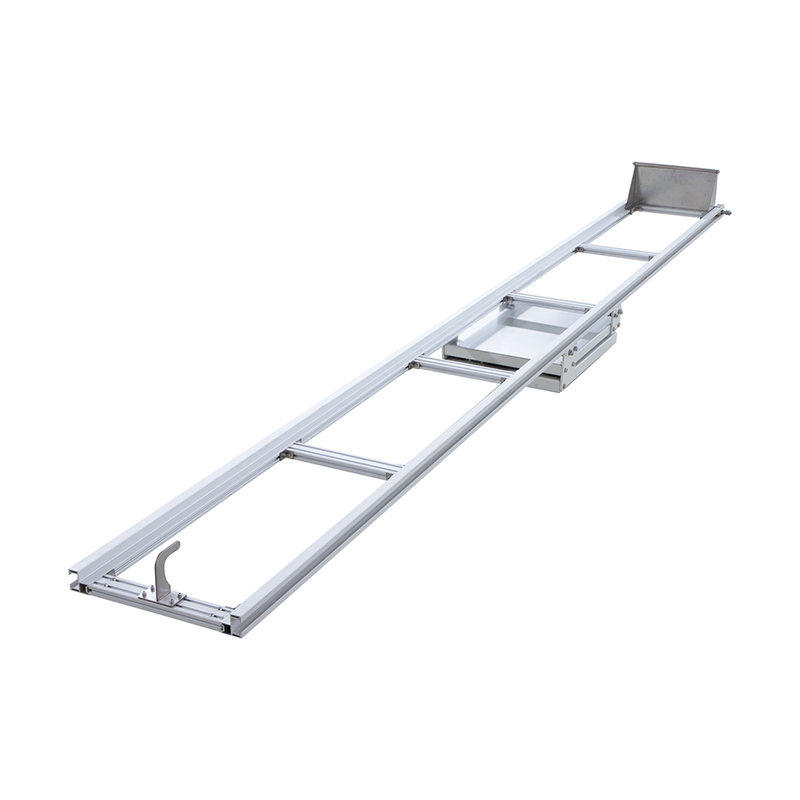
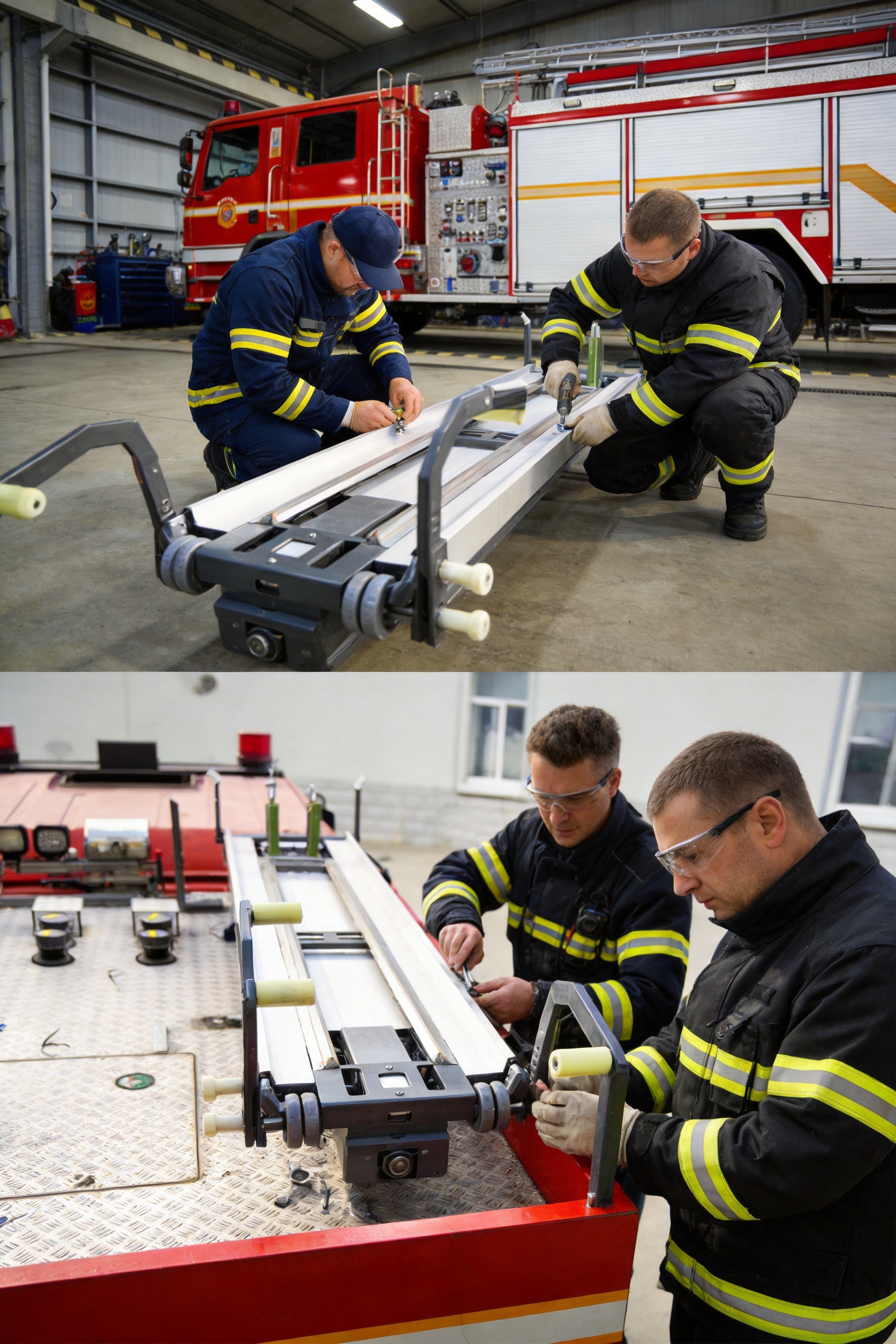
The Electric Fire Truck Ladder Racks supplied by Tianchang Jinlv Fire Equipment Co., Ltd. are designed for fire engines and specialized emergency vehicles that require reliable ladder storage and rapid deployment. The product combines a lightweight aluminum alloy rack body, a robust steel base, assisted movement through a cylinder-based mechanism, and a protective surface treatment involving galvanization and powder coating. It is suitable for ladders measuring 6, 9, 12, and 15 meters, with a maximum equipment load capacity of at least 100 kilograms.
More than a simple transport frame, this ladder rack is an integrated fire truck access and deployment system. Its purpose is to reduce the effort required from firefighters, minimize the time spent retrieving a ladder, improve operational safety, and maintain secure equipment storage while the vehicle is traveling. With several configuration options, including manual single-rail, pneumatic, ground-deploy, and side-tilt models, the system can be selected according to vehicle layout, ladder length, crew requirements, and operating environment.
For fire apparatus manufacturers, municipal fire departments, emergency response contractors, and distributors of rescue vehicle components, the ladder rack offers an adaptable platform supported by professional manufacturing, quality control, product development, and OEM/ODM service capabilities.
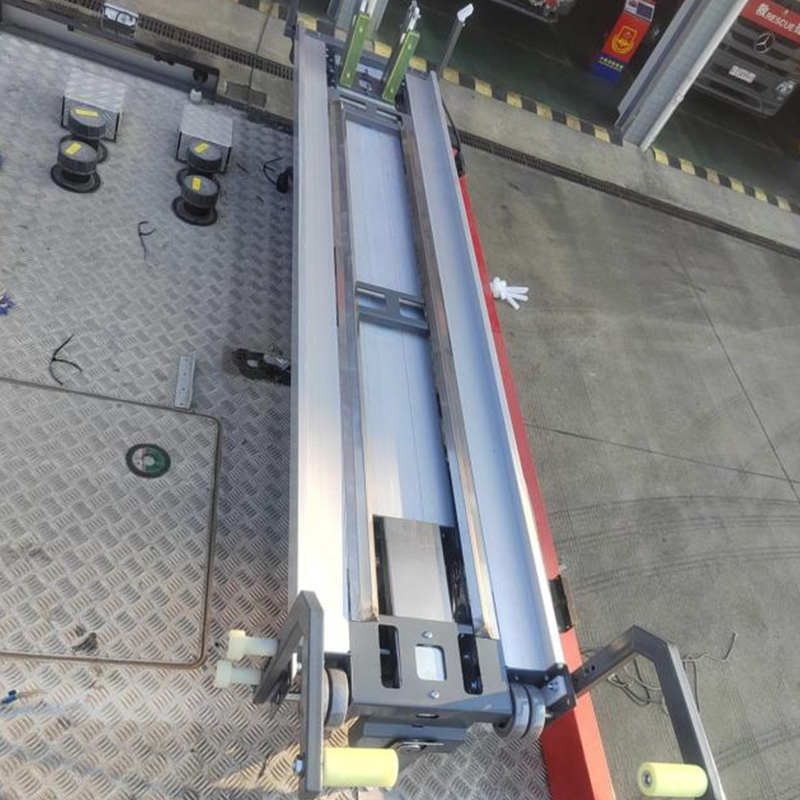
Electric Fire Truck Ladder Racks
Why Ladder Deployment Efficiency Matters in Fire and Rescue Operations
Firefighters often work in environments where every movement matters. A ladder may need to be deployed beside a burning building, on a narrow road, near damaged infrastructure, or in an area affected by smoke, water, debris, and poor visibility. The physical process of releasing a ladder from a roof-mounted rack can become difficult when the equipment is long, heavy, or positioned above shoulder height.
Traditional manual handling may require two or more firefighters to climb onto the vehicle or reach over the side of the bodywork. This can expose personnel to falls, awkward lifting angles, contact with sharp vehicle components, and accidental ladder movement. If the ladder is not controlled during lowering, it may strike the vehicle, nearby equipment, or personnel. These risks become more serious when firefighters are already carrying breathing apparatus, protective clothing, communication equipment, and other tools.
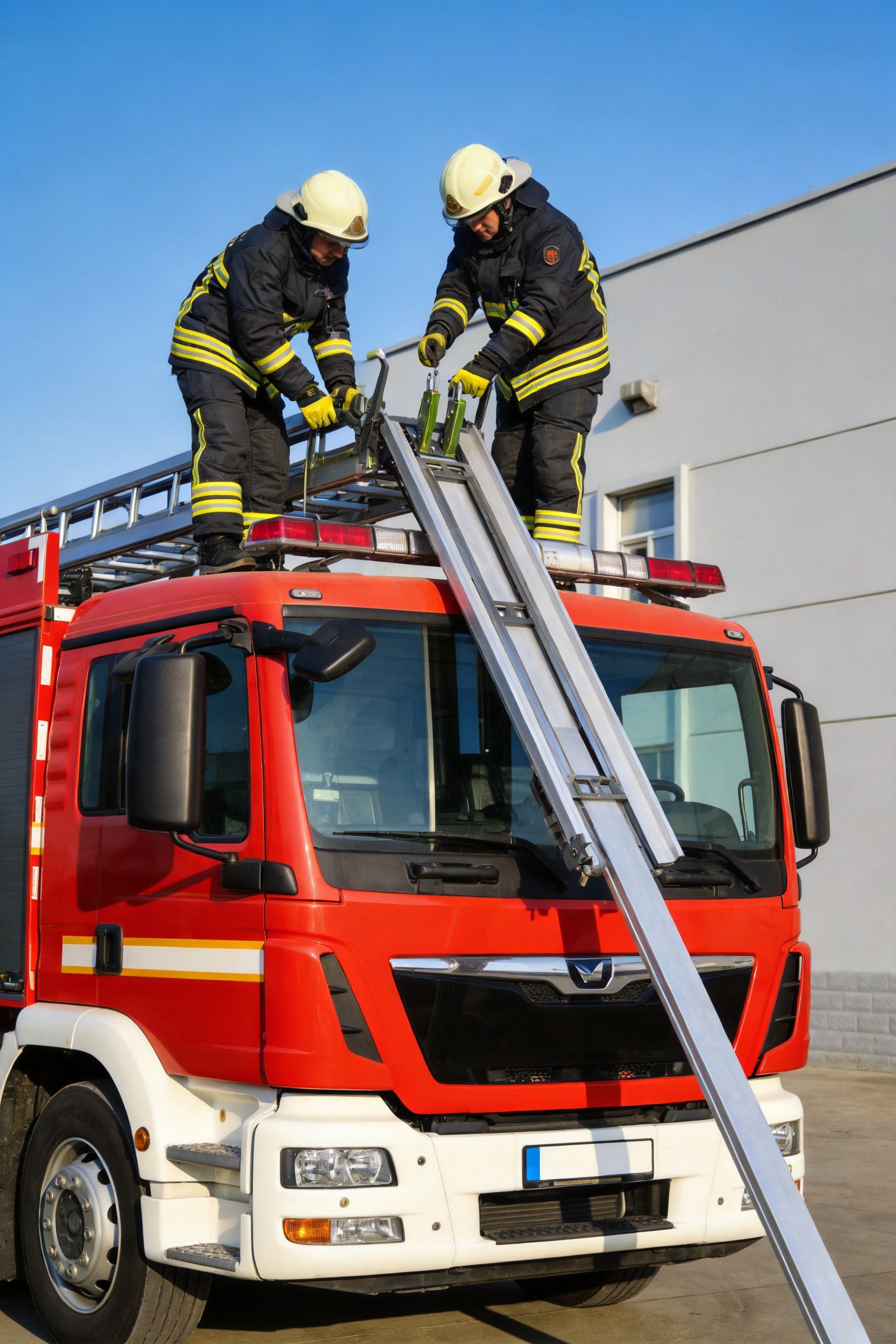
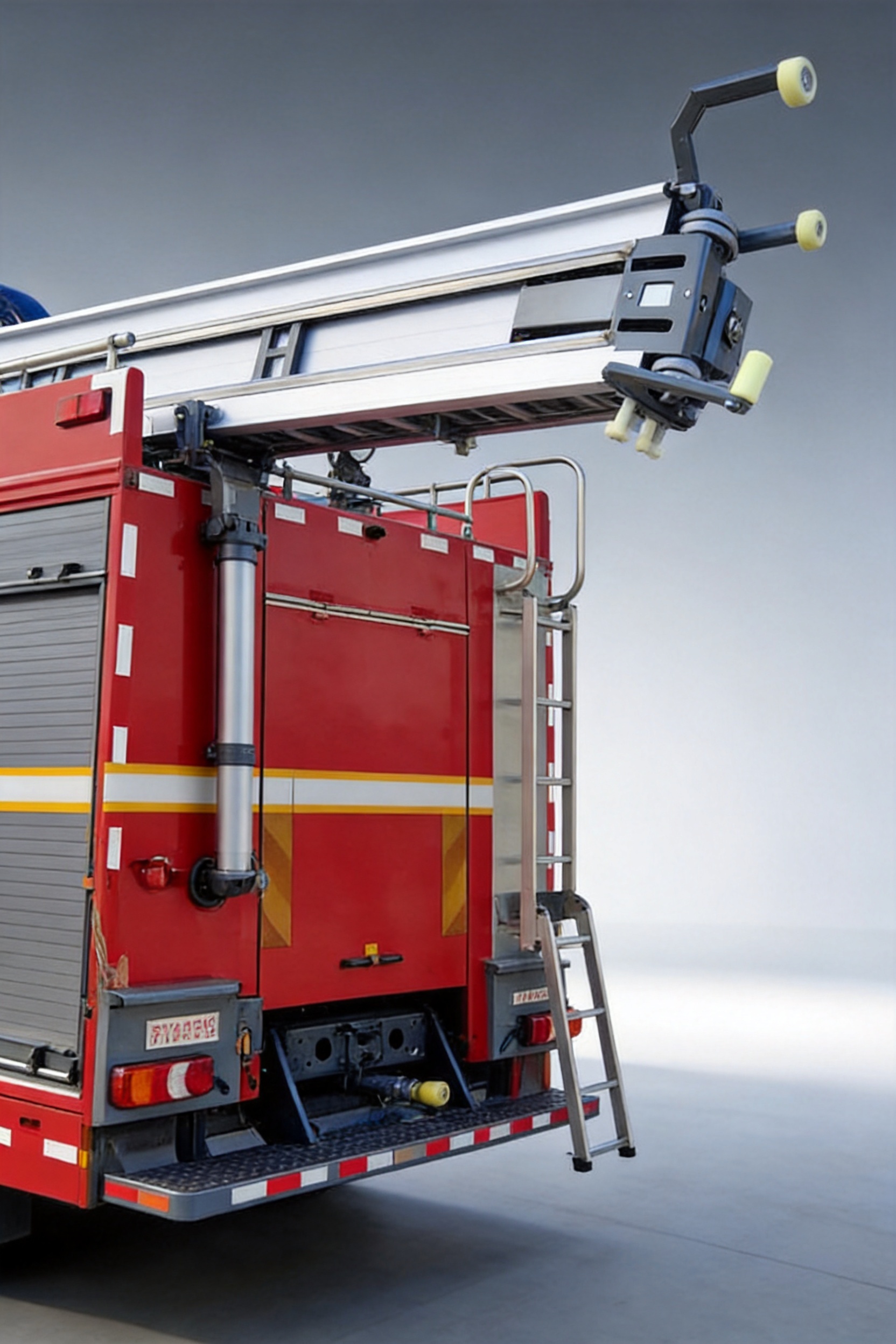
An assisted ladder rack addresses these challenges by controlling the ladder’s movement between its travel position and a more accessible deployment angle. The automatic tilting structure is designed to unfold and tilt within a defined range of approximately 48 to 52 degrees. When tilted down from the roof, the rack can reduce the effective access height to no more than approximately 2.3 meters, while the extension stroke is no more than approximately 2.5 meters. This makes the ladder more accessible from ground level and reduces the need for firefighters to climb onto the truck during retrieval.
Efficient storage also affects vehicle readiness. A ladder that is difficult to return to its rack may be left unsecured, improperly positioned, or handled by fewer people than necessary. A controlled rack helps crews complete the stowing process more consistently after an operation. It can support a more organized workflow, reduce physical fatigue, and help preserve the ladder and vehicle structure over repeated deployments.
These benefits are especially valuable for departments that operate several vehicle types or respond to diverse incidents. A configurable ladder rack can support different ladder lengths and deployment methods while maintaining a consistent approach to equipment handling.
Product Overview
The Electric Fire Truck Ladder Rack is an automatically assisted roof-mounted storage and deployment system for firefighting ladders. Its design focuses on four primary objectives: controlled movement, reduced manual effort, compact installation, and dependable service in demanding vehicle applications.
The system uses a cylinder-based operating structure. The cylinder assists with the rack’s unfolding and tilting movement, allowing the ladder to be brought down from the roof to a more manageable position. Compared with a purely manual rack, an assisted mechanism can reduce the force required from personnel and provide a more controlled movement path. Compared with a larger or more complicated powered arrangement, the cylinder-based design can offer a compact layout, lower system weight, and easier logistics.
The rack body is manufactured from 6061 aluminum alloy. This material is widely valued for its combination of low density, structural performance, corrosion resistance, and suitability for fabricated vehicle components. The base is made from Q235A steel plate, providing a strong foundation for attachment to the fire truck body. The base receives galvanization followed by powder coating, creating a layered protective finish intended to improve resistance to corrosion, wear, and environmental exposure.
The overall ladder rack dimensions are no more than approximately 1760 × 1400 × 850 millimeters, and the total weight is no more than approximately 160 kilograms. These dimensions and weight characteristics help the rack fit within the roof space of many specialized vehicles without creating an unnecessary burden for the vehicle structure or payload calculation.
The rack is suitable for 6-meter, 9-meter, 12-meter, and 15-meter ladders. Different models are available depending on the ladder length and the desired deployment method. This selection structure allows buyers to choose an arrangement that matches the equipment already specified for the vehicle rather than being forced into a single universal configuration.
Key Technical Specifications
| Item | Specification |
|---|---|
| Product type | Automatically assisted fire truck ladder rack |
| Applicable ladder lengths | 6 m, 9 m, 12 m, and 15 m |
| Rack dimensions | Not more than approximately 1760 × 1400 × 850 mm |
| Unfolding and tilting angle | Approximately 48°–52° |
| Height when tilted down from roof | Not more than approximately 2.3 m |
| Extension stroke | Not more than approximately 2.5 m |
| Rack body material | 6061 aluminum alloy |
| Base material | Q235A steel plate |
| Surface treatment | Galvanization followed by powder coating |
| Total weight | Not more than approximately 160 kg |
| Equipment load capacity | At least 100 kg |
| Available configurations | Manual single-rail, pneumatic, ground-deploy, and side-tilt models, depending on ladder length |
Actual vehicle integration should be verified against the final ladder dimensions, vehicle roof structure, center-of-gravity requirements, mounting position, operating clearance, and local regulations. The technical figures above provide a product selection reference, while final engineering should consider the complete fire apparatus design.
Configuration Options for Different Fire Truck Applications
6-Meter Manual Single-Rail Ladder Rack
The 6-meter manual single-rail configuration is intended for fire trucks that use a shorter ladder and require a straightforward, economical storage solution. It can be suitable for vehicles where the crew has sufficient access around the rack and where a manually controlled deployment process meets the operational requirements.
A manual single-rail design may appeal to departments seeking a simple structure with fewer powered or pneumatic components. It can also be useful for applications where vehicle space, budget, or maintenance resources influence the equipment selection. Even with manual operation, the rack must provide stable ladder retention during transportation and predictable release during deployment.
6-Meter Pneumatic Ladder Rack
The 6-meter pneumatic model is a standard assisted option for crews that want to reduce lifting and pulling effort. It is appropriate for fire trucks carrying shorter ladders but still requiring a more convenient and controlled retrieval process.
By using cylinder assistance, this configuration can make repeated deployment and stowing less physically demanding. It is particularly beneficial when a vehicle is staffed by a small crew or when firefighters must conserve strength for rescue, hose handling, breathing apparatus operations, and other emergency tasks.
15-Meter Pneumatic Ladder Rack
The 15-meter pneumatic model is designed for longer ladders that are more difficult to manipulate manually. The additional length increases the importance of balanced support, controlled tilting, adequate retention, and suitable clearance around the vehicle.
For long ladders, the rack must not only hold the equipment securely while the truck is moving but also bring the ladder into a position where firefighters can access it safely. Pneumatic assistance helps address the increased mechanical demand associated with a longer ladder.
15-Meter Ground-Deploy Model
The ground-deploy version is intended for applications where the ladder needs to be brought down toward the ground to make retrieval easier. This layout may be helpful when rapid access is a priority or when the vehicle design allows a lower deployment path.
A ground-deploy configuration can reduce the need for personnel to reach high above the ground. It may also support better handling in situations where the crew is wearing bulky protective equipment or working under reduced visibility. The vehicle body, surrounding equipment, and operating space should be assessed during installation to confirm that the deployment path remains unobstructed.
15-Meter Side-Tilt Model
The side-tilt model is designed for vehicles where a lateral deployment path is more suitable than a forward or rearward movement. This option can be valuable when the roof layout, compartment arrangement, hose reel location, or body design influences the available operating direction.
Side deployment may improve access from a particular side of the vehicle and can be matched to the normal working position of the crew. Proper installation requires attention to side clearance, vehicle width, nearby structures, traffic conditions, and the movement of other fire apparatus components.
Material Selection and Structural Advantages
6061 Aluminum Alloy Rack Body
The use of 6061 aluminum alloy for the rack body provides a practical balance between strength and weight. Fire trucks carry many components, including water, foam, pumps, hoses, ladders, breathing apparatus, rescue tools, generators, and personal protective equipment. Reducing unnecessary structural weight can help preserve payload capacity for equipment that directly supports emergency operations.
Aluminum alloy is also suitable for vehicle-mounted structures because it offers useful corrosion resistance in outdoor environments. Fire apparatus may be exposed to rain, road salt, firefighting water, foam residues, humidity, and frequent washing. A properly designed and finished aluminum structure can help reduce the maintenance burden associated with corrosion.
The lower density of aluminum can make the rack easier to handle during installation, inspection, repair, or replacement. It may also reduce the dynamic load placed on the vehicle roof compared with a rack constructed entirely from heavier steel. This is important when the rack is positioned at a high point on the vehicle because roof-mounted mass can influence vehicle balance and handling.
Q235A Steel Plate Base
The base uses Q235A steel plate to provide a strong support platform between the rack and the fire truck body. Steel is suitable for areas where mounting loads, fastener forces, mechanical reactions, and local structural stresses need to be managed effectively.
Using aluminum for the rack body and steel for the base allows the design to place each material where it provides the greatest practical benefit. The lightweight alloy reduces overall mass, while the steel base provides a durable mounting foundation. The final installation should include appropriate measures for fastening, alignment, electrical or pneumatic routing where applicable, and protection against galvanic interaction between dissimilar metals.
Galvanization and Powder Coating
The base is treated through galvanization followed by powder coating. Galvanization provides a protective zinc layer that helps shield steel from corrosion. Powder coating adds a durable external finish that can improve resistance to abrasion, weathering, and routine cleaning.
This two-stage treatment is especially relevant for fire truck equipment because the rack may operate in wet and contaminated environments. Firefighting water can remain on vehicle surfaces after an incident, while road dust, mud, salt, and chemical residues may accumulate during daily service. A carefully applied protective finish can extend service life and preserve the appearance of the apparatus.
Surface treatment is not a substitute for maintenance. Fasteners, joints, drainage points, moving interfaces, and areas damaged during installation should still be inspected periodically. However, the selected process provides a stronger foundation for long-term service than an untreated steel structure.
Operational Advantages Compared with Conventional Manual Racks
Reduced Physical Effort
The primary advantage of an assisted ladder rack is the reduction in physical effort during deployment and stowing. Long ladders can be difficult to lift, especially when firefighters are wearing gloves, helmets, breathing apparatus, and protective clothing. Cylinder assistance helps manage the rack’s movement and reduces the force that must be applied by the crew.
Reducing physical effort does not merely improve convenience. It can help firefighters preserve energy for more critical tasks, reduce the risk of musculoskeletal strain, and make equipment handling more consistent between different crew members. It can also improve accessibility for departments whose personnel have different physical characteristics or operational roles.
Improved Access from Ground Level
The tilting function brings the ladder down from its roof-mounted travel position. With a tilt angle of approximately 48 to 52 degrees and a roof-down height of no more than approximately 2.3 meters, the equipment can become easier to reach from the ground.
Ground-level access is valuable during incidents where climbing onto the vehicle would be unsafe or time-consuming. It can also make routine inspections and post-operation stowing more manageable. A firefighter should still follow department procedures and maintain a safe position around the moving equipment, but the lower access point can reduce unnecessary reaching and climbing.
More Controlled Movement
A manually handled ladder can move unexpectedly if the load is uneven, the operator loses grip, or the vehicle is positioned on an uneven surface. An assisted rack is designed to provide a more controlled movement path. Controlled movement can help reduce impacts against the vehicle body and surrounding equipment.
For safe operation, users should follow the supplier’s instructions, keep personnel clear of pinch points, verify that the ladder is properly secured before vehicle movement, and inspect the rack before each deployment when conditions permit. The rack improves control, but safe procedures remain essential.
Better Support for Small Crews
Many emergency vehicles operate with limited staffing. A system that can be deployed by fewer personnel may improve response flexibility, provided that local operating procedures permit it. The cylinder-assisted design helps reduce the number of people required to provide lifting force and stabilization during normal ladder handling.
This advantage can be particularly important when one firefighter is managing communications, another is preparing hose lines, and others are performing search, rescue, or hazard assessment. Improving the efficiency of one equipment-handling task can contribute to a better overall division of labor.
Compact and Logistics-Friendly Design
The automatic tilting ladder rack is designed with a compact structure, relatively low weight, and practical logistics characteristics. A maximum overall weight of approximately 160 kilograms can simplify transportation, installation planning, and replacement compared with heavier systems.
Compact dimensions also help vehicle manufacturers and body builders plan the roof layout. Fire apparatus roofs are often crowded with ladders, hose storage, warning equipment, lighting, monitors, rails, and access devices. A rack that remains within a defined dimensional envelope is easier to include in the overall engineering design.
Safety and Ergonomic Considerations
Fire truck equipment must support safe operation under stressful conditions. The ladder rack contributes to safety through its assisted movement, accessible deployment angle, stable storage structure, and defined operating geometry. Nevertheless, the rack should be integrated into a broader equipment safety program.
Before deployment, the operator should confirm that the vehicle is parked securely and that the surrounding area provides sufficient clearance. Personnel should remain away from moving joints, cylinders, rails, support points, and potential pinch zones. The ladder should be checked for correct positioning, and all retaining components should be fully released only when the deployment process is ready to begin.
When the ladder is returned to the travel position, the crew should confirm that it is fully seated and secured. A visual inspection can help identify incomplete locking, misalignment, damaged components, loose fasteners, or foreign material in the movement path. The ladder rack should not be used to carry loads beyond its rated equipment load capacity of at least 100 kilograms.
Training should cover normal deployment, emergency stop procedures where applicable, manual recovery procedures, inspection points, and communication between crew members. Training is especially important when the same department uses multiple ladder rack configurations, because ground-deploy and side-tilt systems may have different clearance requirements.
Ergonomically, the product is designed to reduce high-reaching, lifting, and pulling actions. This can help decrease fatigue and improve handling consistency. The benefits are greatest when the rack is correctly positioned on the vehicle and when surrounding compartments do not obstruct access to the operating area.
Manufacturing Strengths of Tianchang Jinlv Fire Equipment Co., Ltd.
Tianchang Jinlv Fire Equipment Co., Ltd. was established in 2010 and has focused on fire protection accessories for approximately 15 years. Its product scope includes fire truck roller shutters, equipment stowage and mounting systems, boarding ladders, ladder racks, handrails, firefighting nozzles, fire hose cannons, demolition tools, SCBA equipment, cab doors, and plastic tool components.
This product range gives the company experience across multiple areas of fire apparatus construction. A ladder rack does not function in isolation. It must coexist with storage compartments, access systems, handrails, ladders, doors, tools, hose equipment, and other vehicle-mounted components. Experience in related product categories can support more practical design coordination and a better understanding of how equipment is used on a complete fire truck.
Professional Production Facilities
The company is equipped with advanced production facilities and a complete manufacturing process. A complete process is important for equipment that combines formed metal components, structural welding or assembly, moving mechanisms, surface treatment, and final inspection.
Production control begins with the selection and verification of raw materials. Aluminum alloy, steel plate, fasteners, cylinders, protective coatings, and other components must be suitable for the intended application. Consistent material control helps reduce variations in strength, fit, corrosion performance, and appearance.
Fabrication and assembly processes must maintain dimensional accuracy because the rack’s movement depends on correct alignment. The angle of deployment, extension stroke, mounting position, and interaction between the rack and ladder can all be influenced by manufacturing tolerances. Careful process management helps ensure that the finished system operates smoothly and fits the vehicle design expected by the customer.
Quality Management
Tianchang Jinlv Fire Equipment Co., Ltd. has passed GB/T 19001-2016 quality certification. A quality management system provides a structured framework for controlling processes, documenting requirements, managing nonconformities, improving consistency, and supporting traceability.
For a fire truck ladder rack, quality management may involve checks on material specifications, component dimensions, welds or mechanical joints, surface treatment, assembly alignment, movement performance, load-related requirements, packaging, and delivery documentation. Systematic control is particularly valuable for OEM and ODM projects, where products may be manufactured according to customer drawings, vehicle platforms, or application-specific requirements.
Quality is not limited to the final inspection. It should be built into each stage of production. Incoming material checks help prevent unsuitable materials from entering the process. In-process inspections identify dimensional or assembly issues before they become more difficult to correct. Final inspection confirms that the completed rack meets the agreed technical and appearance requirements.
Research and Development Capability
The company has a professional research and development team with industry experience. Fire apparatus requirements continue to evolve as vehicle layouts, emergency response practices, environmental expectations, and international purchasing standards change. Ongoing product development helps manufacturers respond to these changes.
Research and development can include improvements to rack geometry, weight distribution, cylinder integration, mounting interfaces, surface protection, access ergonomics, and compatibility with different ladder sizes. It may also involve adapting products for specific chassis, body builders, climate conditions, or customer operating procedures.
The automatic tilting rack reflects an emphasis on reducing firefighter effort and improving deployment efficiency. Its compact cylinder-based structure combines mechanical assistance with a relatively lightweight product format. This balance is important because a ladder rack must be strong enough for repeated service while remaining suitable for a vehicle that already carries a substantial payload.
OEM and ODM Support
Fire truck manufacturers and fleet operators frequently need customized dimensions, mounting patterns, ladder restraints, operating directions, finishes, labels, and integration details. OEM and ODM support allows the supplier to work with the customer on product configuration rather than offering only a fixed catalog item.
Customization may involve adapting the rack to a particular roof structure, adjusting the deployment direction, coordinating with side compartments, selecting the appropriate ladder length, or developing a configuration for a special rescue vehicle. Technical discussions should include ladder dimensions, vehicle drawings, installation points, available clearance, target operating angle, load requirements, and local compliance expectations.
For fleet projects, the ability to maintain consistent specifications across multiple vehicles can simplify training, spare parts planning, and maintenance. For distributors, a flexible OEM/ODM partner can support different market requirements without requiring an entirely new supply chain for each product variant.
Manufacturing Process Considerations
Engineering and Design Review
Before production, the rack design should be reviewed against the selected fire truck platform and ladder. Key considerations include overall dimensions, center of gravity, mounting strength, deployment clearance, ladder restraint, operator access, and interaction with other roof-mounted equipment.
A design review helps identify potential conflicts before fabrication begins. It may also determine whether the most appropriate model is a standard pneumatic configuration, ground-deploy version, side-tilt version, or manual single-rail model. Early review reduces modification costs and helps create a smoother installation process.
Material Preparation
Material preparation includes the receipt, identification, storage, and cutting or forming of aluminum alloy and steel components. Materials should be protected from contamination and damage before they enter fabrication. Correct identification is important when different alloys, thicknesses, or surface conditions are used in the same product family.
Component Fabrication
Fabrication may involve cutting, drilling, bending, forming, welding, machining, and assembly of the rack body and base. Dimensional accuracy is important because the rack must support a long ladder while allowing controlled movement. Holes and mounting interfaces should be positioned according to the engineering drawings, and structural joints should be inspected for consistency.
Aluminum and steel components may require different fabrication controls. Aluminum requires attention to heat input, surface condition, and compatibility of joining methods. Steel components require suitable preparation and protection against corrosion, particularly at edges, drilled holes, and welded areas.
Surface Protection
The Q235A steel base undergoes galvanization followed by powder coating. Surface preparation before each treatment is important because cleanliness and coating adhesion influence long-term performance. Edges, corners, drainage areas, and fastener interfaces should be considered during the finishing process.
A durable finish supports the rack’s use in outdoor and wet conditions, but the vehicle owner should still wash off corrosive residues and inspect the coating for damage. Any exposed steel resulting from impact or modification should be repaired according to an appropriate maintenance procedure.
Assembly and Functional Inspection
During assembly, the rack body, base, cylinder, rails, supports, restraints, and hardware are brought together according to the approved design. Moving components should be aligned and checked for smooth operation. The ladder should be fitted or simulated during inspection to confirm that the rack supports the intended equipment.
Functional inspection should include deployment and retraction movement, tilt angle, extension stroke, retention, operating clearance, and final stowed position. These checks help verify that the product is not only visually complete but also ready for integration into a fire truck.
Installation and Integration Guidance
Installation should be carried out by qualified personnel who understand both the ladder rack and the host vehicle. The roof structure must be able to carry the static and dynamic loads associated with the rack and ladder. Mounting points should be positioned according to engineering drawings, and the installation should not compromise the vehicle body, waterproofing, wiring, lighting, or other equipment.
The installer should verify the rack’s overall height, width, and length after mounting. Clearance should be checked in the fully stowed position and throughout the complete deployment path. Special attention is required for side-tilt models because the ladder may extend beyond the normal side profile of the vehicle during operation.
For ground-deploy models, the area below and around the rack must remain clear of bumpers, doors, steps, hose lines, tools, and bodywork. For roof-mounted equipment, the installer should also consider access for cleaning, inspection, and routine maintenance.
Fasteners should be selected and tightened according to the approved engineering requirements. Where aluminum and steel are connected, suitable isolation and corrosion-prevention measures should be considered. Pneumatic or assisted components should be routed and protected so that they are not exposed to avoidable impact, abrasion, heat, or contamination.
After installation, the complete system should be tested with the actual ladder or an approved test load. The vehicle should be checked for adequate clearance and safe operation. Any unusual noise, binding, uneven movement, or incomplete locking should be corrected before the fire truck enters service.
Maintenance and Service Recommendations
Regular inspection helps preserve the reliability of a ladder rack. The inspection schedule should be adapted to vehicle usage, road conditions, climate, washing frequency, and the number of deployments. Vehicles that operate near coastal areas, industrial facilities, winter road salt, or high humidity may require more frequent corrosion checks.
Operators should examine the rack for loose hardware, damaged restraints, bent rails, worn contact surfaces, coating damage, corrosion, cylinder leakage, and changes in movement. The ladder should remain properly supported and should not shift excessively when the vehicle is moving.
Moving interfaces should be maintained according to the supplier’s instructions. Lubrication, where required, should use a product compatible with the component materials and operating environment. Excessive lubricant can attract dust and debris, so maintenance should be performed carefully.
The cylinder and associated fittings should be inspected for damage or leakage. Any loss of operating performance should be investigated before the rack is used in an emergency. If a component requires replacement, the replacement should match the required specification and should be installed by qualified personnel.
After exposure to firefighting water, foam, mud, chemicals, or salt, the rack should be rinsed and cleaned as soon as practical. Cleaning helps prevent residues from remaining in joints and on protective surfaces. Damaged coatings should be repaired promptly to reduce the risk of corrosion spreading beneath the finish.
Maintenance records can help departments identify recurring issues and establish replacement intervals. A documented inspection program also supports accountability and helps ensure that the ladder rack remains ready for deployment.
Why This Product Is a Competitive Choice
The Electric Fire Truck Ladder Rack competes effectively by combining several advantages in one platform. Its design is not based only on maximum mechanical strength or lowest initial cost. Instead, it addresses the practical requirements of fire crews: quick access, reduced effort, controlled movement, manageable weight, adaptable configurations, and reliable vehicle integration.
The aluminum alloy rack body reduces unnecessary mass while maintaining a suitable structural platform. The steel base provides a durable mounting foundation. Galvanization and powder coating provide layered protection for exposed steel. The cylinder-based mechanism supports assisted deployment without requiring an oversized or overly complicated structure.
The product range also gives buyers flexibility. A 6-meter manual single-rail rack may be appropriate for a simple application, while a 6-meter pneumatic rack provides more assistance. For long ladders, the 15-meter pneumatic, ground-deploy, and side-tilt options allow customers to select a deployment direction suited to their vehicle and operating method.
The rack’s defined dimensions and movement range make it easier to evaluate during vehicle design. Its load capacity of at least 100 kilograms provides a practical margin for the intended ladder and equipment arrangement, subject to final engineering verification. The relatively compact structure can help preserve roof space for other fire truck equipment.
Another competitive advantage is the supplier’s broader manufacturing experience. A company that produces roller shutters, storage systems, boarding ladders, handrails, nozzles, tools, and other fire apparatus accessories understands the relationship between individual components and the complete vehicle. This can improve communication during product selection, customization, installation, and after-sales support.
Selection Guide for Buyers
When selecting a fire truck ladder rack, buyers should begin with the ladder length and physical dimensions. A 6-meter ladder has different storage and deployment requirements from a 15-meter ladder. The ladder’s weight, width, section arrangement, center of gravity, and support points should all be provided during the technical review.
The second consideration is the desired deployment direction. A standard pneumatic model may be suitable when the ladder can be brought down along the normal vehicle access path. A ground-deploy model may provide better low-level access, while a side-tilt model may be more suitable for a vehicle with a specific body layout or operating position.
The third consideration is the available roof and side clearance. Buyers should identify the position of roof rails, warning lights, monitors, hose reels, storage boxes, exhaust components, antennas, and access steps. The full movement envelope should be reviewed rather than only the final stowed dimensions.
The fourth consideration is vehicle payload and structural capacity. The rack, ladder, mounting hardware, and any related equipment contribute to vehicle weight. The roof structure should be assessed for static and dynamic loads, and the completed installation should not adversely affect vehicle stability or legal road dimensions.
The fifth consideration is the operating environment. Departments working in coastal, humid, dusty, cold, or chemically exposed conditions may require particular attention to surface treatment, drainage, cleaning, and maintenance. The chosen finish and hardware should be considered as part of the complete vehicle specification.
The final consideration is service support. Buyers should confirm documentation, installation requirements, spare parts availability, inspection procedures, training needs, packaging, delivery schedule, and technical communication. OEM and ODM projects benefit from early coordination between the fire truck body builder, ladder supplier, and end user.
Application Value for Different Customers
Municipal Fire Departments
Municipal fire departments can use the ladder rack to improve the readiness and ergonomics of frontline fire engines. Assisted deployment may help standardize handling across crews and reduce unnecessary physical strain during repeated training exercises and emergency calls.
Specialized Rescue Teams
Rescue teams often carry equipment for structural access, traffic accidents, industrial incidents, and natural disasters. A configurable ladder rack can support a vehicle platform designed for multiple rescue roles, particularly when the ladder is only one part of a larger equipment system.
Fire Truck Manufacturers
Fire truck manufacturers can integrate the rack into new vehicle designs or use it as a component for project-specific builds. The available configurations and OEM/ODM capability can help body builders match the rack to different chassis, body layouts, and ladder specifications.
Equipment Distributors
Distributors can offer several ladder rack configurations to customers with different vehicle types and budgets. A product family covering shorter and longer ladders, manual and assisted operation, and different deployment directions can reduce the need to source each application from a separate supplier.
Industrial Emergency Response Fleets
Industrial facilities, airports, energy sites, ports, and large manufacturing plants may operate specialized emergency vehicles. These vehicles often require robust equipment storage and quick access in areas where response conditions can be complex. The ladder rack can support a coordinated equipment layout for site-specific emergency response.
Q&A
What type of product is this?
It is an automatically assisted ladder rack designed to store, tilt, and deploy ladders on fire trucks and specialized emergency vehicles. Depending on the selected configuration, the product may use a manual single-rail arrangement or a cylinder-assisted pneumatic mechanism.
Which ladder lengths are supported?
The rack is suitable for 6-meter, 9-meter, 12-meter, and 15-meter ladders. Final compatibility should be confirmed using the ladder’s actual dimensions, weight, support points, and vehicle installation drawings.
What is the main advantage over a conventional manual rack?
The main advantage is reduced physical effort during unfolding, tilting, retrieval, and stowing. The assisted mechanism also provides a more controlled movement path and can make roof-mounted ladders easier to access from ground level.
What are the available 6-meter configurations?
The available options include a 6-meter manual single-rail ladder rack and a 6-meter pneumatic ladder rack. The manual model may suit simpler applications, while the pneumatic model provides additional assistance for deployment and stowing.
What are the available 15-meter configurations?
The available options include a standard 15-meter pneumatic ladder rack, a 15-meter pneumatic ground-deploy model, and a 15-meter pneumatic side-tilt model. The choice depends on the vehicle layout, crew access requirements, clearance, and preferred deployment direction.
What materials are used?
The rack body is made from 6061 aluminum alloy, and the base is made from Q235A steel plate. The steel base receives galvanization followed by powder coating for improved corrosion and surface protection.
What is the maximum rack weight?
The total ladder rack weight is no more than approximately 160 kilograms, according to the stated product parameters. The final installed weight should be confirmed for the specific configuration and accessories selected.
What is the equipment load capacity?
The stated equipment load capacity is at least 100 kilograms. The customer should confirm that the ladder and any additional supported equipment remain within the approved load and installation requirements.
How far does the rack tilt?
The ladder rack unfolding and tilting angle is approximately 48 to 52 degrees. When tilted down from the roof, the height is no more than approximately 2.3 meters, with an extension stroke of no more than approximately 2.5 meters.
Can the product be customized?
OEM and ODM customization is available. Customization discussions may cover dimensions, mounting interfaces, deployment direction, ladder compatibility, surface finish, vehicle integration, and project-specific requirements.
What quality system supports production?
The company has passed GB/T 19001-2016 quality certification. Its manufacturing approach includes material control, production process management, inspection, research and development, and final product quality control.
How should the rack be maintained?
The rack should be inspected regularly for loose hardware, corrosion, damaged restraints, coating defects, cylinder problems, and abnormal movement. It should be cleaned after exposure to firefighting water, foam, mud, salt, or chemicals, and moving components should be maintained according to the supplier’s instructions.
Is professional installation required?
Professional installation is strongly recommended. The vehicle roof structure, mounting points, clearance, weight distribution, ladder fit, and complete movement path should be checked before the vehicle enters service.
Can the rack be used by a small crew?
The assisted mechanism is designed to reduce the physical effort required from firefighters and may make deployment more manageable for a small crew. Actual operating procedures should follow department training, risk assessment, and safety requirements.
Conclusion
The Electric Fire Truck Ladder Rack is a practical equipment-handling solution for fire engines and specialized rescue vehicles. By combining a lightweight 6061 aluminum alloy body, a Q235A steel base, galvanization and powder coating, cylinder-assisted movement, and multiple configuration options, it addresses the operational challenges associated with storing and deploying long ladders.
Its principal advantages include reduced physical effort, improved ground-level access, controlled tilting, compact dimensions, adaptable deployment directions, and compatibility with ladders from 6 to 15 meters. These features can help firefighters work more efficiently while reducing unnecessary strain and improving equipment organization.
The product is supported by Tianchang Jinlv Fire Equipment Co., Ltd., a manufacturer with experience in fire protection accessories, professional production facilities, GB/T 19001-2016 quality certification, research and development capability, and OEM/ODM support. Its broader product portfolio allows it to understand how ladder racks interact with roller shutters, storage systems, ladders, handrails, tools, and other fire truck components.
For fire departments, vehicle manufacturers, rescue organizations, and distributors, the most suitable ladder rack should be selected through a complete review of ladder specifications, vehicle structure, operating clearance, deployment direction, load requirements, environmental conditions, and maintenance resources. With proper engineering integration and regular inspection, an assisted ladder rack can become an important part of a safer, faster, and more organized fire truck equipment system.
References
1. Product technical information for Electric Fire Truck Ladder Racks, including dimensions, materials, deployment angles, load capacity, and applicable ladder lengths.
2. Tianchang Jinlv Fire Equipment Co., Ltd. company information, manufacturing capabilities, product categories, research and development profile, and OEM/ODM services.
3. GB/T 19001-2016, Quality Management Systems—Requirements.
4. General principles of fire apparatus equipment integration, vehicle-mounted storage, ladder handling, and emergency equipment maintenance.
5. General engineering guidance for aluminum alloy structures, steel mounting bases, corrosion protection, powder coating, and vehicle equipment installation.
Product: Electric Fire Truck Ladder Racks
News
-
-
Fire truck ladder racks are roof-mounted storage and deployment systems that hold ground ladders securely in transit and let firefighters lower them to the side or rear of the apparatus in seconds. ...
READ MORE -
Quick Answer The right fire truck boarding ladder is a fixed, upward-folding, or rotating step assembly mounted at the rear or side of the apparatus that gives firefighters a stable, non-slip surface ...
READ MORE -
Every firefighter has opened a compartment door after a rough response only to find nozzles, webbing, and wrenches piled on top of each other. In gloves and low light, with the pump running, that is ...
READ MORE -
Two pumpers of the same model can feel like two different trucks on the same call. On the first, a firefighter reaches into a compartment, releases one latch with a gloved hand, and pulls a tray far ...
READ MORE -
Two minutes into a working fire, a crew stands in front of a locked steel security door with a crowbar that is too short to pull with both hands. Nothing about the tool is broken. It was simply speci...
READ MORE
Hey! Interested in staying in the loop? Sign up for our updates.
WE WON'T SPAM YOU, PINKY PROMISE.

Tianchang Jinlv Fire Equipment Co., Ltd.
Copyright © Tianchang Jinlv Fire Equipment Co., Ltd. All rights reserved. Custom Fire Truck Equipment Supplier Fire Apparatus Parts Factory
