

 en
 English
 русский
 Español
 عربى


Three rungs up the rear of a pumper, a firefighter in wet gloves misses the grab and catches the handrail instead. Whether that rail holds was decided months earlier, at the bench: by tube wall thick...
READ MORE
Professional Firefighting Axes for Forcible Entry, Rescue, and Emergency Operations
2026.09.15
Content
- 1 1. The Role of a Firefighting Axe in Emergency Operations
- 2 2. Product Construction and Material Selection
- 3 3. Advantages Compared with Ordinary or Low-Grade Axes
- 4 4. Manufacturing Process and Quality Control
- 5 5. Engineering Strengths and Product Development
- 6 6. Applications Across Fire and Rescue Sectors
- 7 7. Ergonomics, Storage, and Field Handling
- 8 8. Procurement Guidance for Buyers and Distributors
- 9 9. Company Manufacturing and Service Strengths
- 10 10. Safe and Responsible Use
- 11 11. Frequently Asked Questions
- 11.1 Q1: What is a firefighting axe used for?
- 11.2 Q2: How is a firefighting axe different from a regular axe?
- 11.3 Q3: Are fiberglass or hardwood handles better?
- 11.4 Q4: Is the axe suitable for fire truck storage?
- 11.5 Q5: Can the product be customized?
- 11.6 Q6: What quality controls are used during production?
- 11.7 Q7: Can the axe be used in extreme environments?
- 11.8 Q8: How should a firefighting axe be maintained?
- 11.9 Q9: Can the manufacturer supply other fire truck equipment?
- 11.10 Q10: Who can purchase this type of product?
- 12 12. Conclusion
- 13 References
- 14 Product: Firefighting Axe
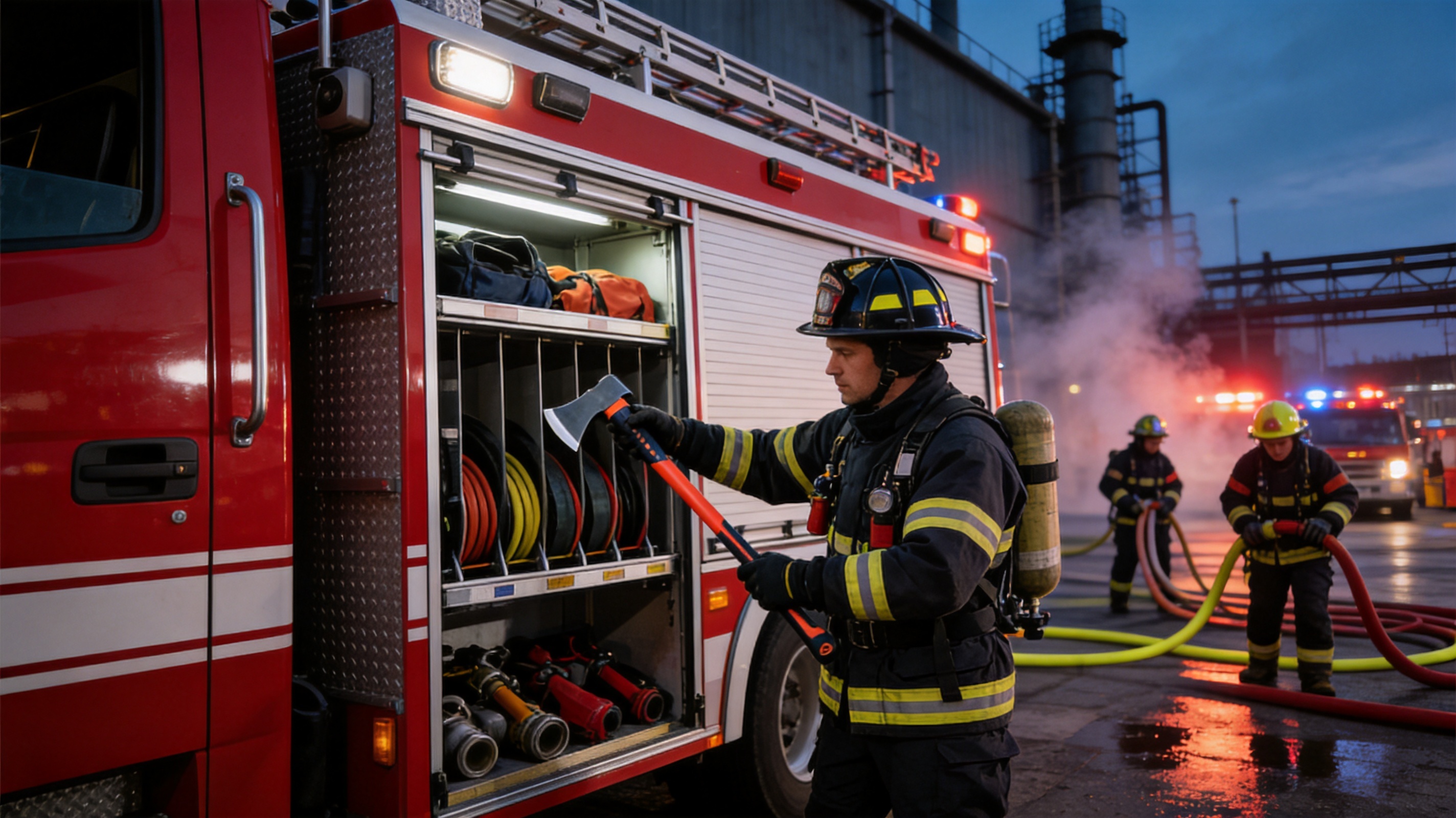
Firefighting axes are essential tools for emergency crews working in environments where speed, strength, reliability, and controlled force can make a decisive difference. During a structural fire, rescue operation, vehicle accident, industrial emergency, or disaster response mission, firefighters may need to breach doors, open roofing materials, clear obstacles, ventilate enclosed spaces, remove damaged structures, or gain access to trapped occupants. A professionally designed firefighting axe provides the mechanical advantage and striking capability needed to perform these tasks efficiently while remaining practical to carry and control.
The firefighting axe described in this article is developed for professional fire departments, emergency rescue personnel, industrial response teams, municipal services, and specialized rescue organizations. It combines a heat-treated forged carbon steel head with a carefully balanced fiberglass or hardwood handle. Multiple configurations are available to support different operational requirements, including forcible entry, ventilation, smoke removal, demolition, and general rescue work.
Manufactured by Tianchang Jinlv Fire Equipment Co., Ltd., the product reflects more than a decade of experience in fire protection accessories and emergency equipment. The manufacturer integrates material selection, forging, heat treatment, machining, handle fitting, finishing, inspection, and customization into a controlled production process. This approach helps provide stable quality, consistent performance, and dependable product support for distributors, fire equipment integrators, vehicle manufacturers, and end users.
Unlike ordinary household axes or general-purpose cutting tools, a professional firefighting axe is designed around the special demands of emergency work. It must withstand repeated impact, remain functional in harsh conditions, provide a secure grip when the user is wearing gloves, and support rapid deployment from a fire truck or rescue equipment compartment. The design must also balance striking power with portability, because a tool that is too heavy can cause fatigue, while one that is too light may not deliver sufficient force for difficult entry or demolition tasks.
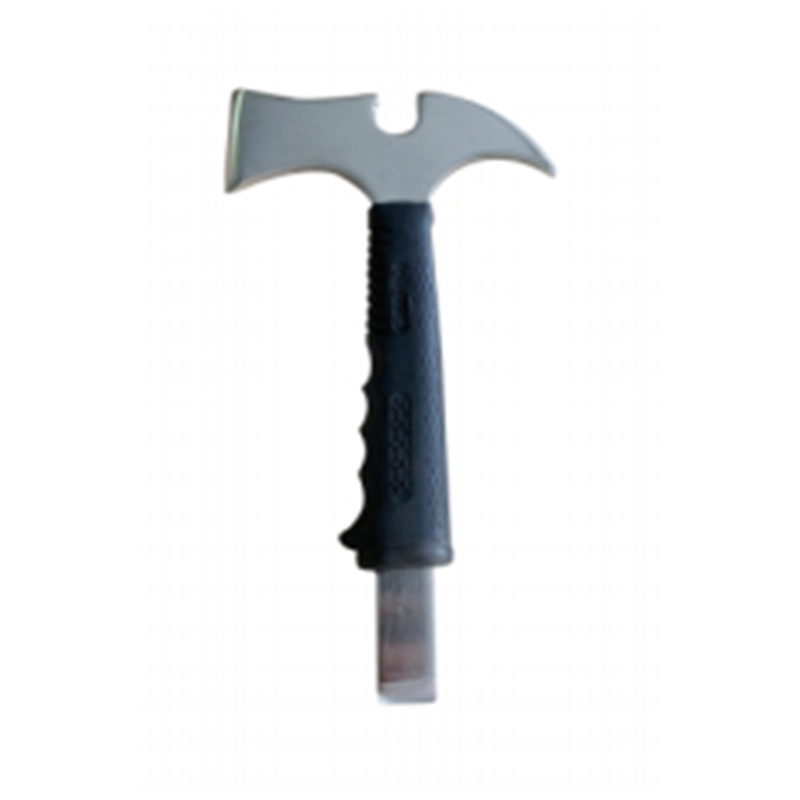
Firefighting Axe
1. The Role of a Firefighting Axe in Emergency Operations
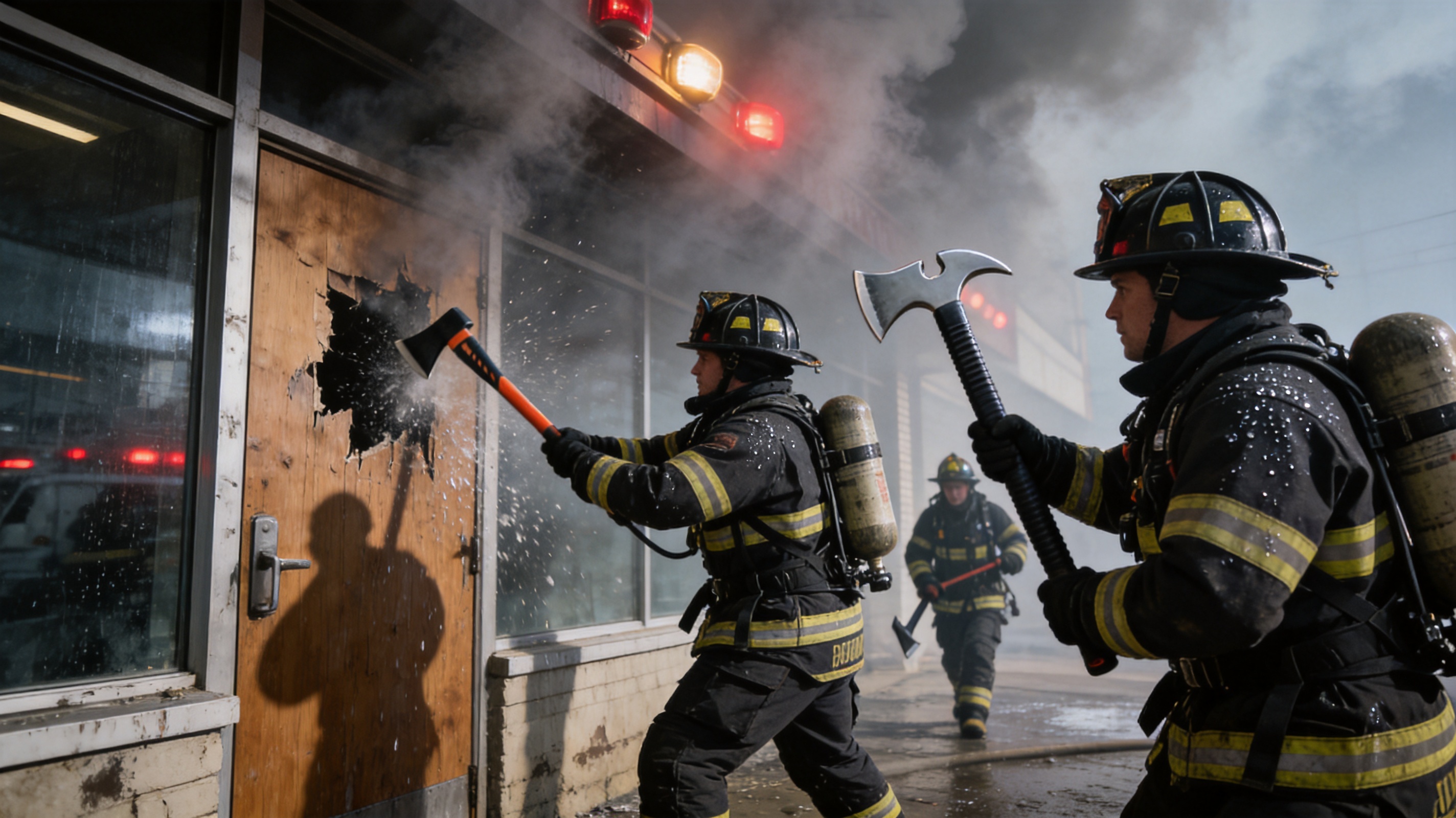
A firefighting axe is commonly associated with breaking through doors, but its role extends far beyond forcible entry. Firefighters use axes as versatile hand tools during many stages of an incident. They may be used to open access points, remove construction materials, expose hidden fire, clear debris, cut or pry selected components, and support rescue operations where powered equipment is unavailable or impractical.
In a fire environment, conditions can change quickly. Smoke, heat, poor visibility, unstable structures, water, falling materials, and limited access can prevent teams from using large tools or machinery. A compact hand tool can be carried directly into a building, moved through narrow passages, and used immediately when an obstruction is encountered. This makes the firefighting axe an important part of both personal protective equipment systems and truck-mounted rescue tool inventories.
Forcible entry is one of the best-known applications. When a door, window, partition, roof panel, or other barrier blocks access, an axe can help create an opening or work together with a halligan-type tool and other entry equipment. The axe head provides a striking edge and concentrated impact area, while the handle gives the operator reach and leverage. The correct technique depends on the structure, the position of the obstruction, the risk of hidden hazards, and the incident commander’s instructions.
Ventilation is another important application. Controlled ventilation can help release heat, smoke, and combustion gases, improving visibility and supporting safer rescue and suppression activities. A firefighting axe may assist with opening roofing materials, wall coverings, ceiling panels, or other building components. The tool is not a substitute for a complete ventilation plan, but it can provide a practical way to create or enlarge openings when conditions require immediate manual intervention.
Firefighters may also use axes during overhaul and salvage operations. After visible flames have been controlled, hidden fire can remain inside walls, ceilings, floors, furniture, insulation, and roof structures. A strong, properly balanced axe can help crews expose concealed areas for inspection. It can also assist in clearing damaged materials and improving access for thermal imaging, hose lines, or other inspection equipment.
In rescue scenarios, the axe can help remove lightweight obstructions, open compartments, break through selected materials, and create a path to an injured person. It may be carried by urban search and rescue teams, emergency response groups, industrial fire brigades, airport rescue units, and disaster relief organizations. Its usefulness comes from its independence from electricity, batteries, compressed air, or hydraulic power.
Operational Requirements for a Professional Axe
A professional firefighting axe must meet several requirements simultaneously. It needs a strong head that can absorb impact without premature deformation. It needs a handle that offers reliable attachment and comfortable control. It must be sufficiently balanced for accurate use, yet durable enough for demanding work. It should also be suitable for storage in fire truck compartments, equipment lockers, rescue packs, or personal tool carriers.
Surface condition is also important. Firefighters frequently work in wet environments, and equipment may be exposed to water, foam, smoke residue, dirt, oils, and other contaminants. A carefully finished and maintained axe is easier to inspect, clean, and return to service. Although no hand tool should be considered maintenance-free, appropriate material selection and production control can reduce avoidable service problems.
2. Product Construction and Material Selection
The performance of a firefighting axe begins with the relationship between the axe head, the handle, and the connection between them. Each component must perform as part of a single system. A high-strength head cannot compensate for a poorly fitted handle, and a durable handle cannot overcome an unsuitable head geometry. For this reason, professional manufacturing requires control over both individual components and final assembly.
Heat-Treated Forged Carbon Steel Head
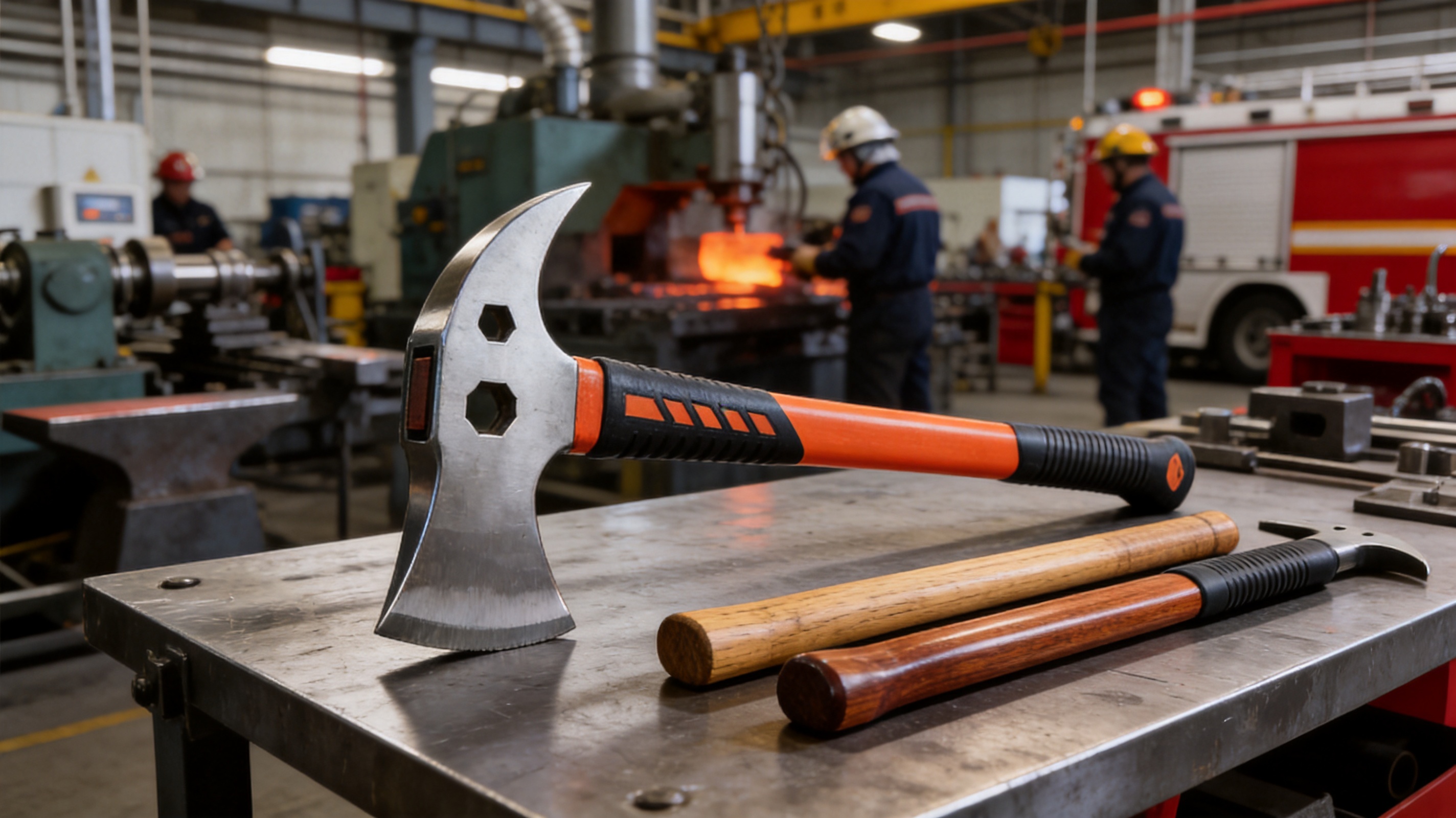
The axe head is manufactured from forged carbon steel and subjected to heat treatment. Forging forms the steel under controlled pressure, helping produce a dense and robust structure suitable for impact applications. Compared with low-strength cast or poorly controlled materials, a properly forged head can offer improved resistance to mechanical stress and repeated striking.
Heat treatment is used to adjust the mechanical properties of the carbon steel. Through controlled heating and cooling stages, the manufacturer can develop an appropriate balance between hardness, toughness, and resistance to deformation. The working edge needs sufficient hardness to maintain its geometry during use, while the main body of the head must retain toughness so that it can absorb impact without becoming excessively brittle.
This balance is especially important in emergency tools. An edge that is too soft may deform quickly, reducing penetration and cutting effectiveness. An edge that is excessively hard without adequate toughness may be more vulnerable to chipping under improper impact or contact with hidden metal. Controlled heat treatment supports a more suitable performance profile for professional rescue work.
Functional Head Geometry
Different firefighting axe configurations can be produced for different operational requirements. Depending on the selected design, the head may emphasize a cutting edge, a pointed penetration section, a striking face, or a combination of functional surfaces. These features allow the tool to address a wider range of barriers and emergency tasks than a conventional wood-cutting axe.
Head geometry also affects balance. The distribution of steel around the cutting edge, striking face, and rear section influences how the axe moves through the swing. A well-balanced tool can be easier to control, especially when the user must work in a confined space, wear thick gloves, or operate from an awkward position.
The product range is intended to support multiple configurations rather than forcing every customer to use one universal design. Fire departments and equipment distributors can select a suitable combination of head style, handle material, length, finish, and other specifications according to the intended application. OEM and ODM cooperation can further support private-label programs, vehicle-equipment packages, and project-specific requirements.
Fiberglass Handle Options
Fiberglass handles are valued for their strength, dimensional stability, and resistance to moisture-related changes. A fiberglass handle is not dependent on the same grain structure as a wooden handle, which can be advantageous when equipment is repeatedly exposed to water, humidity, or changing storage conditions. It can also provide consistent production dimensions for large orders.
For emergency teams that require standardized equipment across multiple vehicles or stations, fiberglass can offer practical benefits. Consistent handle dimensions can simplify storage planning, replacement purchasing, and equipment inspection. The handle can be shaped to support secure control and can be finished with a grip surface suitable for use with protective gloves.
Fiberglass does not eliminate the need for inspection. Firefighters should still check the handle for cracks, deep cuts, severe abrasion, looseness, or other signs of damage before use. The advantage of the material is that, when correctly designed and manufactured, it can provide a durable and stable alternative for professional service environments.
Hardwood Handle Options
Hardwood handles remain popular because they provide a traditional feel, natural shock absorption, and a familiar balance. Many professional users appreciate the tactile feedback and repairability associated with quality wood handles. Properly selected hardwood can provide a comfortable grip and an effective connection between the user and the forged steel head.
Wood requires suitable inspection and care. Users should look for cracks, splinters, compression damage, loose fitting, excessive drying, or moisture deterioration. When stored correctly and inspected regularly, a hardwood-handled firefighting axe can be a reliable tool for demanding rescue work.
Offering both fiberglass and hardwood handles gives buyers more flexibility. Some departments prioritize dimensional stability and low-maintenance storage, while others prefer the traditional handling characteristics of wood. The ability to select the handle material according to operational preference is one of the product’s practical advantages over fixed-specification alternatives.
3. Advantages Compared with Ordinary or Low-Grade Axes
Not every axe is suitable for firefighting. A general-purpose forestry axe, construction hatchet, or household splitting axe may be designed for different impact patterns, materials, and working conditions. Using the wrong tool can reduce efficiency and introduce unnecessary risk. A professional firefighting axe is distinguished by its intended use, material selection, balance, and manufacturing control.
Purpose-Built for Emergency Entry and Rescue
The first advantage is application focus. A firefighting axe is developed for emergency operations rather than routine wood processing. Its design considers the need to open barriers, expose concealed spaces, clear debris, and support rescue work. This makes it a more appropriate component of a fire department’s forcible entry and rescue equipment system.
Ordinary axes may have a cutting profile that works well on wood but performs less effectively against mixed building materials. Fire structures can include timber, composite panels, roofing materials, insulation, plasterboard, doors, metal fittings, and other obstacles. A professional emergency axe is configured to support controlled impact and penetration across a broader range of incident-related tasks.
Improved Strength and Impact Reliability
The use of forged carbon steel and controlled heat treatment provides a stronger foundation than poorly manufactured or unidentified steel alternatives. The product is designed to withstand demanding impact service when used correctly. Manufacturing consistency is important because firefighters must be able to trust that tools supplied across a fleet will have predictable characteristics.
In comparison, low-grade axes may show inconsistent head hardness, uneven edge geometry, rough finishing, weak handle connections, or poor balance. These issues may not be obvious during a visual inspection but can become serious problems under repeated impact. A controlled manufacturing process reduces variation and supports more reliable product quality.
Balanced Handling
Balance affects accuracy, fatigue, and user confidence. A well-balanced firefighting axe can help the operator direct force toward the intended point instead of wasting energy through uncontrolled movement. This is valuable during prolonged overhaul work or when access is restricted and the firefighter cannot use a full swing.
Balanced handling also supports teamwork. In a confined environment, every movement must be deliberate because other firefighters, hoses, ladders, structural elements, and victims may be nearby. A tool that is easier to control can contribute to more efficient and organized operations, although safe use always depends on training, communication, and scene assessment.
Choice of Handle Material
Many competing products are limited to one handle material. Providing fiberglass and hardwood options allows customers to match the axe to their storage conditions, operating preferences, maintenance practices, and procurement standards. This flexibility is particularly useful for international buyers who may have different expectations concerning handle design, weight, grip texture, and replacement procedures.
Suitable for Fleet and Project Procurement
Fire truck manufacturers, rescue equipment distributors, government procurement departments, and industrial emergency teams often need products that can be integrated into a wider equipment package. The firefighting axe can be supplied as part of a fire truck equipment program, a rescue compartment layout, or an emergency response tool set.
OEM and ODM support can help customers coordinate product appearance, packaging, markings, dimensions, handle style, and other project details. This is an important advantage over generic retail products that may be difficult to standardize across multiple vehicles or locations.
| Feature | Professional Firefighting Axe | Ordinary General-Purpose Axe | Operational Benefit |
|---|---|---|---|
| Primary application | Fire entry, rescue, ventilation, demolition, and overhaul | General cutting or splitting work | Better alignment with emergency response tasks |
| Head material | Forged carbon steel with controlled heat treatment | Material and treatment may vary widely | More consistent strength and impact performance |
| Handle options | Fiberglass or hardwood | Often limited to one standard option | Flexible selection for different users and storage conditions |
| Balance | Designed for controlled emergency handling | Usually optimized for routine cutting work | Improved control in confined or hazardous areas |
| Customization | OEM/ODM configurations available | Usually sold as a fixed retail specification | Easier integration into fleet and equipment programs |
| Quality management | Controlled production and inspection procedures | May vary by supplier and product grade | More predictable procurement quality |
4. Manufacturing Process and Quality Control
The manufacturer’s production capability is a central part of the product’s value. Firefighting tools are safety-related equipment, so quality cannot depend only on the final appearance. Reliable performance requires control from raw material procurement through processing, assembly, inspection, packaging, and delivery.
Raw Material Procurement
Production begins with the selection and verification of appropriate raw materials. Carbon steel must be suitable for forging and heat treatment. Handle materials must meet the required mechanical and dimensional standards. Procurement controls help reduce the risk of inconsistent composition, hidden defects, or unsuitable material substitutions.
A professional manufacturer can establish supplier requirements, incoming inspection procedures, material identification practices, and batch records. These measures help improve traceability and make it easier to investigate or correct quality issues if they arise.
Forging and Forming
Forging shapes the axe head under controlled mechanical pressure. This process is important because the head must withstand repeated impact and localized stress. The forming process creates the basic profile before subsequent operations refine the edge, striking areas, openings, and other functional surfaces.
Consistent forging depends on appropriate tooling, heating control, forming pressure, operator skill, and process timing. A manufacturer with established production experience can manage these factors more effectively than a workshop that relies on irregular manual methods. Stable forming also helps maintain consistent dimensions between production batches.
Heat Treatment
After forging and initial processing, the steel head undergoes heat treatment designed to achieve a suitable balance of hardness and toughness. Temperature control, holding time, cooling method, and subsequent treatment stages all influence the final properties of the steel.
Heat treatment must be appropriate for the selected carbon steel and intended product geometry. Excessive hardness can reduce toughness, while insufficient hardness may shorten edge life. A controlled process supports a practical working balance rather than focusing on a single material property.
Machining and Edge Processing
After the main forming and heat treatment stages, the head can be machined, ground, and finished to achieve the required geometry. The cutting edge, striking face, rear section, and handle opening must be processed with attention to alignment and dimensional accuracy.
Edge preparation is particularly important. The edge should be sufficiently sharp and correctly shaped for its intended emergency functions, while the head must retain enough material to withstand impact. Surface finishing also removes unwanted burrs and irregularities that could interfere with safe handling or assembly.
Handle Production and Fitting
Fiberglass handles are formed and finished to the required dimensions, while hardwood handles are selected, shaped, smoothed, and prepared for secure fitting. The connection between the head and handle is inspected carefully because it is one of the most important safety-related areas of a hand tool.
Fitting requires proper alignment, suitable contact, and a stable connection. A handle that is not correctly seated can affect balance and may become loose under impact. Quality control should therefore include inspection of the head-to-handle relationship, overall straightness, grip condition, and visible defects.
Surface Treatment and Final Finishing
Surface finishing helps protect the steel, improve appearance, support easier cleaning, and provide a consistent product presentation. Depending on customer requirements, different finishing and marking options may be available. The final product should be free from sharp unintended burrs, severe surface defects, loose components, and other conditions that could affect use or storage.
Final Inspection
Final inspection evaluates the completed axe rather than isolated components. Inspectors may check dimensions, weight, balance, edge condition, handle alignment, connection security, surface finish, labeling, and packaging. Inspection criteria can be adjusted according to customer drawings, sample approval requirements, or project specifications.
The company operates under a quality management framework certified to GB/T 19001-2016. A quality management system does not replace product-specific inspection, but it provides an organized structure for documenting processes, assigning responsibilities, managing nonconformities, and supporting continuous improvement.
5. Engineering Strengths and Product Development
Firefighting tools must evolve with the needs of modern emergency services. Fire departments increasingly require equipment that is lighter to carry, easier to store, compatible with standardized vehicle compartments, and capable of supporting multiple rescue procedures. Product development therefore involves more than changing the appearance of an axe. It requires an understanding of field conditions, user feedback, manufacturing feasibility, and procurement standards.
The manufacturer maintains a professional research and development team with experience in fire protection accessories. This supports the improvement of product structures, handle options, surface finishes, packaging methods, and custom configurations. Close attention to market trends can also help identify requirements from different regions and application sectors.
Customization for Different Applications
A municipal fire department may require a compact axe for personal or compartment storage. An industrial plant may prioritize a robust tool set for chemical, energy, manufacturing, or warehouse emergencies. A fire truck manufacturer may need an axe that fits a specified equipment rack or roller shutter compartment. A rescue equipment distributor may request multiple models for different customer groups.
OEM and ODM services make it possible to address these different needs. Depending on project scope, customization may involve dimensions, head configuration, handle material, grip design, surface treatment, markings, packaging, and product combinations. Technical discussions should define the intended use, storage limitations, expected quantities, applicable standards, and inspection requirements before production begins.
Integration with Fire Truck Equipment
The firefighting axe is particularly suitable for integration into broader fire truck equipment programs. The manufacturer also supplies fire protection accessories such as roller shutters, equipment stowage and mounting systems, boarding ladders, ladder racks, ladder handrails, nozzles, hose cannons, SCBA-related equipment, cab doors, and plastic tool components.
This broader product capability can simplify sourcing for customers that are developing or upgrading emergency vehicles. Instead of treating the axe as an isolated purchase, buyers can coordinate it with the layout of equipment compartments, mounting systems, access doors, and other rescue tools. Coordinated sourcing may improve compatibility, packaging efficiency, and project communication.
6. Applications Across Fire and Rescue Sectors
Municipal Fire Departments
Municipal fire departments require tools that can be deployed across residential, commercial, industrial, and public infrastructure incidents. A professional firefighting axe can be assigned to engine companies, ladder companies, rescue units, and specialized response vehicles. Its compact format allows it to be stored in compartments where larger powered tools may not fit.
Departments may select different head and handle configurations for different crews. A truck inventory can include axes for forcible entry, overhaul, ventilation support, and general debris removal. Standardized procurement can also make training, inspection, replacement, and fleet management more straightforward.
Industrial Fire Brigades
Industrial sites often maintain internal emergency response teams because incidents may occur far from municipal stations or involve specialized structures. Manufacturing plants, warehouses, energy facilities, ports, airports, and logistics centers may need reliable hand tools for initial response and access operations.
In these environments, storage conditions and maintenance schedules can vary. Fiberglass handles may be selected for locations with high humidity or frequent washdown, while hardwood handles may be preferred where traditional handling and simple field replacement are important. The correct selection should be based on the site’s risk assessment and emergency response procedures.
Urban Search and Rescue
Urban search and rescue teams work in damaged buildings, collapsed structures, transportation incidents, and disaster zones. They often carry a combination of powered equipment, lifting tools, cutting tools, and hand tools. A firefighting axe can provide a portable option for breaking or clearing selected materials when access is limited or when powered equipment cannot be used safely.
Because USAR operations may involve unstable structures and multiple rescue disciplines, tools must be used under a coordinated command system. The axe is most effective when it is included in a planned tool package and handled by personnel trained in structural assessment and rescue techniques.
Vehicle Rescue and Emergency Response
After vehicle collisions or other transportation emergencies, responders may need to clear interior materials, open compartments, remove obstructions, or create access for medical personnel. A firefighting axe can complement hydraulic cutters, spreaders, saws, and stabilization equipment. Its usefulness is greatest when a quick manual intervention is required or when powered tools cannot reach the target area.
Training and Demonstration Programs
Fire academies, technical schools, and emergency training centers can use professional axes for controlled instruction in tool handling, forcible entry principles, ventilation awareness, and overhaul procedures. Training should always take place under qualified supervision, with appropriate protective equipment, a controlled environment, and clear limits on acceptable targets and techniques.
7. Ergonomics, Storage, and Field Handling
A firefighting axe must be powerful enough for demanding tasks but manageable enough for repeated carrying and controlled use. Ergonomics influence user fatigue, grip security, swing control, and storage convenience. The handle length, head weight, grip profile, and overall balance should be considered together rather than evaluated separately.
Grip and Control
Firefighters normally work while wearing gloves, which can reduce tactile sensitivity and make it more difficult to maintain a secure grip. A suitable handle surface should provide dependable control without creating uncomfortable pressure points. The handle should also be free from splinters, sharp edges, excessive roughness, or other defects that could interfere with gloved operation.
Proper technique remains essential. Users should maintain a stable stance, confirm the target area, communicate with team members, and avoid striking materials that may produce unexpected movement or hidden hazards. The product’s balance can support control, but no tool design can replace training and sound operational judgment.
Compartment Storage
Fire truck equipment compartments must use space efficiently. Axes are often stored with entry tools, pike poles, hoses, nozzles, breathing apparatus accessories, and protective equipment. A compact and well-finished axe can be mounted in a dedicated holder or secured in a tool rack to prevent movement during vehicle travel.
Storage systems should keep the axe accessible while preventing accidental contact with personnel or nearby equipment. The tool should be protected from unnecessary moisture, chemical contamination, and mechanical damage. If the axe is supplied as part of a complete vehicle equipment program, its dimensions and mounting requirements should be confirmed during the design stage.
Inspection Before and After Use
Before use, personnel should inspect the head for cracks, severe deformation, chipped edges, excessive corrosion, or other damage. The handle should be checked for looseness, cracks, deep cuts, splintering, bending, or signs of impact failure. The connection between the head and handle should be secure, and the grip should be clean and free of substances that could reduce control.
After use, the axe should be cleaned according to the department’s maintenance procedure. Water, foam residue, smoke deposits, dirt, and corrosive substances should not be left on the tool unnecessarily. The tool should be dried and returned to its designated storage location. Any damage found during inspection should be reported and evaluated before the axe is placed back into service.
8. Procurement Guidance for Buyers and Distributors
When purchasing firefighting axes, buyers should look beyond the lowest unit price. The total value of a professional tool includes material quality, production consistency, service life, inspection support, customization capability, replacement availability, packaging, and supplier communication.
Define the Intended Use
Buyers should first identify whether the axe will be used mainly for forcible entry, ventilation, overhaul, rescue, demolition, industrial emergency response, or general fire truck equipment storage. The intended use influences the preferred head configuration, weight, handle length, and grip design.
Confirm Technical Specifications
Important specifications may include head material, heat treatment, overall length, head weight, edge geometry, handle material, handle finish, surface treatment, balance, packaging, and marking requirements. If a buyer has a technical drawing or existing equipment standard, these documents should be shared during the quotation and sample approval stages.
Evaluate Supplier Manufacturing Capability
A capable supplier should be able to explain its raw material controls, forging process, heat treatment, machining, handle fitting, inspection, packaging, and quality management procedures. Buyers may also request production samples, inspection records, photographs of manufacturing stages, or third-party testing where appropriate.
For larger projects, it is useful to establish a clear quality agreement covering sample approval, acceptable tolerances, inspection methods, packaging, delivery batches, nonconforming product handling, and after-sales communication. These measures reduce misunderstandings and help both parties maintain consistent expectations.
Consider OEM and ODM Requirements
Distributors and vehicle manufacturers may need private labeling, custom packaging, project-specific markings, or coordinated product appearance. These requirements should be identified before production because they can influence tooling, artwork, packaging materials, minimum order quantities, and delivery schedules.
Tianchang Jinlv Fire Equipment Co., Ltd. provides OEM/ODM cooperation and global technical support. Its experience across fire truck accessories and rescue equipment can be useful for customers developing complete equipment packages rather than purchasing a single standalone tool.
9. Company Manufacturing and Service Strengths
Tianchang Jinlv Fire Equipment Co., Ltd. was established in 2010 and has focused on fire protection accessories for approximately fifteen years. This industry experience supports a practical understanding of the requirements faced by fire truck manufacturers, emergency equipment distributors, rescue teams, and fire protection contractors.
The company operates with professional technical expertise, advanced production facilities, and a complete manufacturing process. Its production system covers the movement from raw material procurement to final product delivery. This integrated approach helps reduce process gaps and supports stable quality across different product categories.
Quality management is supported by GB/T 19001-2016 certification. The company states that it strictly controls each stage of production, with an emphasis on reliable product quality, efficient manufacturing, cost control, and customer service. These strengths are relevant to buyers that need consistent supply for fleet orders, distribution programs, or long-term equipment projects.
The company also maintains a research and development team with industry experience. Continuous investment in development allows it to follow changes in fire protection equipment requirements, improve products, and explore efficient and environmentally considerate solutions for different applications.
Its product portfolio includes fire truck roller shutters, equipment stowage and mounting systems, ladders, ladder racks, handrails, firefighting nozzles, hose cannons, demolition tools, SCBA equipment, cab doors, and plastic tool components. This range creates opportunities for coordinated sourcing and technical communication across a complete fire truck or rescue equipment project.
The company’s service philosophy is based on honesty, innovation, quality, and gratitude. For international customers, responsive communication is particularly important because product specifications, shipping arrangements, documentation, inspection requirements, and installation conditions must often be coordinated across different time zones and regulatory environments.
10. Safe and Responsible Use
A firefighting axe is a professional tool and should be used only by trained personnel or under qualified supervision. Users must follow the operating procedures of their fire department, rescue organization, or employer. The proper method depends on the target material, structure stability, environmental hazards, presence of utilities, fire conditions, and coordination with other responders.
Before striking, the user should assess the surrounding area and confirm that no team member, victim, hose, cable, pipe, or other critical object is in the tool’s path. Personnel should wear appropriate protective clothing, gloves, eye protection, helmets, and other equipment required by the operation. The axe should not be used as a substitute for specialized tools when the incident requires hydraulic, pneumatic, electrical, cutting, lifting, or stabilization equipment.
Axes should not be thrown, used as pry bars beyond their intended design, or struck against materials that may cause dangerous fragmentation without suitable protection and authorization. If the head, handle, or connection is damaged, the tool should be removed from service until inspected and repaired or replaced according to departmental policy.
11. Frequently Asked Questions
Q1: What is a firefighting axe used for?
A firefighting axe is used for forcible entry, ventilation support, smoke removal, overhaul, rescue access, demolition, and clearing selected obstacles. It can help firefighters open or enlarge access points, expose concealed fire, remove damaged materials, and support rescue operations in difficult environments.
Q2: How is a firefighting axe different from a regular axe?
A professional firefighting axe is designed specifically for emergency response. It uses a forged and heat-treated carbon steel head, a balanced configuration, and handle options intended for controlled impact and rescue work. A regular household, forestry, or splitting axe may be optimized for wood processing and may not provide the same functional geometry or emergency application focus.
Q3: Are fiberglass or hardwood handles better?
Both materials can be suitable when correctly manufactured and fitted. Fiberglass offers dimensional stability and resistance to moisture-related changes, while hardwood provides traditional handling characteristics and natural shock absorption. The best choice depends on the department’s preferences, climate, storage conditions, maintenance procedures, and replacement policy.
Q4: Is the axe suitable for fire truck storage?
Yes. The compact format and available configurations make it suitable for fire truck equipment compartments, tool racks, rescue lockers, and emergency response vehicles. Buyers should confirm the exact overall dimensions and mounting requirements when designing a storage system or equipment package.
Q5: Can the product be customized?
OEM and ODM customization can be discussed according to project requirements. Potential customization areas may include head configuration, handle material, dimensions, grip design, surface treatment, markings, packaging, and coordinated supply with other fire truck equipment. Final feasibility depends on the requested specifications, quantity, tooling, and approval process.
Q6: What quality controls are used during production?
The manufacturing process includes raw material procurement, forging, heat treatment, machining, handle production, fitting, finishing, inspection, and packaging. The company operates under a GB/T 19001-2016 quality management system and applies process controls intended to support stable product quality and consistent delivery.
Q7: Can the axe be used in extreme environments?
The product is designed for professional emergency and rescue applications, including demanding environments. However, no hand tool is immune to damage or misuse. Performance depends on correct selection, proper training, suitable protective equipment, regular inspection, and compliance with operational procedures.
Q8: How should a firefighting axe be maintained?
Inspect the head, edge, handle, grip, and head-to-handle connection before and after use. Remove water, foam, dirt, smoke residue, and corrosive contaminants. Dry the tool before storage and keep it secured in a designated holder. Any crack, severe deformation, looseness, or other significant damage should be evaluated before the tool returns to service.
Q9: Can the manufacturer supply other fire truck equipment?
Yes. The company’s product categories include roller shutters, equipment stowage and mounting systems, boarding ladders, ladder racks, ladder handrails, firefighting nozzles, hose cannons, demolition tools, SCBA equipment, cab doors, and plastic tool components. This can support customers seeking coordinated sourcing for fire truck and rescue equipment projects.
Q10: Who can purchase this type of product?
Potential customers include fire departments, rescue organizations, industrial fire brigades, emergency equipment distributors, fire truck manufacturers, municipal procurement agencies, airports, ports, infrastructure operators, and other organizations responsible for emergency response equipment.
12. Conclusion
A professional firefighting axe is a compact but highly capable component of modern fire rescue equipment. Its value comes from the combination of a forged and heat-treated carbon steel head, balanced construction, fiberglass or hardwood handle options, controlled manufacturing, and suitability for multiple emergency applications. It supports forcible entry, ventilation, overhaul, demolition, rescue access, and obstacle removal while remaining practical for storage on fire trucks and rescue vehicles.
Compared with ordinary or low-grade axes, the product offers a more specialized design, more consistent manufacturing approach, flexible handle selection, and better suitability for professional procurement. Its advantages are strengthened by the manufacturer’s experience in fire protection accessories, quality management system, research and development capability, OEM/ODM service, and broader fire truck equipment portfolio.
For buyers, the correct selection should be based on intended use, technical specifications, handle preference, storage requirements, procurement quantity, applicable quality expectations, and training procedures. When properly selected, inspected, maintained, and used by qualified personnel, the firefighting axe can provide dependable manual capability during some of the most demanding moments of fire and rescue operations.
References
1. GB/T 19001-2016, Quality Management Systems — Requirements.
2. International Fire Service Training Association, Principles of Firefighter Entry and Rescue Operations.
3. National Fire Protection Association, Standard Practices for Fire Service Tools and Equipment Maintenance.
4. National Fire Protection Association, Fire Service Occupational Safety and Health Guidance.
5. International Association of Fire Fighters, Firefighter Training and Operational Safety Principles.
6. General engineering references on forged carbon steel, heat treatment, tool balance, and impact-resistant hand tool design.
7. Manufacturer product information for professional firefighting axes and related fire truck equipment.
Product: Firefighting Axe
News
-
-
Two minutes into a working fire, a crew stands in front of a locked steel security door with a crowbar that is too short to pull with both hands. Nothing about the tool is broken. It was simply speci...
READ MORE -
Quick Answer The right fire fighting nozzle depends on three factors: the flow rate your pump can deliver, the pattern your crew needs on the fireground, and the thread standard your hose already us...
READ MORE -
When a fire apparatus rolls out of the station for a structure fire or a highway rescue, every bolt, hinge, and ladder surface is about to face heat, vibration, moisture, and rough handling. Some com...
READ MORE -
Every firefighter has opened a compartment door after a rough response only to find nozzles, webbing, and wrenches piled on top of each other. In gloves and low light, with the pump running, that is ...
READ MORE -
Two pumpers of the same model can feel like two different trucks on the same call. On the first, a firefighter reaches into a compartment, releases one latch with a gloved hand, and pulls a tray far ...
READ MORE
Hey! Interested in staying in the loop? Sign up for our updates.
WE WON'T SPAM YOU, PINKY PROMISE.

Tianchang Jinlv Fire Equipment Co., Ltd.
Copyright © Tianchang Jinlv Fire Equipment Co., Ltd. All rights reserved. Custom Fire Truck Equipment Supplier Fire Apparatus Parts Factory
