

 en
 English
 русский
 Español
 عربى

Every firefighter has opened a compartment door after a rough response only to find nozzles, webbing, and wrenches piled on top of each other. In gloves and low light, with the pump running, that is ...
READ MORE
Self-Contained Breathing Apparatus Seat for Fire and Rescue Vehicles
2026.09.19
Content
- 1 1. The Role of an Integrated SCBA Seat
- 2 2. Main Product Functions
- 3 3. Construction and Material Characteristics
- 4 4. Advantages Compared with Conventional Arrangements
- 5 5. Application Scenarios
- 6 6. Manufacturing Strengths and Production Process
- 7 7. Customization and OEM/ODM Support
- 8 8. Installation Considerations
- 9 9. Inspection, Maintenance, and Service Life
- 10 10. Safety and Operational Training
- 11 11. Procurement Evaluation Guide
- 12 12. Why Manufacturer Experience Matters
- 13 13. Sustainability and Cost Efficiency
- 14 14. Practical Limitations and Correct Use
- 15 15. Recommended Implementation Process
- 15.1 Step 1: Define the Vehicle Application
- 15.2 Step 2: Confirm the SCBA Cylinder
- 15.3 Step 3: Review the Interior Layout
- 15.4 Step 4: Select Materials and Features
- 15.5 Step 5: Approve Technical Drawings
- 15.6 Step 6: Conduct Prototype or Sample Verification
- 15.7 Step 7: Establish Inspection and Training Procedures
- 16 16. Frequently Asked Questions
- 16.1 Q1: What is the main purpose of the SCBA seat?
- 16.2 Q2: Which SCBA cylinders is the product designed to accommodate?
- 16.3 Q3: Can the cylinder be removed quickly?
- 16.4 Q4: What materials are available?
- 16.5 Q5: Is customization available?
- 16.6 Q6: Is the seat suitable for all fire trucks?
- 16.7 Q7: Does the seat replace an SCBA inspection program?
- 16.8 Q8: How does the integrated design compare with a separate seat and cylinder rack?
- 16.9 Q9: What should be checked during installation?
- 16.10 Q10: How should the product be maintained?
- 16.11 Q11: Does the manufacturer support OEM and ODM projects?
- 16.12 Q12: What information should be submitted for a quotation?
- 17 17. Conclusion
- 18 References
- 19 Product: Self-Contained Breathing Apparatus(SCBA) Seat
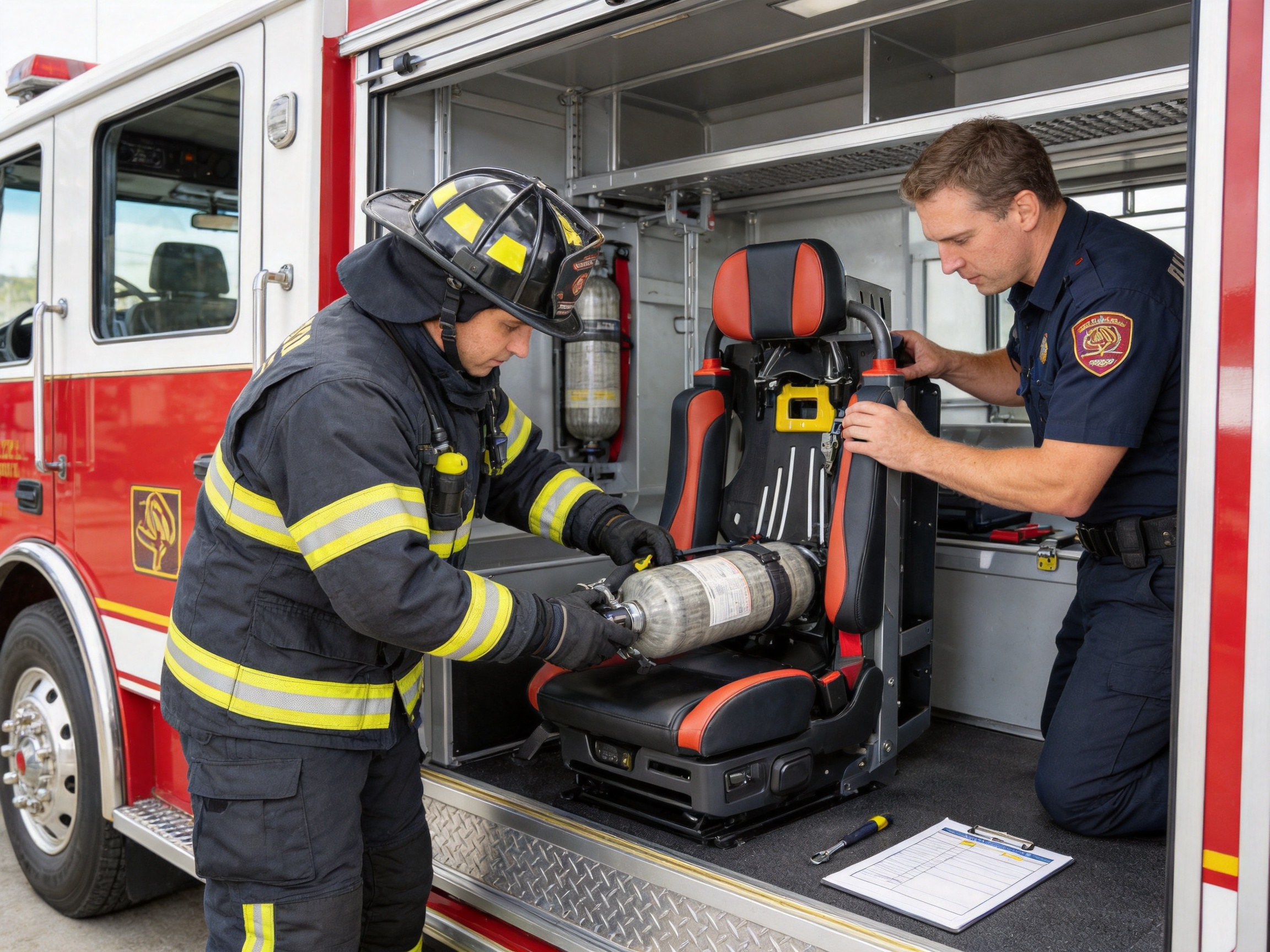
Firefighters often need to move from vehicle transport to emergency intervention within seconds. During this transition, equipment must remain secure, accessible, and ready for immediate use. A vehicle interior that does not provide organized storage can slow down deployment, create movement hazards, and expose valuable rescue equipment to unnecessary damage. The self-contained breathing apparatus seat is designed to address these challenges by combining three essential functions in one integrated structure: firefighter seating, SCBA cylinder retention, and interior safety protection.
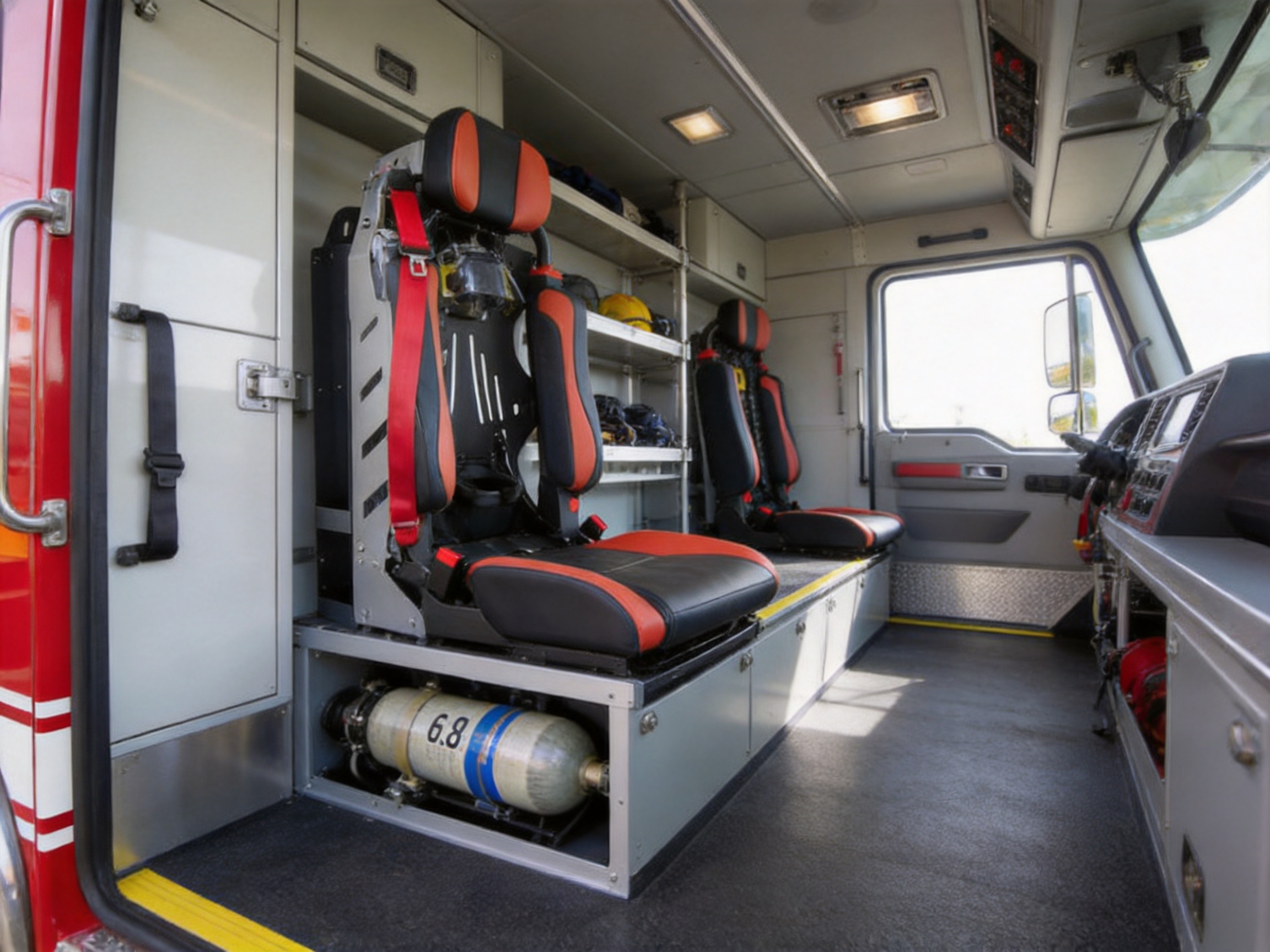
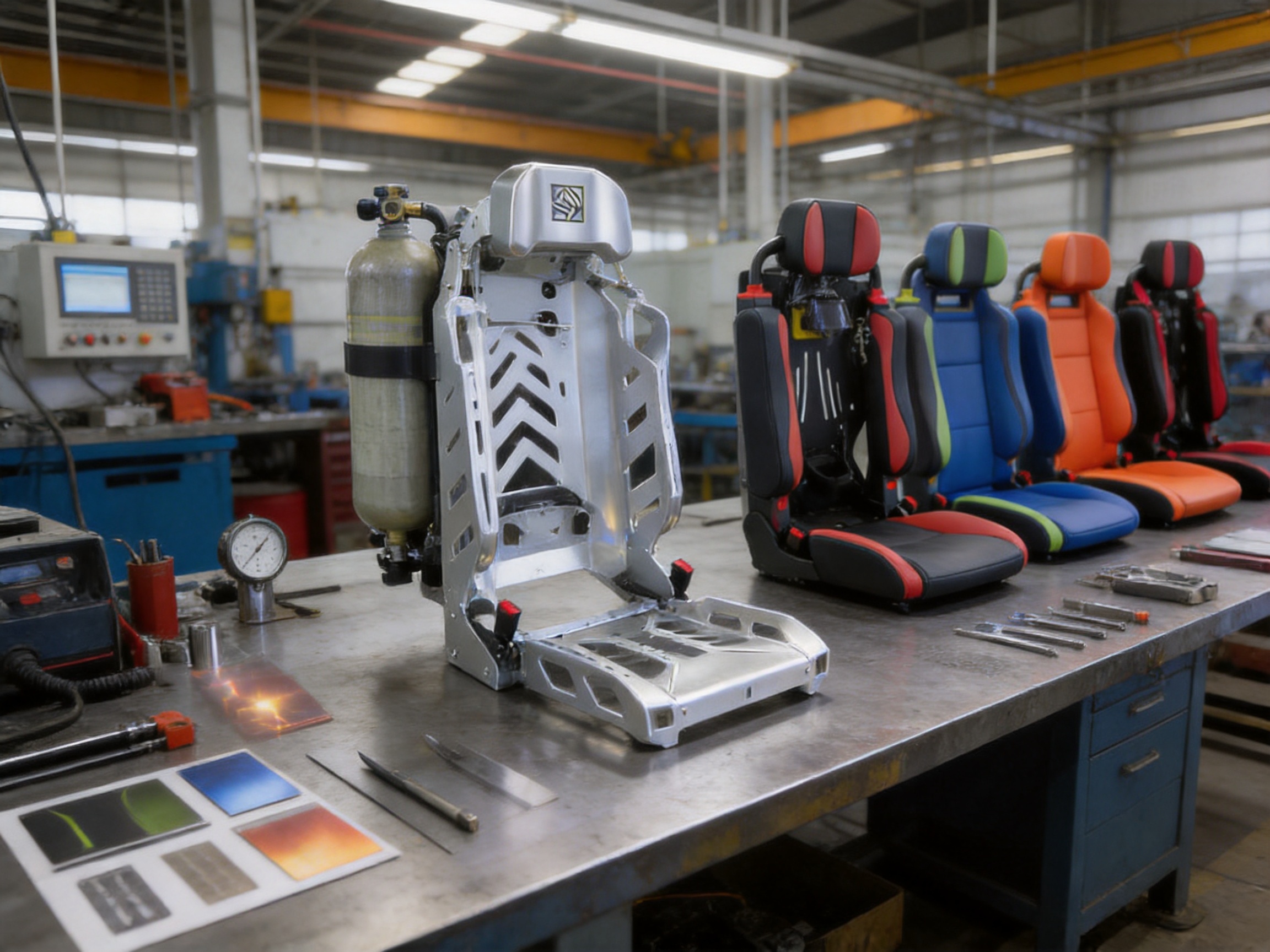
Developed for fire engines, rescue vehicles, and other emergency response platforms, this integrated SCBA air respirator bottle seat provides a practical solution for vehicles that must carry personnel and breathing apparatus in a limited cabin space. The design is adapted to standard 6.8-liter and 9-liter SCBA cylinders and reserves an appropriate cylinder position beneath or within the seating structure. This arrangement allows firefighters to board, sit, secure their equipment, and retrieve the breathing apparatus quickly when an incident requires immediate action.
Unlike a conventional vehicle seat placed beside loose equipment, the integrated design treats the seat and SCBA storage position as one coordinated system. The cylinder is held in a dedicated space rather than being left on the floor or placed in an improvised bracket. The result is a cleaner cabin layout, improved equipment organization, and a safer operating environment for emergency crews.
Tianchang Jinlv Fire Equipment Co., Ltd. manufactures this type of fire truck equipment as part of its broader range of fire protection accessories, vehicle storage systems, ladders, roller shutters, mounting components, and rescue equipment. With production experience dating back to 2010, the company combines product development, metal fabrication, surface treatment, assembly, quality control, and OEM/ODM support to serve fire vehicle manufacturers, emergency fleet operators, equipment distributors, and specialized vehicle integrators.
The following article examines the construction, performance advantages, application value, manufacturing considerations, customization possibilities, maintenance requirements, and procurement factors associated with the SCBA seat.
1. The Role of an Integrated SCBA Seat
A firefighter seat inside an emergency vehicle is not simply a place to sit. It forms part of the vehicle’s operational safety system. Personnel may be seated while wearing protective clothing, helmets, gloves, and other equipment. They may need to move rapidly after the vehicle stops, and they may need immediate access to an SCBA cylinder during a fire, chemical incident, confined-space rescue, or technical response operation.
In a conventional interior arrangement, the SCBA cylinder may be located in a separate cabinet, on an open rack, or in a floor-level storage area. While each arrangement can be suitable for certain vehicles, it may require additional movement or handling. The integrated seat places the cylinder in a carefully planned position close to the firefighter. This reduces unnecessary searching and helps maintain a predictable equipment layout.
The product is particularly useful where cabin space is limited. Fire engines and rescue vehicles must accommodate crew members, breathing apparatus, communication equipment, medical supplies, tools, and personal protective equipment. Every component must make efficient use of available space. By combining the seating function and cylinder storage function, the SCBA seat helps reduce duplicated structures and creates a more organized interior.
The cylinder position is designed to support rapid placement and removal. The available space is arranged to accommodate standard 6.8-liter and 9-liter breathing apparatus cylinders, while allowing the user to take out or return the cylinder without complicated procedures. This feature supports the stated second-level access requirement for emergency response, meaning the apparatus can remain readily available after the crew enters the vehicle and begins preparing for deployment.
For vehicle builders, an integrated design can also simplify interior planning. Instead of designing a seat, a separate cylinder rack, and additional protective panels independently, the vehicle manufacturer can consider one coordinated component. This may assist with installation, cabin layout, service access, and visual consistency.
2. Main Product Functions
2.1 Secure SCBA Cylinder Storage
The primary function of the product is to provide a designated location for an SCBA air respirator cylinder. A dedicated position helps prevent the cylinder from rolling, shifting, or interfering with crew movement. In a moving fire vehicle, unsecured cylinders can become hazardous objects. They may strike interior components, obstruct access, or create a trip hazard when personnel are entering or leaving the cabin.
The integrated seat gives the cylinder a defined storage area within the vehicle’s seating arrangement. The location is planned around common 6.8-liter and 9-liter cylinder sizes. Before installation, the vehicle integrator should confirm the exact cylinder diameter, length, valve arrangement, harness configuration, and clearance requirements of the intended SCBA model. This ensures that the storage position and surrounding structures provide suitable operational access.
2.2 Firefighter Seating
The second major function is personnel seating. The seat is designed for use in fire engines and rescue vehicles, where the user may be wearing heavy protective clothing and carrying additional equipment. A properly planned seat should provide stable support and enough room for the firefighter to sit, fasten any required restraint system, and exit without obstruction.
Product configurations may include a large seat cushion and waist support. These features can improve seating comfort during transport and provide a more supportive posture during longer journeys. The seat structure is also designed to preserve access to the cylinder position, ensuring that comfort improvements do not make the breathing apparatus difficult to retrieve.
2.3 Interior Safety Protection
Vehicle interiors used by emergency personnel must withstand demanding conditions. Equipment may be exposed to heat, moisture, dirt, vibration, impact, and repeated cleaning. The SCBA seat uses a special fire-resistant structural concept and galvanized iron components in key configurations. The metal construction provides a stable foundation for the seat and helps protect the cylinder storage area from ordinary mechanical contact.
The structure is intended to contribute to a safer interior by controlling the position of the cylinder and reducing exposed or poorly organized equipment. Its safety color options can also help distinguish the component from surrounding vehicle structures. A visually identifiable seat and storage unit may make it easier for personnel to recognize the correct equipment location, especially when operating under pressure or in low-light conditions.
2.4 Efficient Use of Vehicle Space
Emergency vehicles have a high equipment density. Storage cabinets, pump controls, hose compartments, electrical systems, communication units, and crew seating must all be arranged within a restricted body or cabin envelope. The integrated SCBA seat supports efficient spatial planning because the seating and cylinder storage functions are combined.
This does not mean that the seat replaces every type of SCBA rack. Different vehicle models and response teams may require different mounting arrangements. However, for applications where crew seating and breathing apparatus access are located in the same cabin zone, the integrated approach can reduce clutter and improve the overall logic of the interior layout.
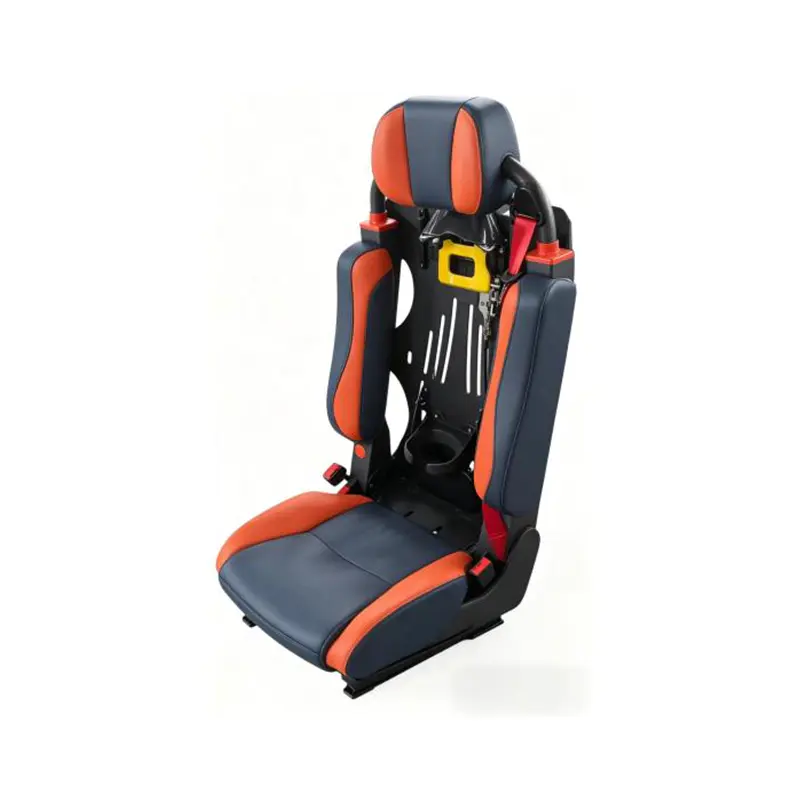
Self-Contained Breathing Apparatus(SCBA) Seat
3. Construction and Material Characteristics
3.1 Galvanized Iron Structural Components
The product information identifies iron with a galvanized coating as a principal material option. Galvanization is widely used to improve the resistance of steel or iron components against corrosion. A zinc coating creates a protective barrier and can provide additional sacrificial protection if the surface is scratched or exposed to moisture.
This characteristic is valuable in fire and rescue vehicles because equipment may encounter water, firefighting foam, wet protective clothing, road spray, condensation, and cleaning agents. Although galvanized material does not eliminate the need for maintenance, it can improve durability compared with untreated carbon steel in similar conditions.
The metal structure also provides a firm foundation for the seat and cylinder position. It can be engineered to maintain its shape during normal vehicle vibration and repeated equipment handling. Correct material thickness, joint design, mounting points, and load distribution remain important and should be verified during vehicle integration.
3.2 Fire-Resistant Structural Concept
Fire apparatus equipment operates in environments where heat and flame exposure may be possible. The SCBA seat incorporates a fire-resistant special structure intended for emergency vehicle use. Its fire-resistant design should be understood as part of the vehicle’s equipment arrangement rather than as a claim that the complete seat can withstand every fire condition indefinitely.
The vehicle manufacturer and end user should evaluate the seat together with the cabin materials, protective coverings, upholstery, fasteners, restraints, and surrounding systems. In-service exposure depends on vehicle design, incident conditions, distance from the fire, ventilation, and duration of heat exposure. Even so, the use of suitable metal construction and a purpose-designed layout provides a more appropriate foundation for fire vehicle applications than an ordinary passenger seat adapted without consideration of SCBA storage.
3.3 Lightweight Hollow Structure
Some product configurations use a lightweight hollow structure and a breathable design. The purpose of this approach is to reduce unnecessary mass while maintaining practical support and coverage. Weight management is important in emergency vehicles because the vehicle must carry crew members, water, hoses, tools, pumps, ladders, medical equipment, and other systems without exceeding its permitted gross vehicle weight.
A hollow structure can also allow air movement around the seating area and simplify cleaning of certain surfaces. Open or semi-open forms may reduce the number of enclosed areas where dust, moisture, or debris can accumulate. The specific benefits depend on the final configuration, surface treatment, upholstery, and installation arrangement.
Lightweight construction should not be confused with weak construction. A correctly engineered structure balances mass, rigidity, load support, mounting security, and user comfort. For this reason, buyers should request product drawings, installation details, load information, and material specifications for the intended vehicle application.
3.4 Seat Cushion and Waist Support
The available configuration may include a large seat cushion and waist support. Firefighters often work while wearing thick clothing and equipment that change the way they sit. A larger cushion can distribute body pressure more evenly, while waist support may help maintain a more stable posture during transport.
Comfort has an operational value. A fatigued or poorly supported firefighter may have more difficulty preparing equipment after arrival. A seat that supports a practical posture can contribute to a more efficient transition from transport to intervention. The cushion material, covering, stitching, fastening method, and fire-performance characteristics should be selected according to the vehicle operator’s requirements.
4. Advantages Compared with Conventional Arrangements
4.1 Integrated Functionality
The most important advantage of the SCBA seat is the integration of seating and cylinder storage. A conventional vehicle seat usually performs only the seating function. A separate SCBA rack may then be installed elsewhere, requiring additional space and separate mounting work. The integrated product addresses both needs within a coordinated assembly.
This integrated approach can reduce layout complexity and make the cabin easier to understand. Firefighters can learn one consistent location for the seat and associated breathing apparatus. Fleet operators can also standardize the interior arrangement across multiple vehicles when the same component is selected for a vehicle series.
4.2 Faster Equipment Access
Emergency operations are time-sensitive. A firefighter may need to don respiratory protection before entering a smoke-filled structure, industrial facility, tunnel, basement, or other hazardous area. The reserved cylinder position allows the equipment to remain near the crew member and supports convenient removal.
Fast access does not depend on the seat alone. The SCBA cylinder must be correctly secured, the surrounding space must remain clear, and the crew must receive appropriate training. Nevertheless, a purpose-designed seat can remove some of the avoidable delays associated with poorly placed or loosely stored equipment.
4.3 Better Cabin Organization
Loose cylinders and improvised storage can create visual and physical disorder. An integrated seat provides a defined location and helps maintain a more disciplined cabin arrangement. Better organization can support faster inspections because missing, misplaced, or incorrectly positioned equipment is easier to identify.
A clean interior also helps reduce interference with doors, walkways, communication equipment, and other emergency systems. The product should be installed as part of a complete cabin plan so that access to emergency exits, seat belts, controls, and adjacent cabinets is not restricted.
4.4 Reduced Installation Duplication
When a seat and cylinder rack are purchased separately, the vehicle builder may need to create additional brackets, protective panels, or transition pieces. The integrated product can reduce some of this duplication by providing a coordinated assembly. This may help streamline procurement and installation, particularly for standardized vehicle models.
The actual installation benefit depends on the vehicle design and the degree of customization required. Jinlv Fire supports OEM and ODM cooperation, allowing buyers to discuss dimensions, mounting points, materials, colors, cushion arrangements, and other project requirements before production.
4.5 Professional Appearance
Emergency equipment must be practical, but its appearance also communicates quality and discipline. The product uses a distinctive safety color scheme and a dynamic structural appearance. A consistent color and finish can help the seat stand out from ordinary interior panels and make the equipment location easier to identify.
For fleet builders, a professional appearance may support brand consistency, customer confidence, and acceptance by fire departments or industrial response teams. Appearance should never replace performance, but a well-finished product can complement a high-quality vehicle interior.
5. Application Scenarios
5.1 Fire Engines
Fire engines carry crews directly to structural fires, vehicle fires, outdoor fires, and other incidents. The crew cabin must support rapid preparation while the vehicle is traveling. The SCBA seat can be positioned where firefighters can sit during transport and retrieve their cylinders when the vehicle reaches the incident location.
The seat may be suitable for front or rear crew areas depending on the vehicle design. Installation engineers should account for cab dimensions, door opening angles, seat spacing, occupant restraints, electrical wiring, and access to other emergency equipment.
5.2 Rescue Vehicles
Rescue vehicles may respond to traffic collisions, industrial accidents, structural collapse, flood events, confined spaces, and technical rescue missions. These vehicles often carry a wide variety of tools and may have changing equipment requirements. An integrated seat can provide a stable position for SCBA storage while preserving nearby space for rescue tools and medical supplies.
Because rescue vehicle missions vary widely, the product may be configured according to the operating team’s priorities. Some customers may emphasize larger cushions and waist support. Others may prioritize a compact structure, specific cylinder clearance, or coordination with a custom cabin module.
5.3 Industrial Emergency Response Vehicles
Industrial plants, energy facilities, chemical sites, ports, mines, and large manufacturing complexes may operate their own emergency response vehicles. These vehicles frequently require specialized equipment storage and may need to transport personnel wearing protective clothing.
The SCBA seat can be considered for industrial fleets that need a controlled location for respiratory protection equipment. Before selection, the user should assess the hazards present at the site, the expected cylinder type, applicable local regulations, required restraint systems, cleaning procedures, and the vehicle’s internal fire protection arrangements.
5.4 Airport and Infrastructure Rescue Fleets
Airport rescue and firefighting vehicles, tunnel response vehicles, utility emergency vehicles, and municipal rescue fleets may also benefit from organized SCBA storage. These operations often require rapid deployment and repeated equipment checks. A standardized seat design can contribute to consistent fleet layouts and simplified user training.
6. Manufacturing Strengths and Production Process
The performance of a fire vehicle component depends not only on its design but also on how it is manufactured. Consistency in material preparation, forming, welding, coating, assembly, and inspection is essential when the product must operate in demanding conditions. Tianchang Jinlv Fire Equipment Co., Ltd. has developed a production system focused on fire protection accessories and vehicle equipment.
6.1 Product Development and Engineering Review
Manufacturing begins with understanding the application. An SCBA seat must be evaluated according to cylinder dimensions, crew seating requirements, available cabin space, mounting direction, access routes, cleaning conditions, and vehicle vibration. Engineering review can identify potential conflicts before production begins.
For OEM and ODM projects, the customer may provide vehicle drawings, cabin layouts, cylinder information, or existing installation dimensions. The manufacturer can then discuss structural proportions, mounting points, seat cushion size, waist support, safety colors, surface treatment, and other requirements. This collaborative process is useful when the product must fit a new fire engine body or a special rescue vehicle.
6.2 Material Procurement and Verification
Material quality affects the strength, corrosion resistance, appearance, and service life of the finished assembly. The company’s quality approach includes control from raw material procurement through final product delivery. Metal sheets, profiles, fasteners, coatings, cushion materials, and other components should be selected according to the product design and the customer’s application.
For galvanized iron components, the condition of the base metal and the quality of the protective coating are important. Surfaces should be checked for damage, contamination, poor adhesion, sharp edges, and other defects that could affect assembly or service. Where the customer requires special materials or finishes, these requirements should be defined before production.
6.3 Cutting, Forming, and Structural Fabrication
Metal components are cut and formed to create the seat frame, cylinder support area, side structures, mounting elements, and protective sections. Accurate dimensional control helps ensure that parts fit together correctly and that the final seat aligns with the vehicle interior.
Formed sections can improve rigidity without adding unnecessary weight. A hollow or reinforced structure may be used to achieve a balance between strength and mass. The exact arrangement depends on the selected model and customization requirements.
Fabrication quality is especially important around mounting holes, load-bearing joints, cylinder contact areas, and edges near the firefighter. Smooth finishing and appropriate edge treatment help reduce the risk of damage to clothing, hoses, cylinder surfaces, or hands during normal use.
6.4 Welding and Joint Control
Welded joints must provide reliable structural continuity. Welding parameters, joint preparation, operator skill, and post-weld inspection all influence the finished result. Areas that support the seat or retain the cylinder deserve particular attention because repeated vibration and equipment handling can place stress on these locations.
After welding, the structure should be checked for distortion, incomplete joints, excessive spatter, sharp projections, and dimensional deviation. Corrective finishing may be performed before coating or assembly. A disciplined welding process helps maintain consistency across production batches.
6.5 Surface Treatment and Galvanized Protection
Surface treatment helps protect metal components and contributes to the product’s professional appearance. Galvanized coating is particularly relevant where resistance to moisture and corrosion is required. Coated surfaces should be visually inspected and handled carefully during subsequent assembly to reduce unnecessary damage.
Where customers request a specific color scheme, the finish should be coordinated with the vehicle interior and safety identification system. Distinctive colors can help make the seat recognizable, while a clean surface supports easier routine inspection and maintenance.
6.6 Assembly and Functional Inspection
Final assembly brings together the structural frame, cushion, waist support, cylinder storage components, mounting hardware, and other selected parts. The assembly process should confirm that the cylinder position is accessible, the seat is stable, and no component interferes with normal use.
Functional inspection may include dimensional checks, visual inspection, mounting verification, movement checks, surface inspection, and review of customized requirements. The product should be assessed in relation to its intended vehicle installation rather than only as an isolated component.
6.7 Quality Management
Tianchang Jinlv Fire Equipment Co., Ltd. states that it has passed GB/T 19001-2016 quality certification. A quality management system supports consistent processes, documented responsibilities, production traceability, corrective action, and continual improvement. Certification alone does not replace product-specific evaluation, but it indicates that the manufacturer has established a structured approach to quality control.
The company’s production philosophy emphasizes control from raw material procurement to final delivery. This is important for fire vehicle equipment because the customer often requires repeatability across multiple units. Stable production can help ensure that replacement parts, fleet installations, and customized batches remain consistent.
7. Customization and OEM/ODM Support
Fire vehicles are rarely identical. Cab dimensions, crew numbers, cylinder brands, access doors, interior panels, seat spacing, and storage requirements vary between platforms. A standard product can provide a practical starting point, but customization may be required for successful integration.
7.1 Dimensional Customization
Customers may request changes to the overall width, height, depth, seat cushion dimensions, cylinder clearance, or mounting position. Dimensional changes should be evaluated carefully to preserve access, structural stability, and compatibility with the selected SCBA cylinder.
7.2 Material and Finish Options
The product can be discussed with regard to aluminum or galvanized iron configurations, depending on the intended application. The provided product information identifies galvanized iron for key flame-retardant and safety configurations and aluminum for lightweight, larger-seat, and waist-support configurations. Final material selection should consider mass, corrosion exposure, structural requirements, cost, and customer specifications.
Color customization may also be available. Safety colors can improve visibility and help coordinate the product with the vehicle’s interior. Customers should specify color requirements using an agreed reference system before production.
7.3 Seat Comfort Customization
Seat cushion size, cushion thickness, waist support, covering material, and support geometry may be discussed for different crew requirements. A compact configuration may be preferred in a narrow cabin, while a larger cushion may be selected for improved comfort in a spacious rescue vehicle.
7.4 Cylinder Compatibility
The standard application supports 6.8-liter and 9-liter SCBA cylinders. If a customer uses another cylinder size or a non-standard harness arrangement, the manufacturer should receive accurate technical information before design confirmation. Compatibility should be verified using actual cylinder dimensions and the vehicle’s intended mounting position.
7.5 Vehicle Integration
For OEM and ODM projects, the seat may be developed alongside other fire truck components, including roller shutters, storage systems, ladders, handrails, tool mounting structures, and interior protection panels. Coordinating these parts through one supplier can simplify communication and support a more consistent fit and finish.
8. Installation Considerations
Installation should be completed by qualified vehicle integration personnel. The seat must be mounted to a structure capable of supporting the intended loads and resisting vibration. The mounting area should be checked for hidden wiring, fuel lines, hydraulic lines, structural members, and other systems before drilling or fastening.
The installer should confirm that the seat does not obstruct doors, emergency exits, walkways, controls, communication systems, lighting, ventilation, or adjacent equipment. The SCBA cylinder should be removable without unreasonable force or awkward movement. The storage position should also be checked with the firefighter wearing typical protective clothing.
Where seat belts or other occupant restraint systems are required, their attachment and operation must be evaluated according to the vehicle design and applicable regulations. The integrated SCBA seat should not be treated as a substitute for required restraint systems.
After installation, the vehicle should undergo a practical access test. Personnel should board the vehicle, sit in the intended position, identify and remove the cylinder, return the cylinder to its storage area, and exit the vehicle. This process can reveal interference that may not be obvious from a drawing alone.
Installation documentation should include product dimensions, mounting recommendations, hardware information, cylinder compatibility notes, cleaning guidance, and inspection requirements. For fleet projects, photographs or diagrams can help ensure that every vehicle receives the same arrangement.
9. Inspection, Maintenance, and Service Life
Routine inspection is essential for all fire vehicle equipment. Before each operational period, users should visually examine the seat frame, cylinder position, mounting hardware, cushion, waist support, coating, and surrounding structures. Any loose fastener, crack, deformation, sharp edge, severe corrosion, damaged cushion, or obstructed access path should be reported and corrected.
The cylinder storage area should be kept free from tools, debris, and liquids that could interfere with placement or removal. The cylinder itself must be inspected according to the SCBA manufacturer’s instructions. The seat is a storage and seating component; it does not replace the inspection, testing, or maintenance requirements of the breathing apparatus.
Cleaning should use methods compatible with galvanized surfaces, cushion materials, and vehicle interior finishes. Harsh chemicals, abrasive tools, or excessive pressure may damage protective coatings or upholstery. After wet cleaning, the component should be dried appropriately to reduce corrosion and odor.
Fasteners should be checked periodically, particularly after the vehicle has operated on rough roads or experienced heavy equipment handling. If the seat is involved in an accident, severe impact, fire exposure, or unusual loading event, it should be removed from service until inspected by qualified personnel.
Service life depends on usage frequency, environmental exposure, vehicle vibration, cleaning practices, installation quality, and maintenance. A well-managed inspection program helps identify wear before it becomes an operational problem.
10. Safety and Operational Training
A well-designed product is most effective when combined with proper training. Firefighters should know the exact location of the cylinder, the correct removal technique, the storage procedure, and the limits of the equipment. Training should be performed while wearing representative protective clothing because gloves, coats, breathing apparatus harnesses, and helmets can affect movement.
Personnel should avoid using the cylinder storage position for unrelated tools or personal items. The seat should not be overloaded or modified without authorization. Any temporary equipment placed near the cylinder should be removed before deployment.
Vehicle operators should include the SCBA seat in regular equipment checks. The inspection should confirm that the cylinder is present, correctly positioned, accessible, and not blocked by other equipment. A short access drill can help verify that the arrangement continues to work after the vehicle has been modified or additional tools have been added.
Training should also address communication between crew members. In a crowded cabin, one firefighter may need to retrieve a cylinder while another is entering or preparing equipment. A predictable layout and agreed procedure can reduce confusion during rapid response.
11. Procurement Evaluation Guide
Purchasers should evaluate the SCBA seat according to the entire vehicle application rather than selecting only by appearance or price. The following points can support a more complete technical review.
| Evaluation Item | Questions for the Buyer | Why It Matters |
|---|---|---|
| SCBA compatibility | Is the seat suitable for the intended 6.8-liter or 9-liter cylinder, and are the actual dimensions confirmed? | Ensures that the cylinder can be stored, secured, and removed efficiently. |
| Vehicle integration | Do the dimensions and mounting points match the cabin structure and interior layout? | Prevents interference with doors, controls, wiring, and adjacent equipment. |
| Material selection | Is galvanized iron, aluminum, or another material appropriate for the operating environment? | Balances strength, corrosion resistance, weight, durability, and cost. |
| Seat comfort | Does the cushion and waist support accommodate firefighters wearing protective clothing? | Supports stable seating and practical transport comfort. |
| Access speed | Can the cylinder be taken out and returned without obstruction? | Supports rapid deployment during emergency response. |
| Surface protection | Are the coating, finish, and color suitable for moisture, cleaning, and fleet identification? | Contributes to service life, inspection visibility, and professional appearance. |
| Quality documentation | Can the supplier provide drawings, material details, inspection information, and installation guidance? | Supports engineering approval, traceability, and consistent fleet installation. |
| Customization | Can the supplier adjust dimensions, colors, cushion size, support features, or mounting details? | Allows the product to fit special vehicle platforms and user requirements. |
| After-sales support | Are replacement components, technical communication, and service assistance available? | Helps maintain the product throughout the vehicle’s working life. |
A qualified supplier should be willing to review vehicle drawings and discuss the intended operating environment. Buyers should also confirm packaging, delivery protection, replacement part availability, warranty conditions, and inspection procedures before placing a large order.
12. Why Manufacturer Experience Matters
Fire vehicle components are specialized products. A supplier that understands only general metal fabrication may not fully appreciate the operational requirements of emergency fleets. Experience with fire truck equipment helps the manufacturer consider rapid access, protective clothing, vibration, corrosion, safety identification, cleaning, cabin organization, and integration with other vehicle systems.
Tianchang Jinlv Fire Equipment Co., Ltd. has focused on fire protection accessories for approximately 15 years. Its product scope includes fire truck roller shutters, equipment storage systems, boarding ladders, ladder racks, handrails, firefighting nozzles, hose cannons, demolition tools, SCBA equipment, cab doors, and plastic tool components. This broader product range gives the company experience with the way individual vehicle components interact within a complete emergency response platform.
The company reports that it maintains advanced production facilities, a complete manufacturing process, professional research and development personnel, and a quality management system certified to GB/T 19001-2016. Its stated corporate principles include honesty, innovation, quality, and gratitude. These principles are reflected in its emphasis on product development, process control, customer communication, and technical support.
For international customers, the ability to communicate about design changes and installation requirements is especially important. OEM and ODM cooperation allows a fire truck builder or distributor to request a product adapted to a particular market, vehicle model, or fleet standard. Technical communication before production can reduce misunderstandings and help ensure that the final product meets the intended application.
13. Sustainability and Cost Efficiency
Cost efficiency in fire vehicle equipment should be evaluated over the full service life rather than only by initial purchase price. A durable seat that is easy to inspect, clean, repair, and integrate may provide better value than a lower-cost component that requires frequent replacement or modification.
Material efficiency is also relevant. A lightweight hollow structure can help control vehicle weight, while galvanized surfaces may reduce premature corrosion-related replacement. A design that combines seating and SCBA storage can reduce the need for separate brackets or protective structures in some vehicle layouts.
Manufacturing efficiency contributes to cost control as well. A complete production process, standardized quality procedures, and experienced assembly personnel can support stable output and reduce variation between units. This is particularly valuable for fleet orders where multiple vehicles must use consistent components.
Environmental responsibility includes appropriate material selection, reduced rework, controlled surface treatment, efficient packaging, and long-term product durability. Customers may wish to discuss their own environmental and procurement requirements during the OEM or ODM design stage.
14. Practical Limitations and Correct Use
The SCBA seat is designed to improve organization, access, and seating within a fire or rescue vehicle, but it does not solve every vehicle interior challenge. The final result depends on correct installation, compatible cylinders, suitable restraints, appropriate surrounding structures, and disciplined crew procedures.
The product should not be modified by drilling new holes, cutting structural parts, removing supports, or adding unapproved accessories without consulting the manufacturer or a qualified engineer. Changes may affect strength, cylinder access, corrosion protection, or occupant safety.
The seat should also not be used as a general-purpose cargo platform. Heavy tools, loose cylinders, and unrelated equipment should not be placed on the cushion or in the cylinder position. Maintaining the intended function of each area is essential for reliable emergency access.
Customers should confirm all applicable national, regional, vehicle, and occupational safety requirements before final selection. Product information should be reviewed together with the vehicle builder’s technical standards and the SCBA equipment manufacturer’s instructions.
15. Recommended Implementation Process
Step 1: Define the Vehicle Application
Identify the vehicle type, cabin layout, crew capacity, intended operating environment, and expected emergency missions. Determine whether the product will be installed in a fire engine, rescue vehicle, industrial response vehicle, airport vehicle, or another specialized platform.
Step 2: Confirm the SCBA Cylinder
Record the cylinder capacity, external dimensions, valve configuration, harness arrangement, and preferred removal direction. Confirm whether the intended equipment is a standard 6.8-liter or 9-liter cylinder or requires a customized design.
Step 3: Review the Interior Layout
Provide cabin drawings or accurate measurements. Mark doors, windows, control panels, communication equipment, electrical components, seat belts, walkways, and adjacent storage systems. This information helps the supplier evaluate clearances and mounting positions.
Step 4: Select Materials and Features
Discuss galvanized iron or aluminum options, cushion size, waist support, hollow structure requirements, protective finish, color, and other customization details. Consider the vehicle’s weight limits and environmental exposure.
Step 5: Approve Technical Drawings
Review dimensions, mounting holes, cylinder clearance, seat height, access direction, and surrounding safety distances. Technical approval should occur before mass production.
Step 6: Conduct Prototype or Sample Verification
Where possible, install a sample in the actual vehicle or a representative mock-up. Test seating, cylinder removal, crew movement, protective clothing clearance, and interaction with adjacent components.
Step 7: Establish Inspection and Training Procedures
Prepare acceptance criteria, routine inspection schedules, cleaning instructions, replacement procedures, and firefighter training material. A consistent procedure supports reliable use across the fleet.
16. Frequently Asked Questions
Q1: What is the main purpose of the SCBA seat?
The main purpose is to combine firefighter seating with organized SCBA cylinder storage and interior safety protection. It helps keep the breathing apparatus in a dedicated, accessible position while providing a practical seat for transport inside fire and rescue vehicles.
Q2: Which SCBA cylinders is the product designed to accommodate?
The standard application is adapted to 6.8-liter and 9-liter SCBA air respirator cylinders. Customers using other cylinder sizes should provide exact technical dimensions so that compatibility can be evaluated before production.
Q3: Can the cylinder be removed quickly?
The product reserves space for the cylinder and is designed to make placement and removal convenient. Actual access speed depends on the vehicle layout, cylinder securing method, surrounding equipment, and user training. The installation should be tested with firefighters wearing normal protective clothing.
Q4: What materials are available?
The provided configuration information identifies galvanized iron for flame-retardant and safety-oriented structures and aluminum for lightweight, larger-seat, cushion, and waist-support configurations. Final material selection should be confirmed according to the project design and customer requirements.
Q5: Is customization available?
Customization is supported. Potential customization areas include dimensions, mounting details, material selection, seat cushion size, waist support, safety colors, cylinder clearance, and vehicle integration features. Technical drawings and application information should be reviewed before production.
Q6: Is the seat suitable for all fire trucks?
No single seat configuration is suitable for every vehicle. Compatibility depends on cabin dimensions, mounting structure, cylinder type, crew arrangement, restraints, and local requirements. The product should be matched to the specific vehicle platform.
Q7: Does the seat replace an SCBA inspection program?
No. The seat provides storage and seating functions, but the cylinder, regulator, mask, harness, and complete breathing apparatus must continue to be inspected and maintained according to the SCBA manufacturer’s instructions and the operator’s safety procedures.
Q8: How does the integrated design compare with a separate seat and cylinder rack?
The integrated design can improve space utilization, reduce layout complexity, support consistent equipment access, and reduce duplicated installation structures. A separate rack may still be preferable in some vehicle layouts, so the choice should be based on the complete cabin design and operational requirements.
Q9: What should be checked during installation?
Installers should check structural mounting strength, cylinder clearance, seat stability, access to doors and exits, seat belt operation, electrical and mechanical interference, cleaning access, and the ability of a firefighter to remove and replace the cylinder while wearing protective clothing.
Q10: How should the product be maintained?
Inspect the frame, coating, mounting hardware, cushion, waist support, cylinder position, and access route regularly. Keep the storage area clear, clean surfaces with compatible products, check fasteners after heavy vehicle use, and remove the seat from service if it suffers damage or severe impact.
Q11: Does the manufacturer support OEM and ODM projects?
Yes. Tianchang Jinlv Fire Equipment Co., Ltd. provides OEM/ODM customization and technical communication for fire truck equipment. Customers can discuss vehicle dimensions, materials, colors, mounting positions, cushion arrangements, and other project-specific requirements.
Q12: What information should be submitted for a quotation?
Useful information includes the vehicle model, cabin drawings, intended seat location, cylinder type and dimensions, required quantity, preferred materials, seat size, color, mounting requirements, delivery destination, and any applicable technical or regulatory standards.
17. Conclusion
The self-contained breathing apparatus seat is a practical component for fire engines, rescue vehicles, industrial emergency fleets, and other specialized response platforms. By integrating seating, SCBA cylinder storage, and interior protection, it helps create a more organized and operationally efficient cabin. Its compatibility with standard 6.8-liter and 9-liter cylinders, dedicated storage space, safety-oriented structure, lightweight configuration options, large cushion, waist support, and customizable design make it suitable for a wide range of vehicle integration projects.
Compared with an ordinary seat or improvised cylinder storage arrangement, the integrated product offers a more coordinated approach to space utilization, equipment access, and cabin organization. Its advantages are strongest when the seat is selected during the vehicle design stage and evaluated together with restraints, doors, storage cabinets, communication systems, and other emergency equipment.
Manufacturing quality is equally important. Galvanized metal components, controlled fabrication, structured assembly, professional research and development, quality management, and OEM/ODM support contribute to a product that can be adapted to different fire vehicle requirements. Tianchang Jinlv Fire Equipment Co., Ltd. brings experience in fire protection accessories and vehicle equipment, supported by a complete production process and technical service approach.
For buyers, the best procurement decision begins with accurate application information. Confirm the cylinder, review the vehicle layout, select the appropriate material and cushion configuration, approve technical drawings, verify installation, and train users in correct access procedures. When these steps are followed, an integrated SCBA seat can become an important part of a safer, cleaner, and more efficient fire vehicle interior.
References
1. Tianchang Jinlv Fire Equipment Co., Ltd. Product Information: Self-Contained Breathing Apparatus Seat.
2. Tianchang Jinlv Fire Equipment Co., Ltd. Company Profile and Fire Vehicle Equipment Manufacturing Information.
3. GB/T 19001-2016, Quality Management Systems — Requirements.
4. General principles of fire apparatus equipment layout, emergency vehicle ergonomics, and protective equipment storage.
5. Manufacturer guidance for self-contained breathing apparatus inspection, handling, storage, and operational readiness.
6. General engineering practices for corrosion protection, galvanized metal components, vehicle vibration resistance, and specialized equipment integration.
Product: Self-Contained Breathing Apparatus(SCBA) Seat
News
-
-
Two pumpers of the same model can feel like two different trucks on the same call. On the first, a firefighter reaches into a compartment, releases one latch with a gloved hand, and pulls a tray far ...
READ MORE -
Specification meetings usually park the ladder rack near the bottom of the option sheet, a few lines above the license plate bracket. That is also why ladder racks become the complaint in year three:...
READ MORE -
Two minutes into a working fire, a crew stands in front of a locked steel security door with a crowbar that is too short to pull with both hands. Nothing about the tool is broken. It was simply speci...
READ MORE -
Three rungs up the rear of a pumper, a firefighter in wet gloves misses the grab and catches the handrail instead. Whether that rail holds was decided months earlier, at the bench: by tube wall thick...
READ MORE -
When a fire apparatus rolls out of the station for a structure fire or a highway rescue, every bolt, hinge, and ladder surface is about to face heat, vibration, moisture, and rough handling. Some com...
READ MORE
Hey! Interested in staying in the loop? Sign up for our updates.
WE WON'T SPAM YOU, PINKY PROMISE.

Tianchang Jinlv Fire Equipment Co., Ltd.
Copyright © Tianchang Jinlv Fire Equipment Co., Ltd. All rights reserved. Custom Fire Truck Equipment Supplier Fire Apparatus Parts Factory
